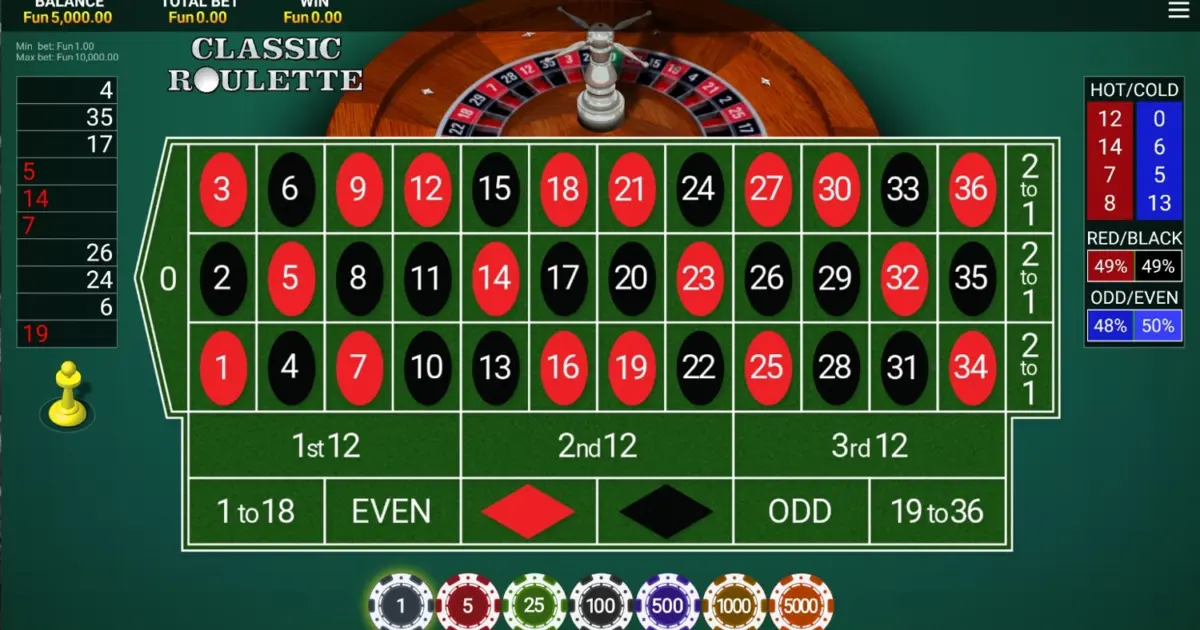
Is Classic Roulette (OneTouch) worth your time? The 97.3% RTP puts it at the well-established standard for a single-zero wheel, and OneTouch delivers exactly the mathematics you would expect from a European layout — no surprises, no gimmicks, and no multiplier mechanics hiding behind a familiar name.
Classic Roulette (OneTouch) and the OneTouch roulette range
OneTouch maintains a small catalogue of just three games on this site, and its roulette presence is built around this title and its companion table simply labelled Roulette. Both carry an identical 97.3% RTP, which strongly suggests they run the same underlying single-zero wheel maths with a cosmetic difference in presentation. The provider’s average RTP across its entire range is also 97.3%, meaning there is no “premium” variant here and no downgraded version either — you are getting the house standard, and that is entirely fine for roulette.
The third entry, Bombay Roulette, carries no published RTP figure in the data available for this review. That absence matters: if that table introduces bonus features, side bets, or altered payouts, the base edge could shift in either direction. Until confirmed, treat it as a separate proposition from Classic Roulette (OneTouch). The name points to a themed layout rather than a structural change to the wheel, but themes do not alter pocket counts.
The wheel, the pockets and the edge
Classic Roulette (OneTouch) is presented as a European-style table, and the 97.3% RTP is precisely what a 37-pocket single-zero wheel produces: a house edge of 2.70% on every standard bet. That figure applies uniformly whether you place a straight-up number at 35:1, a split at 17:1, a street at 11:1, a corner at 8:1, a line at 5:1, or any outside bet like red/black or odd/even at 1:1. The edge does not shift with bet type on a fair single-zero layout — only the variance changes.
There is one important caveat to state clearly: the FACTS for this table do not confirm whether French rules such as La Partage or En Prison are active. If they were, the even-money house edge would drop to approximately 1.35%, which would be the best available bet on the wheel. Without that confirmation, you should plan around the standard 2.70% figure and check the game’s own rules screen before assuming a reduction applies. If it does, it changes nothing about your inside bets — only the even-money options benefit.
97.3% in practice
The RTP figure is a long-run mathematical average. It does not describe any single session, any single table visit, or any single betting pattern. A 97.3% RTP means that across millions of spins, the wheel retains 2.70% of total money wagered. In the short term, outcomes are governed by the same independent randomness that produces streaks of red, clusters of black, or sequences of zero. None of those clusters change the underlying rate of return.
Compared to the site-wide average of 96.97%, this table sits 0.33 percentage points above the corpus mean — a marginal advantage that comes from being a clean single-zero game without exotic side bets that typically drag RTP down. If you are evaluating roulette tables by pure return, 97.3% is the ceiling you should expect from a standard European layout without French rules. Tables that advertise higher numbers either include La Partage, introduce bonus mechanics with their own trade-offs, or are using a different measurement methodology. The comparison is useful: European Roulette (Red Tiger) publishes the same 97.3%, confirming this is the baseline for the format.
Building a bet you understand
The most useful thing you can do before playing any roulette table is to understand exactly what you are wagering. The table below shows the standard bets on a single-zero European wheel alongside their payouts and the true odds against you winning. The gap between payout and true odds is where the house edge lives — it is not a hidden fee, it is arithmetic.
| Bet type | Payout | True odds against | House edge |
|---|---|---|---|
| Straight-up (one number) | 35:1 | 36:1 | 2.70% |
| Split (two numbers) | 17:1 | 17.5:1 | 2.70% |
| Street (three numbers) | 11:1 | 11.33:1 | 2.70% |
| Corner (four numbers) | 8:1 | 8.25:1 | 2.70% |
| Line (six numbers) | 5:1 | 5.17:1 | 2.70% |
| Even money (red, black, odd, even, high, low) | 1:1 | 1.054:1 | 2.70% |
| Column or Dozen (12 numbers) | 2:1 | 2.083:1 | 2.70% |
Notice that the house edge is identical across every row. Inside bets create larger swings because they hit rarely but pay big; outside bets hit more often with smaller returns. Neither is “better” in expected value terms. Your choice should reflect your variance tolerance, not a belief that one shape of bet outperforms another over time.
Systems, streaks and independent spins
No betting system changes the house edge. This is not a matter of opinion or a cautious hedge — it is a mathematical certainty for any game with independent trials. The Martingale, the Fibonacci sequence, the D’Alembert, the Labouchère, and every variant of “wait until five reds come up” all produce the same expected value as flat betting: you lose 2.70% of your total turnover over time. What they differ in is how quickly you reach a table limit or exhaust your bankroll.
The Martingale is the clearest example. Doubling your stake after each loss produces small, frequent wins — until the one sequence of losses arrives that either hits the maximum table stake or empties your balance. The probability of that sequence is fixed by the wheel; no progression shrinks it. On a European wheel, losing ten even-money bets in a row has a probability of roughly 0.126% per attempt, but over thousands of spins that event becomes near-certain, and the loss it produces wipes out every small gain the system generated.
The wheel has no memory. Previous results carry zero predictive weight on an RNG-driven table. A number that has not appeared in two hundred spins is not “due” — it has the same 1-in-37 chance as every other number on the next spin. Any app, tracker, or strategy video that suggests otherwise is describing a cognitive bias, not a feature of the game.
Free demo and staying in control
Classic Roulette (OneTouch) is available as a free demo, which is the correct way to learn the interface, test how bets feel to place, and understand the rhythm of the table without any financial risk. Demo play teaches you mechanics; it teaches you nothing about long-run results because the sample size is meaningless and your emotional response to virtual losses is fundamentally different from real ones.
Before playing with real money, set a fixed entertainment budget in advance — an amount whose loss will not affect your bills, your savings, or your mood the following day. Roulette is a fast game with no skill component that changes the expected outcome, so the only variable you control is how much you commit before the session starts. Treat it as paid entertainment, not as income. If you are 18 or older and have set that limit, play within it. If you find yourself exceeding it, chasing losses, or playing to recover a previous session, that is a signal to stop and seek support.
Who should play Classic Roulette (OneTouch)
This table suits players who want the standard European roulette experience without added complexity. The 97.3% RTP is honest for the format, the maths is transparent, and there is no multiplier layer that distorts the relationship between your bet and your payout. If you value clarity — knowing exactly what each wager costs you in expected terms — this is a well-matched choice.
It is less suited to players seeking high-volatility thrills through bonus features or progressive multipliers, or to anyone looking for an edge. There is none to find. If the variance shape of outside bets feels too flat for your taste, inside bets give you the same expected loss with more dramatic swings — but the direction of that expected loss does not change. The game does exactly what it says on the tin, and that is its strength.
Frequently Asked Questions
Can I play Classic Roulette (OneTouch) for free?
Yes. The demo version is available without registration or deposit. Free play lets you learn the interface and test stake sizes without financial risk. It does not predict real-money results, since short demo sessions produce meaningless samples against a long-run 97.3% RTP.
What is the RTP of Classic Roulette (OneTouch)?
The published RTP is 97.3%, which is the mathematical return expected on a standard 37-pocket single-zero European wheel over millions of spins. That figure sits at the typical ceiling for this wheel type without French rules like La Partage, which are not confirmed for this specific table.
Which wheel does Classic Roulette (OneTouch) use and what is the house edge?
The name and the 97.3% RTP both point to a single-zero European wheel with 37 pockets, producing a house edge of 2.70% on every standard bet. French rules that could reduce the edge to approximately 1.35% on even-money bets are not confirmed in the available data, so check the in-game rules screen before assuming they apply.
Does the Martingale or any other betting system work on this game?
No. No progression changes the expected value on a roulette wheel with independent spins. The Martingale, Fibonacci, D'Alembert, and all variants produce the same 2.70% loss rate per unit of total turnover. They differ only in how quickly they risk hitting a table limit or exhausting your bankroll during an unlucky sequence.
How does Classic Roulette (OneTouch) compare to European Roulette (Red Tiger)?
Both publish an identical 97.3% RTP, confirming they use the same single-zero European wheel maths. The practical differences between them come down to interface design, animation, stake limits, and available call bets rather than the underlying return. Neither offers a mathematical advantage over the other for the player.




