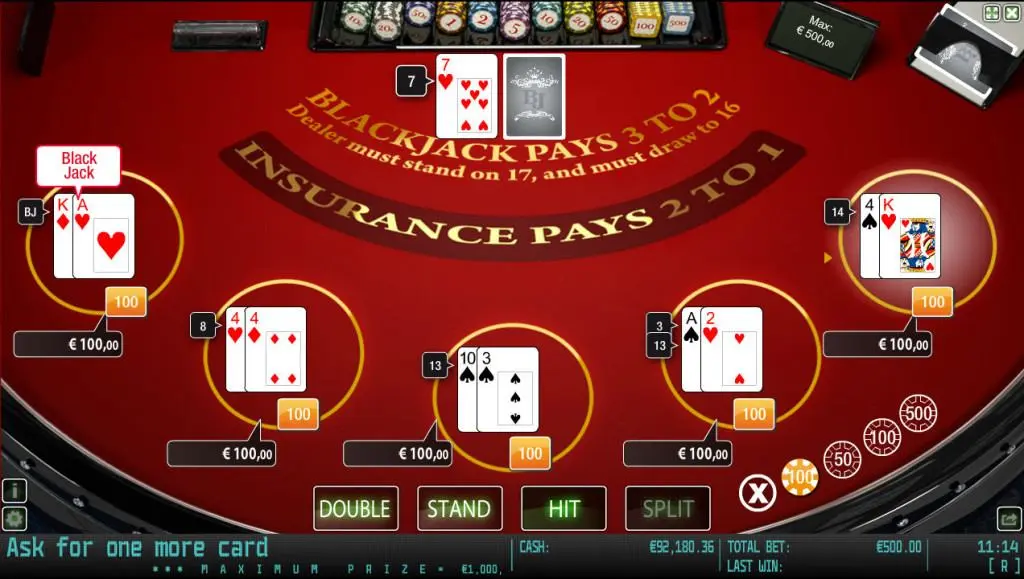
If you want a straightforward answer: blackjack privee carries a published RTP of 99.44%, which puts the house edge at 0.56% — a good number by online blackjack standards. The catch is that this figure assumes flawless basic strategy on every hand, and Worldmatch does not publish the underlying rule set for this table alongside the RTP.
So the table is worth your time if you are willing to check the in-game rules screen and play from a strategy chart. If you plan to play on instinct, the return you actually see will be well below the advertised figure.
BlackJack Privee in one minute
This is a Worldmatch blackjack table with a stated RTP of 99.44% and a free demo available before you commit any money. The name “Privee” suggests a private, high-roller framing rather than a specific rule family, so unlike titles such as “Single Deck” or “European”, it does not tell you anything about the maths.
That means the important details are unconfirmed here. Worldmatch does not publish the deck count, whether the dealer stands or hits on soft 17, the blackjack payout, the double and split rules, surrender availability, or which side bets sit on the felt. Every one of those moves the edge, some of them substantially. Open the paytable in the demo and read it before you decide what to stake.
What you can rely on: the RTP figure, the provider, and the fact that a no-download free demo exists. That is enough to evaluate the table’s ceiling, but not enough to confirm how you should play a 16 against a dealer 10 at this specific table.
House edge versus RTP: the numbers explained
RTP and house edge are the same number expressed two ways: house edge is 100% minus RTP. At 99.44% RTP, the house edge on this table is 0.56%. Over a long run of perfectly played hands, you would expect to lose about 56 cents per 100 units wagered.
The words “perfectly played” carry all the weight. A published blackjack RTP is calculated against optimal basic strategy on every decision — every hit, stand, double and split made exactly as the solved chart says. A casual player who stands on soft 17, skips profitable doubles or splits tens gives up a meaningful chunk of that return. Realised RTP for an untrained player is often a full percentage point or more below the headline.
Rules shift the base edge too, and knowing the general rules of thumb lets you read a paytable properly. A blackjack paying 6:5 instead of 3:2 costs the player roughly 1.4% — by far the most damaging single rule change you can encounter, and enough on its own to turn a 0.56% table into a bad bet. A dealer who hits soft 17 rather than standing costs about 0.2%. More decks cost the player a little, as does the absence of double-after-split, re-splitting aces or late surrender. A European no-hole-card table, where the dealer takes no second card until your hand is finished, costs a further fraction of a percent because you can lose doubled and split stakes to a dealer blackjack.
How this table compares to other online blackjack
The average RTP across the online blackjack tables tracked here is 99.41%, so at 99.44% this table sits marginally above the middle of the pack — a difference of 0.03 percentage points, which is statistically real but practically trivial. You will not feel it. What you will feel is the rule set, which is why an unconfirmed 99.44% table deserves less trust than a confirmed 99.28% one.
Worldmatch runs eight blackjack titles and all of them publish the same 99.44% figure, which suggests a shared maths model rather than genuinely distinct tables. If you want to compare within the range, BlackJack Pro and Black Jack Single carry the same RTP, and the latter’s name at least hints at a single-deck game — normally a player-friendly structure, though single-deck tables frequently claw the advantage back with a 6:5 blackjack, so confirm the payout before you assume anything.
Elsewhere in the Cards category, Multihand Blackjack publishes 99.5%, slightly ahead of this table. None of these gaps should drive your choice. Rules and clear documentation matter far more than five hundredths of a percent.
Basic strategy in practice
Basic strategy is not a system or an angle. It is a solved chart: for every combination of your hand and the dealer’s upcard, one decision has a higher expected value than the others, and the chart tells you which. It has been computed exhaustively, so there is nothing to discover and no judgement to exercise. Playing it correctly is the only way to reach the published 99.44%.
It also has a hard ceiling. Basic strategy minimises the house edge; it never removes it. A 0.56% edge played perfectly is still a 0.56% edge, and no sequence of correct decisions turns a negative expectation positive.
One important point for this table specifically: card counting does not work here. An RNG blackjack table reshuffles a full virtual shoe before every hand, so the composition of the next deal carries no memory of what came before. There is no depleted deck to track and no count to build. Anyone selling counting advice for RNG blackjack is selling nothing.
Because the exact chart depends on deck count and whether the dealer hits soft 17, and neither is published for this table, read the rules screen first and use the chart matching those rules.
Betting systems and why they do not change the odds
Martingale, D’Alembert, Fibonacci, “double after a loss” — none of them alter the expected value of a blackjack hand. Each hand is settled at the same house edge regardless of what you staked on the previous one, and the edge applies to every unit you put at risk. Stacking bets in a pattern changes the shape of your variance: it concentrates many small wins against rare large losses, or the reverse. The average outcome does not budge.
The practical failure mode with doubling progressions is the table maximum and your own bankroll. A run of losses escalates the required stake geometrically, and you hit one ceiling or the other long before the mathematics rescues you. Worldmatch does not publish the limits for this table, so you cannot even size a progression sensibly here.
No hand is ever “due”. The RNG has no memory of the six losses behind you. Flat betting a unit you are comfortable losing is the honest approach: it keeps your exposure predictable and lets the 0.56% edge play out slowly rather than in a single catastrophic sequence.
The free demo
A free demo is available, and it is the right first step. Use it for two things: reading the paytable and rules screen to establish the deck count, soft-17 rule, blackjack payout, double and split permissions and any side bets, then drilling basic strategy until the chart decisions become automatic. Play BlackJack Privee free for long enough to stop hesitating on 12 against a 3.
What the demo cannot do is forecast money outcomes. A winning or losing demo session tells you nothing about a real-money session, because both are short runs against the same fixed edge and short runs are dominated by variance.
If any side bets appear on the felt, treat them as separate games with their own maths. Perfect Pairs and 21+3 style wagers carry house edges many times the base game’s, and insurance is a losing proposition at standard 2:1 odds against a shoe you cannot read. Decline it.
Blackjack is for adults 18 and over. Set a budget before you open the table, treat it as the cost of entertainment rather than a source of income, and stop when the budget is gone.
Verdict
A 99.44% RTP is a genuinely competitive figure, and BlackJack Privee rtp sits just above the 99.41% average for the tables covered here. Worldmatch keeps that number consistent across all eight of its blackjack titles.
| Detail | Value |
|---|---|
| Game | BlackJack Privee |
| Provider | Worldmatch |
| RTP | 99.44% |
| House edge | 0.56% with perfect basic strategy |
| Category | Blackjack / Cards |
| Provider average RTP | 99.44% |
| Category average RTP | 99.41% |
| Free demo | Available |
The reservation is documentation. Without a published rule set you are trusting a number you cannot verify against the conditions that produce it, and a single 6:5 blackjack payout would undo the whole advantage. Check the rules screen in the demo, play from the matching chart, and this is a reasonable table. Skip that step and the RTP is just a figure on a page.
Frequently Asked Questions
Can I play BlackJack Privee for free?
Yes. A free demo is available with no download required, so you can open the table, read its rules screen and practise basic strategy without staking money. Use the demo to confirm the deck count, soft-17 rule and blackjack payout, none of which Worldmatch publishes externally, before you decide whether to play for real.
What is the RTP of BlackJack Privee?
Worldmatch publishes 99.44%. That figure assumes perfect basic strategy on every hand — every hit, stand, double and split played exactly as the solved chart dictates. A player making decisions by feel will realise a materially lower return, often a full percentage point or more below the headline number.
What is the house edge, and which rules affect it?
The house edge is 0.56%, being 100% minus the 99.44% RTP. Rules move it: a 6:5 blackjack instead of 3:2 costs roughly 1.4%, a dealer hitting soft 17 about 0.2%, and extra decks or missing double-after-split, re-split aces and late surrender each cost a little more.
Does card counting work on BlackJack Privee?
No. This is an RNG table, so the virtual shoe is reshuffled before every hand and no card composition carries over. There is nothing to count. Betting progressions such as Martingale do not help either — they reshape variance without changing expected value, and the table limits are not published here.
Who makes BlackJack Privee and how does it compare to their other tables?
Worldmatch, which runs eight blackjack titles all publishing the same 99.44% RTP. BlackJack Pro and Black Jack Single carry identical figures, suggesting a shared maths model. Within the wider Cards category, Multihand Blackjack edges slightly ahead at 99.5%, though a difference of six hundredths of a percent is practically meaningless.




