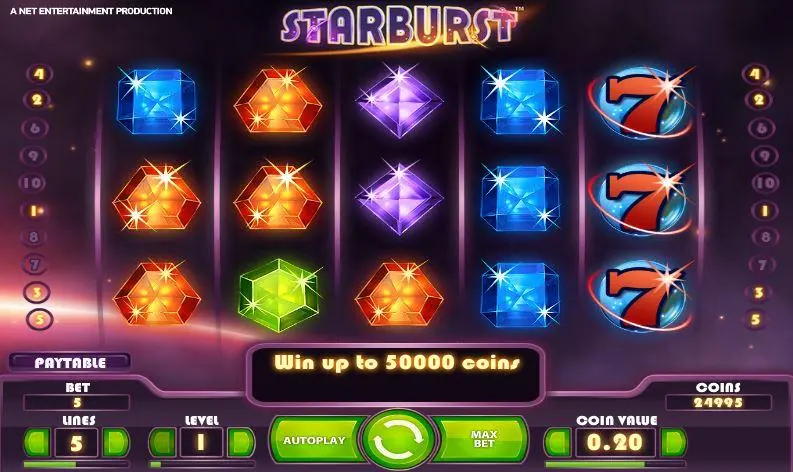
Starburst slot by NetEnt is one of the most recognized games in online slots. It returns 96.1% RTP with low volatility on a straightforward 5-reel, 10-payline grid, and its popularity percentile of 98.8 confirms it remains widely played.
Starburst at a glance
This is NetEnt’s long-running gem-themed title, and the numbers below are the ones that matter before you decide whether it fits your playstyle.
| Specification | Value |
|---|---|
| Provider | NetEnt |
| RTP | 96.1% |
| Volatility | Low |
| Reels | 5 |
| Paylines | 10 |
| Minimum stake | $0.10 / £0.10 / €0.10 |
| Maximum stake | $100 / £100 / €100 |
| Free demo | Available |
NetEnt has not published a max win multiplier for this title, so treat any figure quoted on other sites with caution. The theme falls under gems and diamonds, one of 484 titles in that category across this site’s corpus. At rank 246 with a 98.8th-percentile popularity score, Starburst sits in a high-visibility tier without being the single most-played game in the database. If you want to compare its structure against another NetEnt title with a different feel, Gonzo’s Quest uses a cascade mechanic instead of fixed paylines.
What a 96.1% RTP actually returns
RTP is a theoretical average calculated across millions of spins. A 96.1% figure means that for every $100 wagered over an extremely large sample, $96.10 is returned to players as winnings in aggregate. This does not predict any individual session.
Work through a concrete example: 1,000 spins at the $0.10 minimum stake costs $100 total wagered. At 96.1% RTP, the theoretical return is $96.10, leaving a $3.90 house edge on that volume. At 10,000 spins, the same math projects $961 returned from $1,000 wagered. The gap between expectation and reality in a single sitting is enormous, which is why RTP tells you about long-run cost, not short-run outcomes.
Starburst’s 96.1% sits $0.39 above the corpus average of 95.71%, placing it slightly above the median of games tracked here. It also matches NetEnt’s provider average of 96.1% exactly, across 191 titles. So you are getting the house standard from this developer, not a promotional bump or a below-average rate.
Low volatility and what your session will feel like
Low volatility means wins land more frequently but tend to be smaller relative to your stake. You will experience fewer dead spins and fewer explosive moments. Your bankroll erodes gradually rather than in sudden drops, and it grows in small increments rather than single large hits.
Practically, this means you can stretch a modest budget over more spins. If you want 200 spins at $0.50 per round, that costs $100, and low volatility makes it realistic to still have most of that budget remaining at spin 200. The trade-off is that you are unlikely to see a single spin return many times your stake. The ceiling is lower than high-volatility alternatives.
Starburst XXXtreme, the direct sequel by the same provider, runs at 96.26% RTP — a slightly higher theoretical return — but targets a different risk profile entirely. If you prefer frequent small wins and long sessions, the original’s low volatility suits that preference.
The 5-reel layout and how wins are counted
Five reels with 10 fixed paylines is one of the simplest configurations in modern slots. Fixed means every spin activates all 10 lines; you cannot choose to play fewer. Each line is a specific pattern across the 5 columns, and matching symbols along an activated line from the leftmost reel produce a win.
With 10 lines at the $0.10 minimum, the actual per-spin cost breaks down to $0.01 per line. Raising to $1.00 per line costs $10 per spin. This line-count structure keeps the math predictable: more lines would mean more simultaneous win opportunities but also a higher minimum cost per spin.
Gem-themed slots vary widely in their mechanics. Joker’s Jewels from the same theme category carries a 96.5% RTP — a third of a percentage point higher than Starburst — which over 10,000 spins at $1 each means roughly $40 more returned theoretically. The layout and volatility of that title differ from Starburst, so the comparison is about cost structure, not gameplay identity.
Stake range and sizing a bankroll
The $0.10 to $100 range gives a 1,000x spread, which accommodates both micro-stakes players and those willing to risk more per spin. At the floor, $0.10 per spin with low volatility makes $50 stretch to around 500 spins before you exhaust the balance, assuming average returns. At the ceiling, $100 per spin with the same RTP means the $3.90 theoretical house edge per spin adds up quickly over short sessions.
For bankroll planning, divide your total entertainment budget by your target number of spins to find your per-spin stake. A $100 budget aimed at 300 spins works out to roughly $0.33 per spin, well within Starburst’s range. If you want 100 spins, that is $1.00 per spin, also within range.
There is no optimal stake that changes the expected value. RTP applies identically at $0.10 and at $100. Each spin is independent; past results do not influence future outcomes at any bet level.
Playing the Starburst demo before you commit
A free demo is available for this game. Demo play lets you observe the spin pace, the frequency of small wins, and how the 10-line structure feels in practice without risking money. The outcomes in demo mode are not connected to real-money results, so treat the demo as a familiarization tool for mechanics and rhythm, not a predictor of what your funded session will produce.
If you decide to play for real money, treat it as paid entertainment. Set a budget you are comfortable losing entirely, and stop when that budget is reached. You must be 18 or older. Starburst’s low volatility and 96.1% RTP make it a slower, more predictable experience than many alternatives, which some players find less stimulating over long periods. If you are comparing gem titles at a higher return rate, Love Gems Hold and Win lists 97.1% RTP, though its mechanics and volatility differ from this game.
Verdict: who should play Starburst
This is a sensible choice if you want a game with straightforward mechanics, modest risk, and a theoretical return slightly above the market average. The $0.10 floor makes it accessible, and the low volatility keeps sessions from ending abruptly on cold stretches. It will not reward patience with a dramatic payoff — that is not what it aims for.
Skip it if you chase large single-hit wins or prefer complex bonus structures that change the base game’s rhythm. NetEnt’s own catalog includes Pirates Party at 96.17% RTP, a fractionally higher return with a different theme, if you want a comparable option within the same provider’s portfolio.
Starburst remains widely played for good reason: it is easy to understand, cheap to try, and the numbers are honest. The 96.1% RTP is neither exceptional nor poor — it is average-plus, from a provider that averages exactly that across 191 games. That consistency is itself a selling point for anyone tired of guessing whether a title’s published RTP reflects the real experience.
Frequently Asked Questions
Is Starburst available to play for free?
Yes, NetEnt offers a free demo version of Starburst that lets you spin without staking money. The demo uses the same 5-reel, 10-payline layout at 96.1% RTP. Results in the demo are randomly generated and bear no relationship to what will happen when you play with a funded balance.
What does Starburst's 96.1% RTP mean in practice?
Over a very large number of spins, 96.1% RTP means the game theoretically returns $96.10 for every $100 wagered. At 1,000 spins of $0.10 each, that projects $96.10 returned from $100 staked. Individual sessions will vary wildly from this figure in both directions.
Is Starburst a low-risk slot to play?
Starburst carries low volatility, meaning wins occur more frequently but at smaller values relative to your stake. Your bankroll declines slowly rather than in large jumps, making it suitable for players who want extended session length on a fixed budget without dramatic swings.
What else does NetEnt make besides Starburst?
NetEnt has published 191 games in this site's database, with an average RTP of 96.1% across the portfolio. Notable titles include Gonzo's Quest at 96.0% RTP and Starburst XXXtreme at 96.26%, which offers a slightly higher theoretical return with a different feature structure.
Can you win real money playing the Starburst demo?
No. The free demo version of Starburst uses simulated credits only and cannot produce real-money payouts. You must deposit funds at a licensed operator to wager actual money. The demo exists to let you test the game's pace and mechanics before deciding whether to stake cash.




