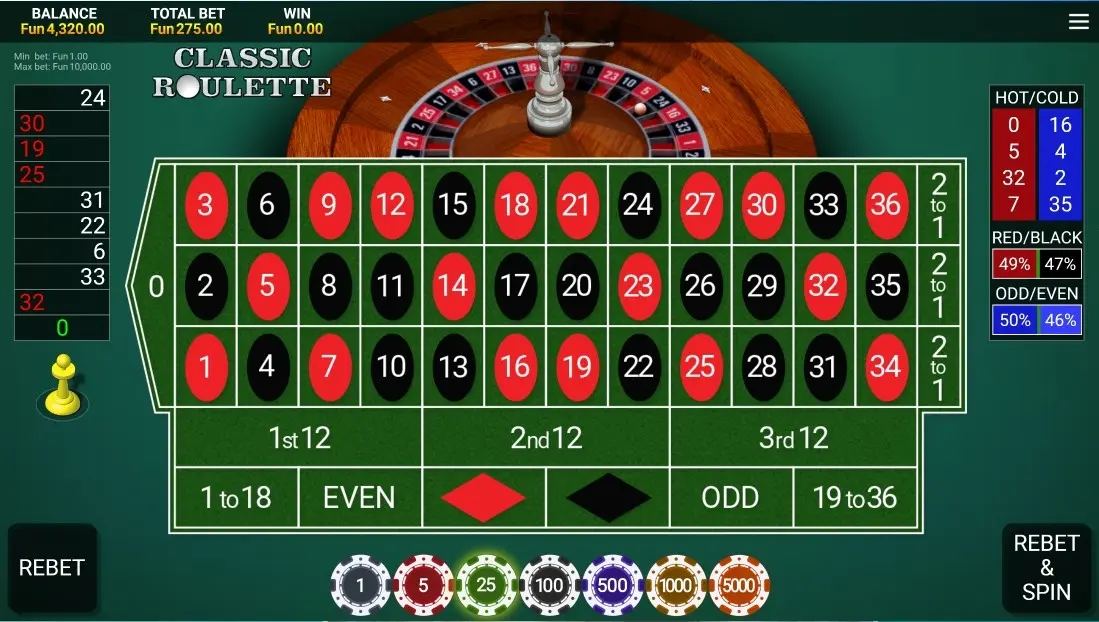
OneTouch’s Roulette sits at 97.3% RTP, the figure you expect from a single-zero European wheel with standard payouts. No multipliers, no side bets, no rule variants—just the 37-pocket layout and the 2.70% house edge that comes with it. If you want classic roulette without feature layers, this table delivers exactly that, and the free demo lets you confirm the feel before committing real money.
Roulette and the OneTouch roulette range
OneTouch operates a small roulette catalogue: three tables, all carrying the same 97.3% RTP. This version shares its return-to-player figure with Classic Roulette (OneTouch), suggesting a consistent approach across the provider’s range. The third title, Bombay Roulette, lacks published RTP data, so comparison stops there. The provider average matches the corpus average almost exactly—97.3% against 96.97%—placing OneTouch in the middle of the pack for roulette returns. No table in the range advertises French rules or La Partage, so even-money bets face the full 2.70% edge rather than the 1.35% you’d find on a French-rule wheel.
The wheel, the pockets and the edge
The 97.3% RTP figure points strongly to a single-zero European wheel: 37 pockets numbered 0 to 36, with the house edge built from the gap between true odds and payout odds. A straight-up bet pays 35 to 1, but the true odds on a 37-pocket wheel are 36 to 1. That one-pocket shortfall—present on every bet type—produces the 2.70% house edge. Even-money bets (red/black, odd/even, high/low) pay 1 to 1 when the true odds are 19 to 18, and dozens or columns pay 2 to 1 against true odds of 2.08 to 1. The shape of variance differs—straight-up bets swing harder, outside bets swing less—but the expected loss per euro wagered stays locked at 2.7 cents regardless of how you distribute your chips.
97.3% in practice
RTP is a long-run statistical average, not a session promise. Over millions of spins, the table will return 97.3% of all wagers to all players combined, but your personal hundred spins might finish anywhere from deep red to well ahead. Variance governs short-term outcomes: a single straight-up hit can lift a session into profit, while a dozen missed even-money bets can drain a bankroll faster than the house edge alone predicts. The 97.3% figure tells you the table takes 2.7% on average—useful for comparing wheels, but not a forecast of tonight’s results. Track your play in entertainment budget terms, not projected returns, because the maths guarantees the house wins over time while individual sessions remain genuinely random.
Building a bet you understand
Roulette offers dozens of bet combinations, but every standard bet on a single-zero wheel carries the same 2.70% house edge. The table below shows how payout and probability interact to produce that identical margin across bet types.
| Bet type | Pockets covered | Payout | True odds | House edge |
|---|---|---|---|---|
| Straight-up | 1 | 35:1 | 36:1 | 2.70% |
| Split | 2 | 17:1 | 17.5:1 | 2.70% |
| Street | 3 | 11:1 | 11.33:1 | 2.70% |
| Corner | 4 | 8:1 | 8.25:1 | 2.70% |
| Line | 6 | 5:1 | 5.17:1 | 2.70% |
| Dozen / Column | 12 | 2:1 | 2.08:1 | 2.70% |
| Even-money | 18 | 1:1 | 1.06:1 | 2.70% |
Inside bets (straight-up through line) produce higher volatility: longer stretches without a win, but larger payouts when you hit. Outside bets (dozens, columns, even-money) win more frequently but in smaller amounts. Neither route changes your expected loss per euro wagered. Choose bet types based on your tolerance for swings and session length, not on a belief that one category offers better value than another—the maths makes them identical in the long run.
Systems, streaks and independent spins
No betting system changes the house edge. Martingale (double after every loss) is the most famous example: it promises to recover all losses plus one unit profit after the first win, and it works perfectly until you hit a long losing streak and either run out of money or slam into the table limit. A sequence of eight consecutive losses on an even-money bet—probability roughly 0.4%, so not rare over thousands of sessions—turns a one-unit starting bet into a 256-unit requirement. Most tables cap maximum bets well below that point, and even if they didn’t, your bankroll wouldn’t stretch forever. The Fibonacci and D’Alembert progressions soften the escalation curve but share the same structural flaw: they redistribute variance without touching expected value, and they accelerate the moment when you can no longer continue the sequence.
Waiting for five reds before betting black changes nothing. The wheel has no memory; the probability of black on the next spin remains 18/37 regardless of what landed in the previous ten, fifty, or five hundred spins. Casinos happily display result histories because those displays sell a false pattern. Every spin is an independent event with the same fixed probabilities, and no amount of tracking, charting, or waiting alters that fact.
Free demo and staying in control
OneTouch provides a free demo for this table, letting you test the interface, bet placement, and spin pacing without financial exposure. Demo mode uses the same RNG and payout structure as real-money play, so the maths you see is the maths you’ll get, but demo results have no predictive value for your real-money sessions—variance guarantees different outcomes every time. Use the demo to learn the controls and confirm you enjoy the experience, not to scout for patterns or test a system.
Roulette is entertainment with a cost, not an income strategy. Set a budget you can afford to lose before you start, treat that money as the price of the session, and stop when it’s gone. The house edge guarantees the casino wins over time; your job is to decide how much that entertainment is worth to you. 18+ only. If gambling stops being fun, step back.
Who should play Roulette
This table suits players who want European roulette without feature overhead. If you prefer the 2.70% house edge of a single-zero wheel over the 5.26% edge on American double-zero layouts, and you have no interest in multiplier mechanics or side bets, OneTouch’s Roulette delivers a clean implementation. It won’t appeal to players hunting French-rule wheels with La Partage—those tables cut the even-money edge to 1.35%, a measurable improvement—and it offers nothing new if you already play European Roulette (Red Tiger) or another standard single-zero table at the same RTP. The free demo removes the friction of trying it, so if you’re comparing European wheels across providers, spend ten minutes in demo mode and decide whether the interface and pacing match your preference. Roulette remains a house-edge game no matter which provider you choose; the decision rests on execution and feel, not on a maths advantage that doesn’t exist.
Frequently Asked Questions
Is there a free demo for OneTouch Roulette?
Yes, OneTouch provides a free demo mode for this table, using the same RNG and payout structure as real-money play. Demo results don't predict your real-money sessions because every spin is independent, but the demo lets you test the interface and confirm the feel before committing funds.
What RTP does OneTouch Roulette offer?
OneTouch Roulette runs at 97.3% RTP, the standard return for a single-zero European wheel with no rule variants. That figure translates to a 2.70% house edge on every standard bet type, from straight-up numbers to even-money outside bets.
Does this table use a single-zero or double-zero wheel?
The 97.3% RTP confirms a single-zero European wheel with 37 pockets and a 2.70% house edge. A double-zero American wheel would deliver 94.74% RTP and a 5.26% edge, so the published figure rules that out.
Can a betting system beat the 2.70% house edge on this table?
No betting system changes the house edge. Martingale, Fibonacci, and other progressions redistribute variance and increase table-limit risk, but they cannot alter the expected loss per euro wagered. Every spin is independent; the wheel has no memory, and no amount of tracking or progression removes the maths disadvantage.
How does OneTouch Roulette compare to European Roulette by Red Tiger?
Both tables sit at 97.3% RTP and operate single-zero European wheels with identical house edges. The maths is the same, so the choice rests on interface preference, spin pacing, and visual execution rather than any advantage in returns or bet options.




