If you like stripped-back classics with no frills, the star bell 7s slot will look familiar from the first spin, but its 94.03% RTP sits noticeably below what most players see elsewhere. That lower return does not make it unplayable, yet it does change how far a modest budget stretches and who will get the most entertainment from it. Try it for free first, check the maths below, and decide if the retro format offsets the statistical cost.
Star Bell 7s at a glance
Star Bell 7s is a 3-reel Slot Machine from Kalamba Games, filed under Classics and retro as its primary theme alongside a 3-Reels tag. Kalamba has released 165 games, with a provider average RTP of 95.92%, so this title sits below the studio’s own norm. Across the wider corpus tracked here the average RTP is 95.71%, which puts Star Bell 7s 1.68 percentage points under that benchmark.
The game holds rank 2940 and lands in the 85.3rd popularity percentile, meaning it is played less than the top tier but still has a consistent audience among retro fans. With only three reels, expect a compact grid and a small set of paylines or win ways compared with modern 5-reel video slots — the FACTS block confirms the reel count but does not list a specific payline or ways figure, so treat any number you see elsewhere with caution.
Who it suits comes down to tolerance for trade-offs. If you value a fast, readable classic that you can dip in and out of without learning complex bonus rules, the format delivers. If you prioritise higher long-run return or feature-heavy play, the numbers below suggest you will find stronger options in the same theme, and the comparison table makes that gap concrete.
| Figure | Value |
|---|---|
| Provider | Kalamba Games (165 games) |
| RTP | 94.03% |
| Provider average RTP | 95.92% |
| Corpus average RTP | 95.71% |
| Difference vs corpus | -1.68 percentage points |
| Reels | 3 |
| Themes | Classics and retro, 3-Reels |
| Rank / Popularity | 2940 / 85.3rd percentile |
| Free demo available | Yes |
No max win, volatility rating, hit frequency, stake range or feature list has been published in the FACTS supplied for this review. Missing data is not a flaw, but it limits what you can plan for — without a stated volatility or top payout you should size your session on the only hard number you have, the RTP, and use demo play to get a feel for swing size before committing funds.
What a 94.03% RTP actually returns
RTP is a long-run average, not a promise for any single session. A 94.03% RTP means that across many millions of spins, the game is designed to return £94.03 for every £100 wagered, keeping £5.97 as the house edge. Every spin is independent; the percentage does not tilt toward you after losses or tighten after wins.
To make that concrete, imagine 1,000 spins at £0.20 per spin, so you stake £200 in total. On the statistical average you would expect to get back about £188.06 (£200 × 0.9403) and show a £11.94 loss over that sample. In reality you will land above or below that line — sometimes well above, sometimes well below — because short-term variance dominates, but the average guides your expectation if you repeated that 1,000-spin block many times.
Compared with the 95.71% corpus average, the gap matters over time. The corpus average would return about £191.42 on the same £200 staked, a £8.58 average loss. The difference is roughly £3.36 more retained per £200 wagered on Star Bell 7s. Against Kalamba’s own average of 95.92%, the cost is slightly larger. If you rotate between retro titles, that 1.68-point deficit is the equivalent of paying an extra 1.68p per £1 staked for the specific classic presentation. For a short, low-stakes taster the cash difference is small; stretched over thousands of spins it compounds, which is why players who chase the best long-run value often filter by RTP first.
For perspective within the same studio, Pearls of Aphrodite is listed at 96.81% RTP, almost 2.8 points higher, while Love Gems Hold and Win from the related Classics and retro set shows 97.10%. You do not get more wins simply because another game has a higher RTP, but you do buy a statistically cheaper hour of entertainment when the percentage is higher.
Unlisted volatility and what your session will feel like
FACTS does not include a volatility rating for Star Bell 7s, and Kalamba Games has not published one in the data supplied here, so treat any label you see elsewhere with caution. Volatility describes how returns are distributed — low volatility tends toward smaller, more frequent hits that stretch a bankroll, high volatility tends toward longer dry runs punctuated by larger swings — but without an official rating we cannot place this game on that scale.
What you can do instead is infer session feel from what is known and test it yourself. Three-reel classics historically lean toward simpler maths with fewer paylines, which often produces a choppier hit pattern than a 20- or 40-line video slot, yet many 3-reel games also use lower top multipliers that keep swings moderate. Neither pattern can be asserted for Star Bell 7s specifically without published volatility or hit-frequency data.
The practical approach is to use the free demo to watch the rhythm. Play a few hundred spins at a flat stake and note three things: how many spins go without any return, how large the biggest single-spin return is relative to your stake, and how quickly your demo balance moves up or down. If you see long flat stretches, plan for a larger bankroll or a shorter session. If hits are frequent but small, the game may suit extended low-stakes play even without an official volatility tag.
Bankroll planning should default to conservative assumptions when volatility is unknown. Set a loss limit before you start, divide it into enough spins to survive a cold run, and remember that volatility affects the shape of results, not the long-run RTP — the 94.03% average does not improve if you wait out a losing streak.
The 3-reel layout and how wins are counted
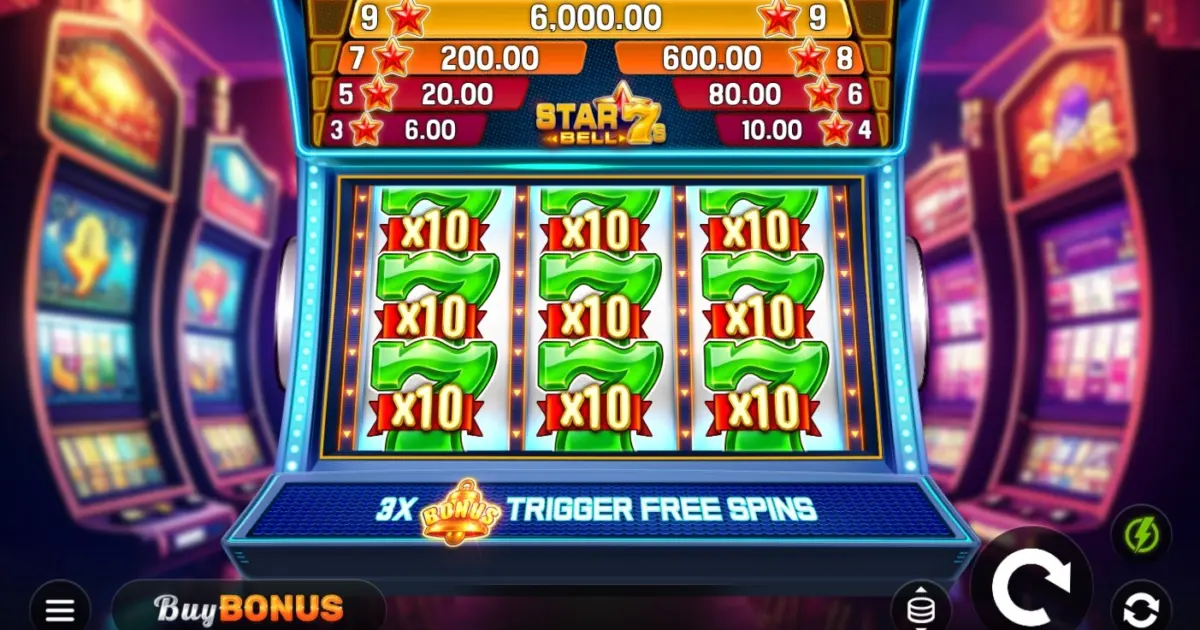
Three reels means a narrow window: typically three columns and one to three rows, far fewer symbols in view than a 5×3 or 5×4 video slot. That compact grid makes it easy to read outcomes instantly, which is a core part of the retro appeal.
How wins are counted depends on paylines or ways, and FACTS does not state a payline count or ways mechanic for Star Bell 7s, so no specific figure can be confirmed here. In general terms, many slots award wins when matching symbols land on a designated payline running left to right, while ways-based games pay for matching symbols on adjacent reels regardless of exact line position. Both systems still require you to stake per spin, and the number of lines or ways changes how often you hit versus how much each hit pays, but the overall return still averages to the stated RTP.
Reel count also influences hit frequency and maximum combinations in a purely mathematical sense. With three reels there are simply fewer possible symbol combinations than with five reels, which can make the paytable easier to memorise and the top combinations rarer in absolute terms. Without a published paytable or ways count, the safest way to understand this layout is to open the in-game info panel in demo mode and count the lines or ways listed there before you risk real funds.
If you want a same-theme comparison with a more documented grid, Sizzling Hot Deluxe is another Classics and retro title at 95.66% RTP, while 40 Super Hot at 95.81% shows how a higher line count changes hit texture in the retro category. Neither is a clone of Star Bell 7s, but both illustrate how reel and line design alter session feel even when the theme is similar.
Stake range and sizing a bankroll
The FACTS block supplied for this review does not include a minimum stake, maximum stake, or default coin range for Star Bell 7s, and no official stake limits have been published in the data here. When that range is unpublished, you cannot calculate a precise bankroll multiple in advance, so any stake figure quoted on a third-party site should be checked inside the game client itself.
Still, the maths of sizing a session works the same regardless of the limits. Decide on a total budget you are comfortable spending as entertainment, divide it by the stake you intend to use, and that gives you the number of spins your session can support before variance intervenes. For example, a £20 budget at £0.20 per spin buys 100 spins on paper, while the same budget at £0.50 buys 40 spins — fewer chances to ride out a cold patch. Because Star Bell 7s has a below-average RTP, the expected cost per 100 spins is slightly higher than the corpus norm, which reinforces the value of starting at the low end of whatever range the game offers.
Keep stakes flat within a session. Raising stakes to chase losses does not change the 94.03% long-run expectation and only accelerates variance; each spin remains independent with the same house edge. If you find the minimum stake in the demo is higher than you would like, treat that as useful information and consider whether a lower-stake alternative in the same retro group would give you a longer, more relaxed session for the same outlay.
Playing the star bell 7s slot demo before you commit
Star Bell 7s is listed as free demo available, which is the most useful tool you have given the missing volatility and stake details. Demo play lets you confirm reel behaviour, read the paytable directly in-game, and watch how often small returns appear without spending, and you can do so with Star Bell 7s no download required in most browsers.
Use the demo with intent rather than spinning aimlessly. Set a pretend bankroll, pick a single stake level you would actually use, and run 200–300 spins to observe the tempo. Note how many dead spins you encounter, whether wins tend to be single-line or cover multiple lines, and how the balance trends over that sample. That snapshot will not predict real-money results — demo and real play use the same maths but short-term luck still dominates — yet it gives you a personal sense of variance that the unpublished volatility figure cannot.
Keep play safe and contained. You must be 18+ to gamble, set a time and money budget before you start, and treat slots as paid entertainment, not a way to make money. If you feel you are chasing or playing longer than planned, pause and use the safer-gambling tools offered by licensed sites, such as deposit limits, reality checks and self-exclusion. If you need support, contact a recognised help organisation in your country.
When you move from demo to real play, if you choose to, carry the same limits over. Flat stakes, a fixed stop-loss, and a clear stopping point for wins and losses protect you from the natural swings of any 3-reel game, especially one where the published return is below average.
Verdict: who should play Star Bell 7s
Star Bell 7s fits a narrow but clear audience: players who want a quick, readable 3-reel classic and accept that the trade-off is a lower statistical return. The 94.03% RTP is 1.68 points under the corpus average and 1.89 points under Kalamba’s own average, so on maths alone it is a more expensive hour than many alternatives, including several retro peers listed in FACTS.
That does not rule it out. If you prefer minimal rules, fast results and a nostalgic loop over feature depth, and you plan to play at low stakes for a short session, the entertainment value may outweigh the RTP gap. The free demo makes that judgement easy to make without cost — if after 200 demo spins you enjoy the pace and can picture that rhythm for a budgeted session, you have your answer.
Who should skip it? Value-focused players who filter by return, or anyone wanting complex bonuses and higher long-run efficiency, will find stronger candidates in the same provider catalogue or theme group. In those cases the related games highlighted earlier give you a like-for-like retro feel with a higher percentage back over time. Play Star Bell 7s free first, compare it directly, and let the demo tempo and the hard 94.03% figure decide whether it earns a place in your rotation.
More from Kalamba Games
- Flaming Scarabs — 96.48% RTP
- Emerald Bisons PrizeMatch — 94.07% RTP
Frequently Asked Questions
Can I play Star Bell 7s for free before wagering real money?
Free demo available is listed as yes for Star Bell 7s, so you can try it without depositing. Demo uses the same 94.03% RTP maths as real play but cannot pay cash and does not predict future results. Use it to check the 3-reel pace and in-game paytable.
What is the RTP of Star Bell 7s and what does 94.03% mean?
Star Bell 7s has a 94.03% RTP, which is 1.68 points below the corpus average of 95.71% and below Kalamba's 95.92% average. Across millions of spins it would return £94.03 per £100 staked on average. Every spin is independent, so short-term results vary widely around that long-run figure.
What volatility is Star Bell 7s and how risky is it?
No volatility rating is published in FACTS for Star Bell 7s, so no official low, medium or high label can be confirmed. That means you cannot infer swing size from a tag. Test the free demo at a flat stake for a few hundred spins to observe dead-spin runs and balance movement before deciding bankroll size.
Who makes Star Bell 7s and what else do they offer?
Star Bell 7s is made by Kalamba Games, a studio with 165 games tracked here and a 95.92% average RTP. Related Kalamba titles in FACTS include Pearls of Aphrodite at 96.81% and Agent 51 at 96.73%, both above this game's 94.03%, illustrating the range within the same catalogue.
How does Star Bell 7s compare to Sizzling Hot Deluxe?
Both are Classics and retro titles, but Sizzling Hot Deluxe is listed at 95.66% RTP versus 94.03% for Star Bell 7s, a 1.63-point advantage. That suggests a lower expected cost per £100 staked on Sizzling Hot Deluxe over a large sample, though both have independent outcomes and different reel maths.