If you want a short answer: the 96.24% RTP on the rise of olympus origins slot sits above both the Play’n GO house average of 95.80% and the 95.71% average across every game in our database. That is a genuine, if modest, edge on paper. What is not published is a volatility rating, a max win figure or a stake range, so anyone telling you how swingy this game is at a given bet size is guessing.
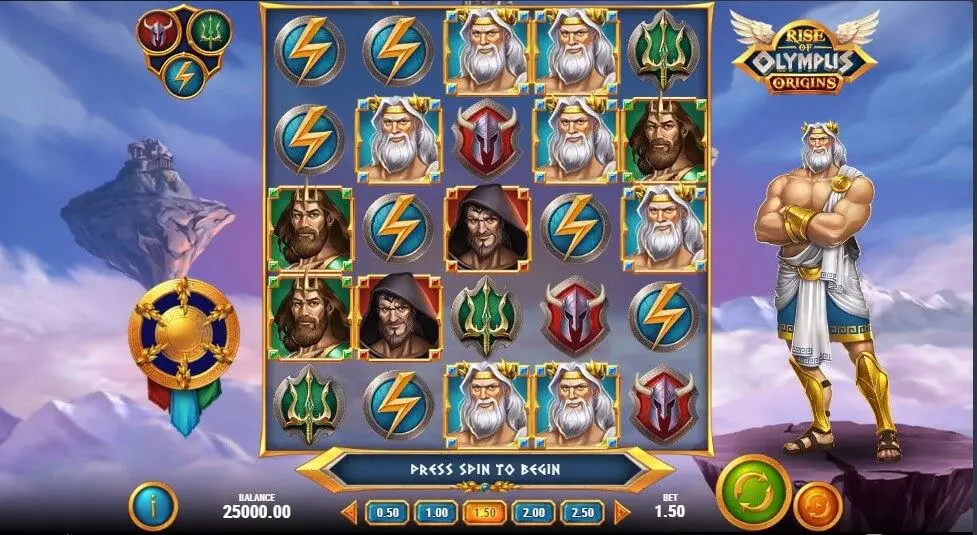
The 5-reel grid explained
Five reels is the default shape of the modern online slot, and it is the only structural detail Play’n GO has confirmed here. A five-reel layout gives a designer room for a reasonable number of symbol positions without the extreme mathematical stretch of six or seven columns, which is why so much of the market settles there.
What a reel count tells you on its own is limited. It does not fix the row height, the number of symbols per strip, or how often a paying combination lands. Two five-reel games can behave completely differently: one paying small amounts frequently, the other going long stretches with nothing. The reel count is a container, not a prediction.
The game is filed under Mythology, one of 801 titles carrying that theme in our index, alongside the 5-Reels tag. A theme label supports the broad subject matter and nothing more, so treat any detailed description of characters, animations or soundtrack that you find elsewhere as someone’s impression rather than confirmed specification.
| Provider | Play’n GO |
|---|---|
| RTP | 96.24% |
| Reels | 5 |
| Theme | Mythology |
| Free demo | Yes |
| Site-wide average RTP | 95.71% |
Paylines, ways and how the rise of olympus origins slot pays
The payline or ways count has not been published in the data available here, so it cannot be stated. That absence is worth knowing before you load the game, because payline structure shapes how a session feels more than almost any other visible number.
In general terms, slots resolve wins in one of three ways. Fixed-payline games check a set number of defined patterns across the reels, so your stake is divided across those lines. Ways games count matching symbols in any position on adjacent reels, which typically produces many small results. Cluster or grid games pay on groups of touching symbols instead of lines at all. Many slots also use wilds that substitute for regular symbols, scatters that trigger a bonus round, and free-spin rounds with added multipliers. Some newer releases sell direct entry to those rounds as a buy feature.
All of that is standard industry machinery, not a claim about this title. Until the paytable is in front of you, the paytable screen in the demo is the only reliable source for what actually pays and how often.
96.24% RTP put in context
Return to player is a long-run statistical average, not a session promise. At 96.24%, the theoretical return is £96.24 for every £100 staked, measured across a sample far larger than any individual will ever play. Across 10,000 spins at £1, the expected total return is about £9,624 against £10,000 wagered, and real results will scatter widely around that figure in both directions.
The comparison is where the number earns its keep. The average across our whole corpus is 95.71%, so this title runs 0.53 percentage points better. Play’n GO’s own 434-game library averages 95.80%, putting this release slightly above their own house standard.
It is not their highest, though. Legacy of Dead returns 96.58%, a third of a point better again, while Book of Dead sits at 94.25% — two points lower, which over 10,000 £1 spins is a £200 difference in expected cost. Within the mythology theme, Gates of Olympus is close behind at 96.50%.
Volatility and hit patterns
There is no published volatility rating for this game, and no hit frequency figure either. Rather than guess, it is more useful to understand what each profile would mean for you.
Low volatility means frequent small returns. Your balance drifts down slowly, sessions last longer for a given bankroll, and the biggest results stay modest. Medium volatility widens the swings in both directions. High volatility means long dry runs punctuated by occasional larger payouts, and it demands a noticeably bigger bankroll relative to your stake to survive the gaps without running out.
Crucially, two games with identical 96.24% RTP figures can deliver completely different experiences depending on volatility. The RTP tells you the long-run cost; volatility tells you how bumpy the road is. Every spin is an independent event, so a run of losing spins does not make the next one more likely to pay, and a game is never due, hot or cold. The free demo is the practical way to gauge the rhythm yourself, keeping in mind that a few hundred spins is a tiny sample.
Choosing a stake between the minimum and maximum
No stake range has been published for this title, so the betting limits need checking in the game itself. You will normally find them in the bet selector at the bottom of the screen, with the minimum and maximum shown once you open the stake menu.
The useful principle does not depend on the exact figures. Work backwards from your bankroll and how long you want to play, not forwards from the stake you fancy. If you have £50 and want 250 spins, your stake is £0.20 — arithmetic, not preference. Halve the stake and you double the spin count for the same money.
Because volatility is unknown here, err towards the conservative end of whatever range the game offers until you have seen how it behaves. And be clear on one point: no staking pattern, progression or bet-sizing system changes the expected return. Adjusting your stake changes the size of the swings and how long your money lasts, nothing else. The 96.24% figure applies at every bet level equally.
Demo play versus real money
A Rise of Olympus Origins free demo is available, which means you can see the paytable, the payline structure and the feature set before committing anything. That matters more than usual here, given how much of the specification is unpublished. Demo mode runs the same mathematical model, so the RTP is identical, but the outcomes you see are a small sample and cannot predict what a real-money session will do. A generous demo run is luck, not a signal.
What the demo genuinely tells you: whether you like the pace, whether the features engage you, and whether the base game holds your attention between bonus triggers.
Slots are for adults aged 18 or over. Decide your budget before you open the game, treat that amount as the price of the entertainment rather than an investment, and stop when it is gone. If the money ever stops feeling like entertainment, that is the moment to close the tab.
Verdict on Rise of Olympus Origins
The case for playing it is the RTP. At 96.24% it beats the corpus average by 0.53 points and edges past Play’n GO’s own library average, so the long-run cost per £100 staked is lower than typical. Its rank of 2,932 puts it in the 85th percentile for popularity, so plenty of people have found it worth their time.
The case for caution is the missing data. Without a volatility rating, payline count, stake range or max win figure, you cannot size a session properly from the spec sheet alone. Among Play’n GO slots, Legacy of Dead offers a higher return if RTP is your deciding factor, and Divine Divas is almost identical at 96.25%. Load the demo, read the paytable, then decide.
More from Play'n GO
- Legacy of Dead — 96.58% RTP
- Rise of Olympus 100 — 96.2% RTP
- Moon Princess — 96.0% RTP
- Divine Divas — 96.25% RTP
- Fire Joker — 96.0% RTP
- Crystal Hall — 96.2% RTP
- Moon Princess Origins — 96.2% RTP
- Rise of Olympus — 96.0% RTP
Frequently Asked Questions
Can I play Rise of Olympus Origins for free?
Free play is available for this title, so you can test it without staking money. The demo uses the same 96.24% RTP and the same mathematical model as the real-money version, which makes it the sensible place to check the paytable, payline structure and feature set that Play'n GO has not published in the specifications.
What is the RTP of Rise of Olympus Origins?
The RTP is 96.24%, meaning a theoretical long-run return of £96.24 per £100 wagered across an extremely large number of spins. That sits 0.53 percentage points above the 95.71% average across our database and slightly above Play'n GO's own 95.80% library average. It is a statistical average, never a session guarantee.
Is Rise of Olympus Origins high volatility?
No volatility rating has been published for this game, so any figure quoted elsewhere is an estimate. Volatility determines swing size and how long a bankroll lasts, while the 96.24% RTP determines long-run cost. Since the two are independent, the free demo is the practical way to judge the game's rhythm yourself.
Who makes Rise of Olympus Origins?
Play'n GO developed it. They have 434 titles in our index with an average RTP of 95.80%, so this release runs slightly above their own standard. Their better-known games include Book of Dead at 94.25% and Legacy of Dead at 96.58%, the higher-returning of the two by a clear margin.
How does it compare to Gates of Olympus?
Gates of Olympus returns 96.50% against 96.24% here, so it holds a 0.26 percentage point edge — around £26 in expected return difference across 10,000 £1 spins. Both draw on mythology, one of 801 themed titles in our index. Volatility figures are unpublished for this game, so a direct risk comparison is not possible.