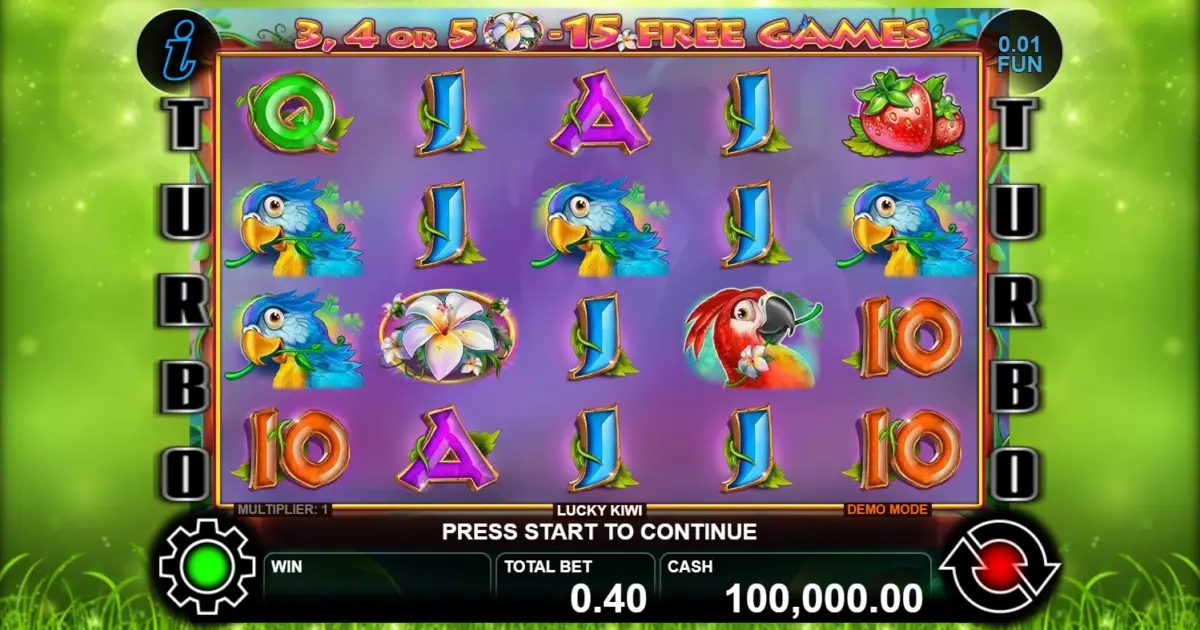
If you want a straightforward 5-reel Animals slot with an above-average baseline, Lucky Kiwi is worth a look. The headline is a 96.58% RTP, 0.87 points above the corpus average, and you can test the whole thing as a free demo before risking a bankroll. That makes the lucky kiwi slot easy to compare on maths alone without guessing about features that are not published.
Lucky Kiwi versus the average slot
Lucky Kiwi sits above both benchmarks you would normally check first. Its 96.58% RTP beats the average across all tracked slots in this corpus, which is 95.71%, by 0.87 percentage points. It also edges the CT Gaming studio average of 96.19% by 0.39 points, so it is not just above the market, it is above its own provider’s typical level.
What does 0.87 points actually change? RTP is a long-run statistical average, not a promise for a single session. Over 1,000 spins at £1 per spin, the difference between 95.71% and 96.58% is an expected return of £957.10 versus £965.80 — a gap of £8.70 in expected loss (£42.90 versus £34.20). Over 10,000 spins the same gap scales to £87.00. Those figures describe the average across a very large number of spins; your short-term results will swing wider than that in either direction because every spin is independent.
The popularity rank gives context for how often players choose it. At rank 2924, Lucky Kiwi is in the 85.3rd percentile for play. That is a useful reality check: above-average maths does not automatically mean high traffic, and lower traffic does not mean the maths is poor. You are comparing a solid RTP baseline against a crowded market of Animals titles where many games cluster around 95% to 96.5%.
CT Gaming has not published volatility, hit frequency, or max win for this title in the FACTS available, so you cannot model swing size precisely. In that situation the most honest approach is to treat Lucky Kiwi as an unknown-volatility 5-reel game until more data is published, and to size your session so that natural variance does not force you out early.
| Figure | Value |
|---|---|
| Game | Lucky Kiwi |
| Provider | CT Gaming |
| RTP | 96.58% |
| RTP vs corpus average (95.71%) | +0.87 points |
| Provider average RTP | 96.19% |
| Reels | 5 |
| Themes | Animals, 5-Reels |
| Primary theme | Animals |
| Popularity rank | 2924 (85.3rd percentile) |
| Free demo available | Yes |
RTP breakdown: 96.58% in context — lucky kiwi slot
96.58% RTP means that for every £100 wagered, the game is designed to return £96.58 on average over a very large sample — millions of spins — with the remaining £3.42 as the long-run house edge. That edge applies to the total amount staked, not to your starting balance, and it does not describe what will happen in 50 or 200 spins.
To make the figure tangible, consider three samples at £1 per spin. Over 100 spins (£100 staked) the expected return is £96.58, an expected loss of £3.42. Over 1,000 spins (£1,000 staked) the expected return is £965.80, an expected loss of £34.20. Over 10,000 spins (£10,000 staked) the expected return is £9,658.00, an expected loss of £342.00. Those are mathematical expectations; any single block of 100 or 1,000 spins can be well above or below due to variance, and previous results do not influence the next spin.
Compared with the corpus average of 95.71%, Lucky Kiwi saves you £0.87 per £100 staked in expected value. Compared with the CT Gaming average of 96.19%, it saves £0.39 per £100. Those are not dramatic per hour, but they compound over time. If you compare two games solely on RTP and plan to play many sessions, the higher number gives you more spins for the same theoretical cost, assuming volatility is similar.
No alternative RTP versions are listed for this title in FACTS. Some studios publish multiple configurations for different markets; here only 96.58% is provided, so treat any other figure you see elsewhere as unverified until CT Gaming confirms it. The practical use of RTP is budgeting: divide your planned stake by the expected loss rate to estimate how long a sample might last on average, then add a buffer for swings.
Volatility profile
FACTS does not include a volatility rating for Lucky Kiwi, and no hit frequency or max win is published. That absence matters because volatility is what tells you how turbulent a session is likely to feel, even when RTP is known.
In general terms, low volatility tends to produce more frequent but smaller results, which can stretch a fixed bankroll over more spins with smaller drawdowns. High volatility tends to produce longer flat stretches punctuated by larger swings, which requires a larger buffer and a smaller bet relative to bankroll to sustain the same number of spins. Medium volatility sits between those two patterns. Without a published rating you cannot place Lucky Kiwi on that spectrum, so any claim that it is low, medium or high would be invention.
What you can do instead is use the structure you do know. This is a 5-reel slot in the Animals category, and the broader Animals group contains 1,788 titles with a wide range of maths. That tells you the theme alone does not predict variance. Until volatility is disclosed, the cautious way to approach any unknown-volatility game is to assume it could behave like a higher-variance title: keep stakes modest relative to your total budget, decide in advance how many spins you want to allow, and accept that short-term outcomes will deviate from the 96.58% average.
If a volatility figure appears later, you can reassess. Until then, do not infer risk from popularity, theme art, or reel count. Reels and RTP describe layout and long-run return; they do not tell you the distribution of wins around that average.
CT Gaming as a studio
CT Gaming has 95 games tracked in this dataset, with an average RTP of 96.19%, which is 0.48 points above the corpus average of 95.71%. That suggests the studio generally prices its games slightly more generously than the market average on RTP alone, and Lucky Kiwi at 96.58% sits above even that studio mean.
A catalogue of 95 titles is mid-sized — large enough to show a pattern but not so large that every game is a reskin of the same model. When a provider has a clear average, you can use it as a quick benchmark for new releases: is the new game above or below what the studio usually offers? Here the answer is above.
For direct comparisons inside the same studio, consider Tesla Power, which is listed at 96.6% RTP — a touch higher than Lucky Kiwi — if you want to see how a different CT Gaming maths model at a similar RTP level feels in demo play. The two other related titles from the provider in FACTS, Magician Dreaming and Beetle Star, have no RTP published in the available data, which itself is useful information: you cannot rank them on expected value until those figures are confirmed, so favour the games where the number is disclosed.
Provider averages do not tell you about volatility, feature complexity, or hit frequency, and they do not guarantee that every new game will stay above 96%. They do tell you where the studio typically positions its return, and on that measure CT Gaming is consistently above the corpus.
Three Animals alternatives worth comparing
The Animals theme is crowded, with 1,788 games tracked, so comparing on disclosed numbers is one of the few objective ways to shortlist. Lucky Kiwi’s 96.58% gives you a high baseline within that group, but three related Animals alternatives in FACTS show how close the competition is.
Strength of Hercules is listed at 96.31% RTP, 0.27 points below Lucky Kiwi. In expected-value terms that is £0.27 per £100 staked — about £2.70 over 1,000 spins at £1. Those differences are small per session but they accumulate if you replay a favourite, so if RTP is your primary filter, Lucky Kiwi retains the edge here.
Hercules Power Wild comes in at 96.2%, 0.38 points below Lucky Kiwi. Again, the gap is modest, but it means the long-run cost per £100 is £3.80 versus £3.42. If you prefer that game’s presentation, you are trading a small amount of expected value for taste, which is a legitimate choice as long as you recognise the trade.
Apex Strike Megaways is 96.13%, 0.45 points below Lucky Kiwi. That is the largest gap of the three outside the provider set, yet still under half a point. With no volatility published for any of these specific titles in FACTS, you cannot rank them on swing size, so the honest comparison is RTP and availability of demo play.
All four — Lucky Kiwi and the three alternatives — are Animals titles, so theme alone will not differentiate them on maths. Use free demo sessions to see which pacing you tolerate best, then let the disclosed RTP decide close calls.
Getting the most out of the free demo
Lucky Kiwi is available as a free demo, which is the most practical way to answer personal fit questions that RTP cannot. Use demo play to check how the 5-reel layout feels at your preferred stake, how quickly your balance moves during flat stretches, and whether the session length matches your budget — not to hunt for patterns, because each spin is independent and demo outcomes do not predict real-money results.
A simple demo routine works well: set a fixed number of spins, for example 200, at a fixed stake, note your starting balance and your ending balance, and repeat once more. That gives you two small samples of how variance can swing around the 96.58% average. If you find yourself needing to drop stake to stay in the game, that tells you your planned real-money stake may be high relative to your bankroll for an unknown-volatility title.
Because no stake range, max win, or bonus mechanics are published in FACTS, do not rely on demo play to reveal features that are not documented. Treat the absence as caution: if a site lists a buy-feature price or a max win multiplier for this title, ask where that number came from before you budget around it.
Keep it as entertainment with limits. You must be 18+ to play. Decide on a budget before you start, use deposit and time limits where available, and treat any real-money play as paid entertainment, not a way to make money. If you feel you are chasing losses or playing longer than planned, step away and seek support from a responsible-gambling organisation in your jurisdiction. Demo play is useful for learning, but it does not change the house edge.
Should you play Lucky Kiwi?
Lucky Kiwi makes its case on a single, verifiable number: 96.58% RTP on a 5-reel Animals slot, 0.87 points above the corpus average and 0.39 points above the CT Gaming average. That is a genuinely above-average baseline, and with free demo available you can test session feel without commitment.
The counterweight is missing information. No volatility, hit frequency, stake range, or max win is published in FACTS, so you cannot fully model risk or the size of potential swings. In a theme with 1,788 alternatives, that lack of detail is the main reason to compare. If you want a similar theme with disclosed RTP, the three alternatives above are within 0.27 to 0.45 points; if you want to stay inside the same studio at a fractionally higher RTP, Tesla Power at 96.6% is the closest provider comparison.
Play it if you prioritise a higher-than-average RTP and are comfortable sizing stakes for an unknown-volatility game, and use the demo to confirm pacing before you commit funds. If you need a fully documented risk profile before you choose, wait until CT Gaming publishes volatility and related figures, or pick a title where those numbers are already disclosed. Either decision is reasonable — let the maths, not the theme, drive it.
Frequently Asked Questions
Can I play Lucky Kiwi as a free demo without wagering real money?
Free demo play is listed as available for Lucky Kiwi, so you can try it without staking real funds on supporting sites. Demo credits have no cash value and outcomes do not predict real-money results, but the mode is ideal for checking pacing and session length before you decide to play for real.
What is the RTP of Lucky Kiwi and what does it mean for my session?
Lucky Kiwi has 96.58% RTP, which means it is designed to return £96.58 per £100 wagered over a very large sample, with a £3.42 house edge. That average only emerges over millions of spins; over 100 or 1,000 spins your actual return can be well above or below due to variance.
What is Lucky Kiwi's volatility and how risky is it?
No volatility rating, hit frequency, or max win is published for Lucky Kiwi in the available FACTS, so its risk profile cannot be verified. In general, high volatility brings bigger swings and needs a larger bankroll buffer, while low volatility is steadier, but you should not assume either label for this game until CT Gaming discloses it.
Who makes Lucky Kiwi and what else does the studio offer?
Lucky Kiwi is made by CT Gaming, which has 95 games tracked with an average RTP of 96.19%, above the corpus average of 95.71%. Related titles include Tesla Power at 96.6% RTP, which is slightly above Lucky Kiwi, plus Magician Dreaming and Beetle Star where no RTP is currently published.
How does Lucky Kiwi compare to other Animals slots I might try?
At 96.58%, Lucky Kiwi is ahead of several Animals alternatives tracked here: Strength of Hercules at 96.31%, Hercules Power Wild at 96.2%, and Apex Strike Megaways at 96.13%. The gaps are 0.27 to 0.45 points per £100, so the difference is modest but compounds over many sessions.