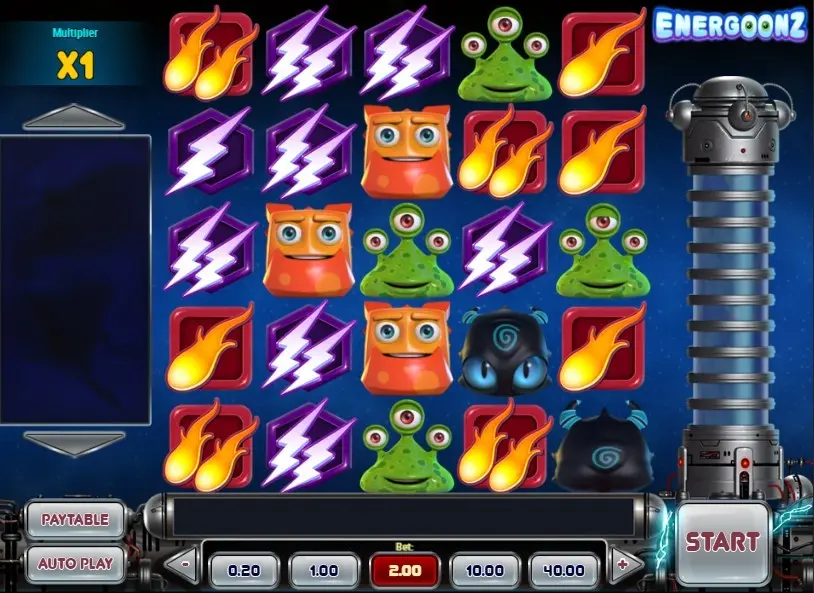
The single number worth knowing before you load this game is its return to player: 96%, which is above both the Play’n GO catalogue average of 95.8% and the 95.71% average across every title reviewed here. Beyond that, the published data on this five-reel release is thin. There is no volatility rating, no paylines count, no stake range and no max win figure on record, which matters for how confidently you can plan a session around it.
Who makes Energoonz
Energoonz comes from Play’n GO, a studio with 434 titles in this catalogue. That volume tells you something useful. A developer releasing at that scale is not building one flagship game and living off it; it is producing a broad library across many maths models, which is why the studio’s average RTP of 95.8% sits so close to the industry-wide figure. Averages that large are stable. One generous title or one stingy one barely moves them.
What that means for you as a reader is that the studio name alone does not predict much about any individual release. Play’n GO ships games at 94% and games above 96.5%, and the gap between those two ends of its range is wider than the gap between the studio average and the market average. So the provider is a signal about production standards and availability rather than about the returns on a specific machine. Judge each game on its own published numbers.
By popularity, this title ranks 2855 in this catalogue, placing it in roughly the 86th percentile. That is a mid-table position: played, catalogued, discussed, but not one of the studio’s headline properties.
| Provider | Play’n GO |
|---|---|
| RTP | 96.0% |
| Reels | 5 |
| Free demo | Yes |
| Site-wide average RTP | 95.71% |
Where Energoonz sits in the Play’n GO catalogue
Against its stablemates, the 96% return is a solid mid-to-upper placement rather than a standout. The studio’s best-known release, Book of Dead, runs at 94.25% — that is 1.75 percentage points lower, which over £10,000 of total wagering is a £175 difference in expected return. Fame and returns are not the same thing, and this is the clearest example of it in the Play’n GO library.
Go the other direction and you find Legacy of Dead at 96.58%, the highest of the three comparison points here. If RTP is your primary filter and you are choosing purely on the published figure, that title has the mathematical edge over this one by 0.58 points. Not a dramatic gap, but a real one over a long enough sample.
Where this game gains ground is on transparency of a different kind: there is a free demo available, so the parts of it that no spec sheet captures — pacing, how often small returns land, whether the mechanic holds your attention — are checkable at zero cost. Neither RTP nor the studio name tells you whether you will actually enjoy the thing.
RTP: 96.0% against a 95.8% house average
Return to player is a long-run statistical average, not a session promise. A 96% figure means that across an enormous number of spins, the game is modelled to return £96 for every £100 staked, keeping £4 as the house edge. The word doing the heavy lifting there is enormous: the sample sizes that make an RTP converge run into millions of spins, far more than any individual plays in a lifetime.
Over 1,000 spins at £1 a spin, £1,000 wagered would model out to £960 returned. In practice your actual result will land somewhere in a wide band either side of that, and the shape of that band is determined by volatility, not by RTP. Two games at identical 96% returns can feel completely different — one grinding out steady small returns, the other paying nothing for long stretches.
The +0.29 point edge over the corpus average of 95.71% is genuine but modest. On £1,000 of total wagering it is worth about £2.90 in expected terms. Useful as a tiebreaker between otherwise similar games; not a reason to choose this one over a game you would rather play. Each spin is independent, and no sequence of results changes the odds of the next one.
Volatility and who it suits
No volatility rating has been published for this title, so anyone telling you it is low, medium or high is guessing. That absence is worth taking seriously, because volatility affects your session more directly than RTP does.
Low-volatility slots pay small amounts frequently. Your balance drifts rather than lurches, sessions last longer on a given budget, and the largest single return is usually modest. High-volatility slots invert all of that: long dry runs punctuated by occasional larger returns, which means the same bankroll buys far fewer spins before it is exhausted, and short sessions can end a long way from the modelled 96%. Medium sits between the two.
Without that rating, the practical workaround is to play the demo and watch the rhythm. Count how many spins in fifty return nothing at all. If that number is high, you are dealing with something swingy and should size your real-money stakes smaller relative to your budget. If returns land regularly, the balance will behave more predictably. You cannot calculate volatility from a short demo run, but you can get a rough feel for which end of the scale a game lives on. Treat that as an impression, not a measurement.
Playing Energoonz slot for free
An Energoonz free demo is available, which is the cheapest research you will ever do on a slot. The demo runs the same maths model as the real-money version, so the mechanics, reel behaviour and pacing are identical. What differs is the money: demo credits have no cash value, cannot be withdrawn, and a good or bad run in demo mode carries no predictive weight whatsoever for what happens with real stakes. Every spin is independently generated in both modes.
Demo play is genuinely useful for three things: confirming the game runs properly on your device, learning what the paytable actually rewards, and deciding whether you like it enough to stake money on it. It is not useful for testing strategies, because there are none — no stake pattern, timing choice or progression alters the house edge on a random-number-generated slot.
Slots are paid entertainment, not income. Play only if you are 18 or over, decide the amount you are willing to lose before you start, and treat that amount as the price of the session rather than a stake you expect back. If it stops being fun, stop.
Similar picks
The theme data here is unusually sparse. The only descriptor attached to this game is the structural label “5-Reels”, and no other titles in this catalogue share it, so there is no thematic cluster to point you toward. That is a gap in the data rather than a judgement on the game.
What a five-reel layout tells you is limited but real: it is the standard modern grid, wide enough to support multi-line or ways-based win evaluation, and it sets expectations about reel pacing. It says nothing about theme, art direction or feature set, and no paylines or ways figure has been published here to fill in the rest.
For a same-studio alternative with a published return in the same territory, Divine Divas sits at 96.25% — a quarter of a point above this title. If you want to compare how two Play’n GO games at near-identical returns feel across fifty spins each, that is a sensible pairing, and both are checkable free with no download required.
Verdict
A 96% return, above both averages that matter, wrapped in a spec sheet with real gaps. That is the honest summary. The RTP is the strongest thing on record: better than the 95.8% Play’n GO average, better than the 95.71% corpus average, and comfortably ahead of the studio’s most famous release.
The gaps are what should temper your enthusiasm. No volatility rating means you cannot judge swing size before you play. No stake range means you cannot plan a bankroll from the page. No max win figure has been published, so treat any such number you see quoted elsewhere with scepticism until the studio confirms it.
Who it suits: anyone who filters on RTP, wants a Play’n GO title above the studio average, and is willing to spend fifteen minutes in the demo working out the pacing for themselves. Who should look elsewhere: anyone who needs published volatility and win-cap figures before committing a budget. Legacy of Dead’s 96.58% is the higher number if RTP alone decides it.
More from Play'n GO
- Fire Joker — 96.0% RTP
- Reactoonz — 96.51% RTP
- Rich Wilde and the Tome of Madness — 96.59% RTP
- Moon Princess — 96.0% RTP
- Rise of Olympus — 96.0% RTP
- Moon Princess Origins — 96.2% RTP
- Divine Divas — 96.25% RTP
- Legacy of Dead — 96.58% RTP
Frequently Asked Questions
Can you play Energoonz for free?
A free demo of this Play'n GO title is available, running the same maths model as the real-money version at the same 96% RTP. Demo credits carry no cash value and cannot be withdrawn, but the reel behaviour, paytable and pacing are identical, which makes it the cheapest way to decide whether the game suits you.
What is the Energoonz RTP?
The published return to player is 96.0%, meaning the game is modelled to return £96 per £100 staked across a very large sample of spins. That sits 0.2 points above the Play'n GO average of 95.8% and 0.29 points above the 95.71% average across this catalogue. Short sessions will vary widely from that figure.
Is Energoonz high or low volatility?
No volatility rating has been published for this game, so any claim that it is low, medium or high is guesswork. That absence matters, because volatility determines swing size and how many spins a given budget buys. The practical workaround is to run the free demo and note how often fifty spins return nothing.
Who developed Energoonz?
Play'n GO, a studio with 434 titles in this catalogue and an average RTP of 95.8% across them. Their library spans a wide maths range, from Book of Dead at 94.25% to Legacy of Dead at 96.58%, so the studio name tells you more about production scale and availability than about any individual game's return.
How does Energoonz compare to Book of Dead?
On published returns, this title is ahead: 96.0% against 94.25% for Book of Dead, a gap of 1.75 percentage points, or roughly £175 in expected return over £10,000 wagered. Book of Dead is far better known, but fame and RTP are separate things. Volatility figures are unpublished for this title, so swing comparison is not possible.