If you want a quick filter, Aztec Bonanza gives you a 96.53% RTP on a 5-reel format from a very large studio. That RTP is above both the wider market average and Pragmatic Play’s own average, which is enough reason to put it on a shortlist if you compare on numbers first. The aztec bonanza slot does not publish volatility, paylines or max win in the data available here, so your decision has to rest on the maths you can verify and what you learn in the free demo rather than assumed features.
Aztec Bonanza slot versus the average slot
This comparison starts with a single, verifiable gap: Aztec Bonanza returns 96.53% against a corpus average of 95.71%. The difference is +0.82 percentage points. That is not a marketing claim, it is arithmetic over a very large sample of spins.
What does 0.82 points mean for you? Take a notional £1 per spin. Over 1,000 spins you would wager £1,000. At 96.53% the theoretical return is £965.30; at the corpus average of 95.71% it is £957.10. The gap is about £8.20 per £1,000 wagered in expected value. Over 10,000 spins the theoretical gap scales to about £82. That does not make any single session feel different, but it does change the long-run cost of play if you compare two games side by side over many sessions.
Popularity context helps too. The game sits at rank 2,798, which places it around the 86th percentile for visibility in the tracked set. That suggests it is not among the handful of titles that dominate lobby placement, but it is far from obscure. A mid-to-high visibility rank often means you will find it at more casinos and have more community data points to sanity-check quoted figures, though rank itself says nothing about results.
Theme breadth is also worth noting if you filter by category. The Aztecs category contains 273 titles in this dataset. That is a crowded field, so an above-average RTP is a more useful differentiator here than theme alone. If you are choosing between several Aztecs titles, the maths gap is one of the few objective ways to separate them before you touch the demo.
Finally, none of this changes the core fact that every spin is independent. A higher RTP does not make wins more likely on the next spin, it only lowers the theoretical house edge from 4.29% to 3.47% over a huge sample. Session outcomes remain random and can sit well above or below the average.
RTP breakdown: 96.53% in context
96.53% RTP means £96.53 returned for every £100 wagered across a very large number of spins. The remaining £3.47 is the house edge in the long run. You will not see that split in a single evening; you will see streaks, swings and clusters that average out only as the sample grows into hundreds of thousands of spins.
Put the figure against two useful benchmarks. Pragmatic Play’s average across 739 tracked games is 96.32%, so this title sits 0.21 points above its own studio average. Against the broader corpus at 95.71%, the lead is 0.82 points as noted. Both comparisons frame it as slightly better than typical on price, not dramatically different, but consistently above the middle.
It also helps to translate RTP into cost per session for planning. If you run 500 spins at £0.50, you wager £250. The theoretical return at 96.53% is about £241.33, implying a theoretical cost of £8.67 for that session length. At the corpus average, the same session would cost about £10.73 in theory. Again, actual results will vary widely, but the expected cost difference is concrete.
Where RTP does not help is predicting pattern. It does not describe how often wins occur, how large they are, or whether the game pays in small frequent hits or rare larger ones. Those are volatility and hit-frequency questions, and no hit frequency or volatility rating is provided in the available data for this game, so you cannot infer a hit rate from the RTP alone.
The practical use of 96.53% is therefore narrow and honest: it tells you the long-run price, lets you compare cost across titles, and sets expectations for thousands of spins. For anything about how an evening will feel minute by minute, you need to observe the demo and accept that short-term variance dominates.
Volatility profile
No volatility rating has been published for Aztec Bonanza in the data supplied for this review. That absence matters, because volatility is what shapes most of what you feel between payouts: session length on a fixed budget, the size of swings, and how often your balance moves up or down.
In general terms, low-volatility slots tend to produce more frequent, smaller wins that keep a session going longer on a modest bankroll, while high-volatility slots tend to deliver longer dry stretches punctuated by larger, less frequent wins that demand a bigger buffer to ride out. Medium volatility sits between those poles. Those are concepts that apply across many games, not claims about this one.
Because the rating is missing here, you should not assume where this title sits on that spectrum. Any third-party label you see quoted elsewhere should be treated with caution unless Pragmatic Play itself publishes it and you can verify the source. Missing data is itself useful information: it tells you to manage for uncertainty.
How to adapt without a rating? Use the demo to observe behaviour over a meaningful sample, not a handful of spins. Track how quickly a notional balance moves, how often any return occurs at all, and how your balance behaves after 200–500 spins rather than 20. Even then, remember that demo play cannot predict real-money results; it only shows you the structure and the pace.
Other missing specifics reinforce that cautious approach. Payline or ways count, stake range, hit frequency and maximum win have not been supplied here, so bankroll maths has to stay general. Plan by spins and notional cost per 100 spins rather than by chasing a published max win that you cannot verify in this dataset.
Pragmatic Play as a studio
Pragmatic Play is tracked here with 739 games and an average RTP of 96.32%. That catalog size puts it among the largest providers in the dataset, which has two practical implications: you will find plenty of comparisons within the same studio, and studio-level habits such as RTP positioning are based on a large sample.
At 96.53%, Aztec Bonanza sits a fifth of a point above that studio average. That is a small but consistent nudge in the player’s favour on price, and it avoids the pattern where a new title launches below the studio norm. It also keeps the game competitive inside Pragmatic Play’s own lineup.
If you want to compare within the studio, look at titles you will actually encounter together in lobbies. Gates of Olympus is listed at 96.50% and tends to be one of the studio’s most visible releases, making it a useful anchor for price comparison. For a similarly priced alternative that is easy to find, Sweet Bonanza at 96.51% sits almost identically on RTP, so your choice between them comes down to personal preference for format rather than theoretical cost. Another common lobby presence is Joker’s Jewels at 96.50%, which again shows how tightly this studio clusters around the 96.5% area for many of its well-known games.
Large catalogues also mean varied mechanics across titles, but you should not infer mechanics for Aztec Bonanza from siblings. Features differ title to title, and none are asserted for this game in the available data. Use provider context to judge reliability and availability, not to assume what this specific game does on the reels.
Three Aztecs alternatives worth comparing
With 273 Aztecs-themed games in the tracked set, you have many ways to stay in theme while changing the maths. The three below are selected because their RTPs give you a spread around Aztec Bonanza’s 96.53%, which makes the trade-offs visible.
Gems Bonanza is priced at 96.51%, essentially level with Aztec Bonanza on long-run cost. If you prefer to hold theme-adjacent play while keeping the theoretical price unchanged, this is the closest like-for-like on RTP among the linked alternatives.
Hypercharged Inca Jungle sits at 96.00%, about half a point lower. Over 1,000 spins at £1, the theoretical return gap versus 96.53% is roughly £5.30. That is not huge in a single session, but it adds up if you compare extended play across months. If you like its format, you are paying a slightly higher theoretical price for that preference.
Kukulkan’s Queen at 96.06% lands between the two, 0.47 points below Aztec Bonanza. It keeps you inside the broader Mesoamerican motif while costing a little more in theory than the title under review. Again, the difference is modest per session but measurable over a large sample.
None of these RTP gaps tell you which game will feel more fun or how volatile any of them are, because volatility and hit frequency are not supplied here for Aztec Bonanza or for the comparators beyond their RTPs. Use these numbers to rank expected cost, then use the free demo to judge pace, clarity and personal taste. Theme is plentiful; price lets you shortlist without guessing.
Getting the most out of the free demo
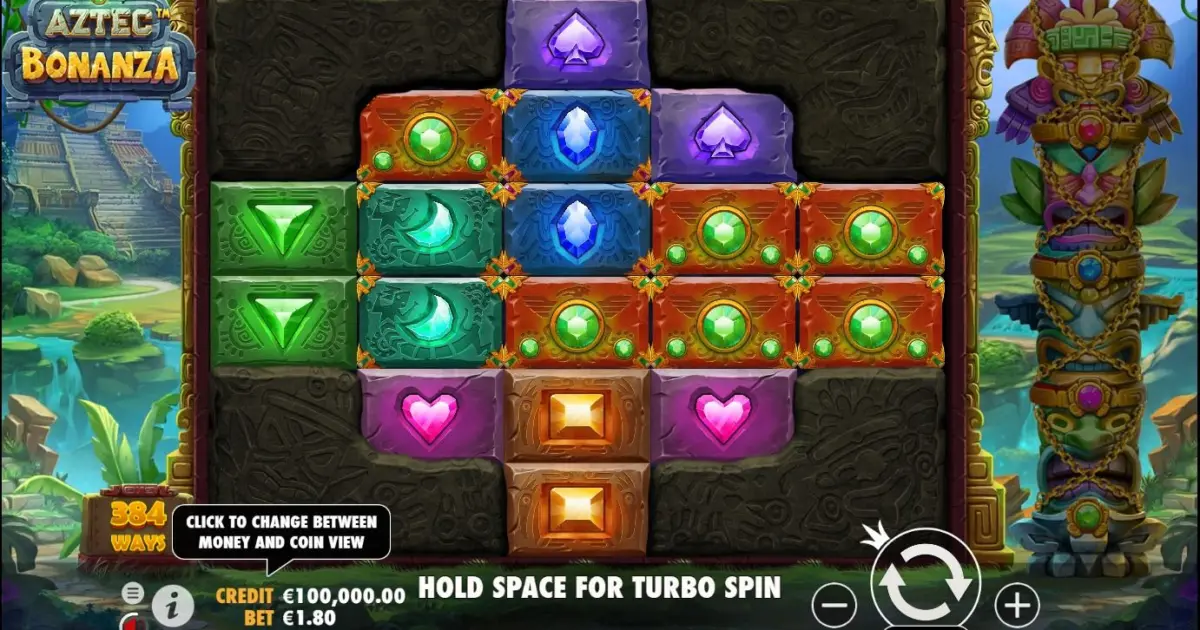
The free demo is available for this title, and it is the safest way to answer questions the data cannot. Because paylines, stake range and hit frequency are not provided here, the demo lets you see the reel count in action, check how the paytable is laid out, and gauge how quickly a notional balance moves over a few hundred spins. Try the Aztec Bonanza free demo for a structured 200-spin sample rather than a quick handful, and note how often any return occurs and how your balance evolves.
Keep demo stakes and session length consistent when you compare. If you test Aztec Bonanza at a notional £0.50 for 300 spins, test the comparator at the same notional stake and spin count. That way you are comparing observed pace and clarity, not mixing different bet sizes. No demo outcome predicts real-money results; every spin remains independent and random even when you switch to play with money.
Use the demo to check practical details too: information screens, language support, and how clearly the game explains its own rules. Those quality-of-life factors matter more than any single big-win story you might see elsewhere.
Play responsibly and keep it as entertainment. You must be 18+ to play, set a budget before you start, and treat any money wagered as the cost of entertainment rather than a way to make money. Take regular breaks, use deposit and session limits where available, and step away if it stops being fun.
Should you play Aztec Bonanza?
On the numbers you can verify, Aztec Bonanza is a slightly better-than-average proposition. Its 96.53% RTP beats the corpus by 0.82 points and the Pragmatic Play average by 0.21 points, which lowers the long-run house edge to 3.47% compared with 4.29% at the corpus midpoint. Over 500 spins at £1, that is a theoretical cost of about £17.35 versus £21.45 at the average, before variance.
The counterweight is what is not published here: volatility, hit frequency, payline structure and max win. Without those, you cannot model session swings or bankroll depth precisely. The game runs on 5 reels and sits in the Aztecs category, but beyond that you are best served by what you can observe in the free demo.
Choose it if you want an Aztecs-themed, 5-reel option that is priced above the middle and widely available from a major studio, and you are comfortable judging volatility feel yourself in demo. If you need a known volatility label or a specific stake range to plan a tight budget, pick a title where those figures are published and verifiable, then revisit this one once you have seen its pace first-hand. Either way, compare on RTP first, then let the demo decide.
| Item | Detail |
|---|---|
| Game | Aztec Bonanza |
| Provider | Pragmatic Play |
| RTP | 96.53% |
| Reels | 5 |
| Themes | Aztecs, 5-Reels |
| Popularity rank | 2798 (86th percentile) |
| Provider games tracked | 739 |
| Provider average RTP | 96.32% |
| Corpus average RTP | 95.71% |
| Free demo | Available |
More from Pragmatic Play
- Release the Kraken Megaways — 96.4% RTP
- Pirates Pub — 96.03% RTP
- Jelly Express — 96.5% RTP
- Cash Box — 96.02% RTP
- Eastern Fury — 96.53% RTP
- Fire Strike — 96.5% RTP
- Wild West Gold — 96.51% RTP
- Heart of Cleopatra — 96.48% RTP
Frequently Asked Questions
Can I play Aztec Bonanza for free before wagering?
Yes, the free demo is listed as available for Aztec Bonanza. The demo uses notional credits with no real-money payout and every spin remains independent and random. Use it to check the paytable and pace over a few hundred spins, keeping stake and spin count consistent if you compare alternatives.
What is the RTP of Aztec Bonanza and what does it mean in practice?
The published RTP is 96.53%, which means £96.53 returned per £100 wagered over a very large sample. The other £3.47 is the long-run house edge. If you wager £1,000 over many sessions, the theoretical return is about £965.30. Short-term results will vary widely around that average.
What is Aztec Bonanza's volatility and how risky is it?
No volatility rating is provided in the available data for Aztec Bonanza, so risk profile cannot be stated as fact. In general, high volatility tends to mean longer dry spells with larger occasional wins, while low volatility favours smaller, more frequent returns. Observe the demo for pace but remember it cannot predict real-money variance.
Who makes Aztec Bonanza and what else do they offer?
Aztec Bonanza is by Pragmatic Play, tracked here with 739 games and an average RTP of 96.32%. The studio's catalog clusters around 96.5% for many well-known titles, including Gates of Olympus at 96.50% and Sweet Bonanza at 96.51%, so Aztec Bonanza sits slightly above its maker’s average on price.
How does Aztec Bonanza compare to Gems Bonanza?
On price they are almost identical: Aztec Bonanza at 96.53% versus Gems Bonanza at 96.51%, a gap of just 0.02 points. Over 1,000 spins at £1 the theoretical difference is about £0.20. Choose between them on theme presentation and demo feel, since the long-run cost is effectively the same.