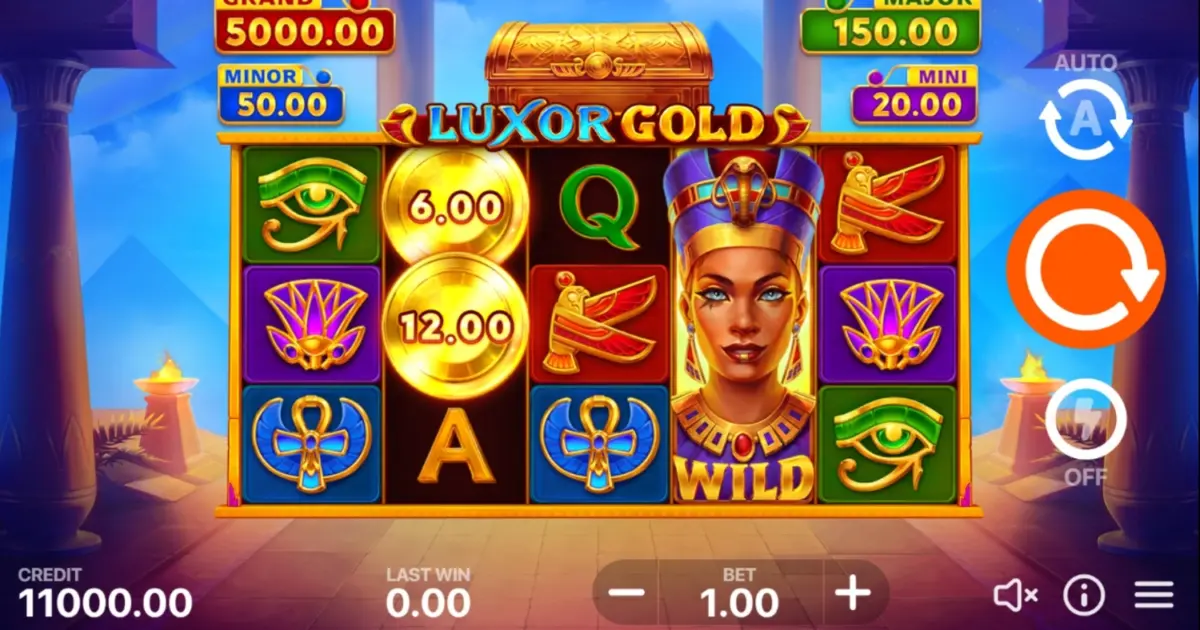
Playson’s five-reel Egypt release posts a return-to-player figure of 95.76%, which sits just above the 95.71% average across the games catalogued on this site and above Playson’s own 95.61% house average across 112 titles. If you want a familiar Egyptian setting and you judge a game by where its maths sits against its peers, the Luxor Gold: Hold and Win slot is a sensible one to load in demo mode. If you are looking for a published max win, a documented bonus structure or an official volatility rating, Playson has not released those figures for this title, and nothing here will be invented to fill the gap.
Is Luxor Gold: Hold and Win worth playing?
It is worth a look if you value a slightly above-average RTP and are content to find out the rest of the game’s behaviour for yourself in the demo. It is not worth chasing if you need published specifics before you play, because most of them are absent.
Here is what is actually known. Five reels. Egypt theme. Slot machine subcategory. RTP of 95.76%. A free demo exists. It sits at popularity rank 2,775, which places it in the 86.1st percentile of the games tracked here, so it is played more often than roughly six in seven titles in the catalogue without being a household name.
What is not known is longer. No paytable detail, no symbol list, no free-spin count, no multiplier ceiling, no hit frequency, no stake range, no release date, no max win. That absence matters practically: if you see a specific max win multiplier quoted for this game somewhere else, there is no published source behind it, so treat it sceptically.
| Provider | Playson |
|---|---|
| RTP | 95.76% |
| Reels | 5 |
| Theme | Egypt |
| Free demo | Yes |
| Site-wide average RTP | 95.71% |
What 95.76% RTP means over 1,000 spins
RTP is a long-run statistical average, not a session promise. At 95.76%, the theoretical return is 95.76p for every £1 staked, measured across a sample far larger than any single player will ever produce. The house edge is the remainder: 4.24%.
Put numbers on it. Stake £0.20 a spin for 1,000 spins and you have wagered £200, with a theoretical return of £191.52 and a theoretical cost of £8.48. Stake £1 a spin across the same 1,000 spins and you have wagered £1,000, with a theoretical return of £957.60 and a theoretical cost of £42.40.
Those are averages, and 1,000 spins is nowhere near enough to land on one. Real 1,000-spin samples scatter widely around the expected value, which is why two people playing the same game the same number of times can finish hundreds of pounds apart. Each spin is resolved independently of every spin before it, so nothing you did earlier in a session shifts the odds of what comes next.
Against its peers, the 0.05 percentage point edge over the corpus average is real but small. It does not distinguish this game meaningfully from the mass of titles clustered around 95.7%.
How volatile is the Luxor Gold: Hold and Win slot?
Playson has not published a volatility rating for this game, so any confident claim about its swing profile is guesswork. That is worth stating plainly rather than papering over, because volatility affects your session more directly than RTP does.
As a general principle across slots: low-volatility maths pays smaller amounts more often, which keeps a balance moving gradually and makes a modest bankroll last longer. High-volatility maths pays less often but larger when it does, which produces long flat stretches punctuated by sharp jumps and demands a bigger bankroll relative to your stake to ride out. Medium sits between the two.
Two games can share an identical 95.76% RTP and feel nothing alike, because RTP describes the total returned over a huge sample while volatility describes how lumpily that total arrives. Since the rating is unpublished here, the demo is the only honest way to form a view. Play a few hundred spins at a fixed stake and watch how often the balance moves and how far it falls between returns. That tells you about the demo session you just played, and nothing more, but it is better information than an invented label.
What the Egypt theme brings to the game
The theme is recorded as Egypt, alongside a 5-Reels tag. That label tells you the game draws on ancient Egyptian imagery and naming conventions, and the title itself points at Luxor and at gold. Beyond that, no symbol artwork, animation or audio detail has been published, so this review will not describe visuals it cannot verify.
What the label does tell you is how crowded the field is. There are 908 Egypt-themed games in the catalogue here, which makes it one of the most heavily worked settings in the market. The practical consequence is that theme alone is a weak reason to pick one game over another; the numbers and the feel of the base game matter far more, and you have plenty of substitutes if this one does not land.
The “Hold and Win” part of the name is Playson’s branding across a range of their titles rather than a documented mechanic description in the data available here. Many slots use hold-style respin features, but whether and how this one implements that is not something the published facts confirm.
Stakes, session length and bankroll
No minimum or maximum stake has been published for this title, so check the betting range in the game window before you commit anything. That is a one-second job in the Luxor Gold: Hold and Win free demo and it settles the question properly.
The arithmetic of session planning does not depend on the game. Divide your budget by your stake to get your spin count: £30 at £0.20 a spin is 150 spins, and at £1 a spin it is 30. A typical pace is 400 to 600 spins an hour, so £30 at £0.20 buys you roughly fifteen to twenty minutes of play before variance is even considered.
Because volatility is unpublished, err towards the cautious assumption and keep your stake small relative to your budget. A common working guideline is a bankroll of a few hundred times your spin stake if you want a reasonable chance of playing long enough to see the game’s full range of outcomes. Whatever the figure, decide it before you start, and treat it as money already spent on entertainment rather than as capital you expect back.
Alternatives if Luxor Gold: Hold and Win is not for you
If the 95.76% figure is what puts you off, the same provider offers something dramatically different on paper: Super Burning Wins: Classic 5 Lines carries a 99.99% RTP, which is roughly a 4.2 percentage point smaller house edge, though it is a stripped-back five-line classic rather than a themed five-reeler.
For a closer sibling, Coin Strike: Hold and Win sits in the same Playson Hold and Win family at 95.66%, fractionally below this title. If you want to stay in Egypt with a higher return, Book of the Sun pays 96.23%, about half a percentage point better. And for a comparison in the other direction, Book of Dead returns 94.25%, which costs you £15.10 more per £1,000 wagered in theoretical terms than the game reviewed here.
Final take
A competent, mid-table performer on the one number that is published. 95.76% is marginally better than average for both Playson slots and the wider catalogue, the theme is well-trodden, and the free demo means you can assess everything the data does not cover at no cost. The honest summary is that the published information is thin, and the demo is where you fill the gaps.
Slots are 18+ and every spin is independent, so no result is ever owed to you. Set a budget you are comfortable losing before you open the game, treat it as paid entertainment rather than a way to make money, and stop when the budget is gone. Demo play uses no real money and its results do not predict real-money outcomes.
Frequently Asked Questions
Can I play Luxor Gold: Hold and Win for free?
A free demo is available for this Playson title, so you can spin it with virtual credits and no deposit. That is the practical way to judge the parts Playson has not published, including the paytable, feature behaviour and stake range. Demo results use no real money and do not predict real-money outcomes.
What is the RTP of Luxor Gold: Hold and Win?
The published RTP is 95.76%, leaving a house edge of 4.24%. Over a very large sample that returns £95.76 per £100 staked, so £1,000 wagered has a theoretical return of £957.60. It edges the 95.71% catalogue average and Playson's 95.61% average, but the gap is small enough to be near-negligible.
Is Luxor Gold: Hold and Win high or low volatility?
Playson has not published a volatility rating for this game, so treat any figure you see quoted elsewhere as unsourced. Generally, low volatility pays small amounts often and stretches a bankroll, while high volatility pays rarely and larger. Running a few hundred demo spins at a fixed stake is the only reliable way to gauge it.
Who makes Luxor Gold: Hold and Win?
Playson develops it, and the studio has 112 titles in the catalogue here with an average RTP of 95.61%. Their range runs from high-RTP classics like Super Burning Wins: Classic 5 Lines at 99.99% to the Hold and Win series, which includes Coin Strike: Hold and Win at 95.66%. This title is a five-reel Egypt entry.
How does it compare to Book of the Sun?
Book of the Sun returns 96.23% against 95.76% here, so it holds roughly 0.47 percentage points less of your stake, about £4.70 per £1,000 wagered in theory. Both use an Egypt theme, one of 908 such games in the catalogue. Neither figure tells you how the swings feel in a short session.