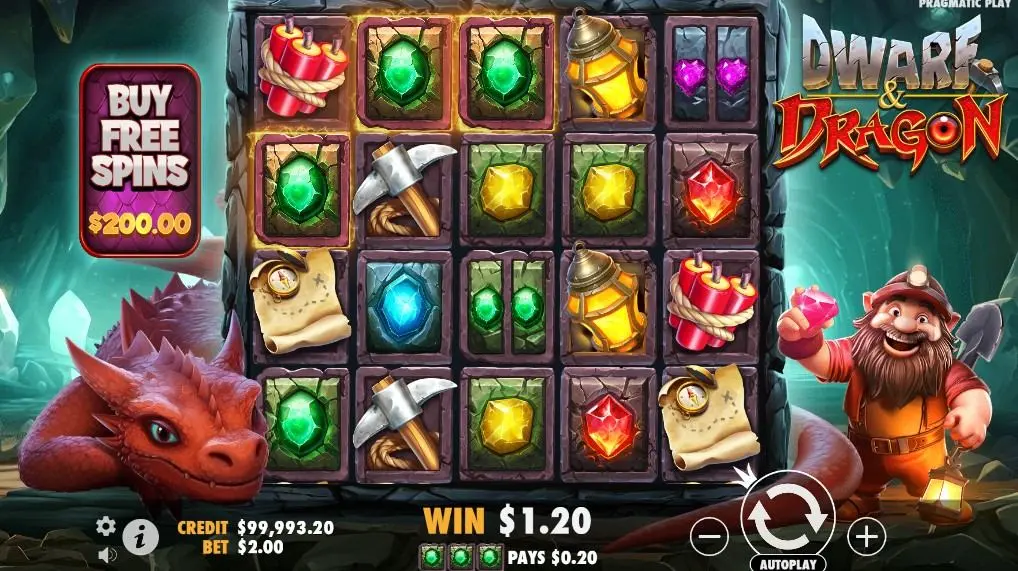
Dwarf & Dragon is a five-reel Pragmatic Play release with a published return-to-player figure of 96.59%, which sits 0.88 percentage points above the 95.71% average across this catalogue. If the return figure is the first thing you check, the dwarf & dragon slot clears a bar most titles do not. What has not been published is a volatility rating or a usable maximum win multiplier, so the risk side of the game is something you will have to read off your own session rather than off a spec sheet.
Who makes Dwarf & Dragon
Pragmatic Play is the studio behind it, and it is one of the largest suppliers represented here: 739 titles in this catalogue alone. Scale matters for a practical reason. A studio with that many games in circulation tends to publish consistent RTP documentation, roll out the same certified maths across operators, and keep older titles playable rather than quietly retiring them. It also means the studio’s average is a meaningful benchmark rather than a small-sample curiosity.
That average sits at 96.32% across the 739 games. Dwarf & Dragon is above it, though not dramatically so, at 96.59%. The gap is 0.27 percentage points, which translates to roughly 27p of extra theoretical return per £100 wagered over a very large sample. That is a real difference, but it is not the difference between a good session and a bad one. Over a few hundred spins it will be invisible underneath ordinary variance.
Ranked on popularity, this one comes in at 2759, placing it in the 86.2nd percentile. Read that as reasonably well played but not a headline act.
Where Dwarf & Dragon sits in the Pragmatic Play catalogue
Against the studio’s best-known releases, the return figure holds up well. Gates of Olympus publishes 96.5%, so this title is fractionally ahead of one of the most played slots the studio has ever shipped. Sweet Bonanza lands at 96.51%, again marginally below. The spread across all three is under a tenth of a percentage point, which tells you something useful: Pragmatic Play tunes most of its headline maths to roughly the same target, then differentiates on theme and mechanics.
That has a direct consequence for how you choose. Since the returns are near-identical, RTP is not the tiebreaker here. What separates these games is how the volatility feels, how long a typical session runs on a fixed bankroll, and whether the theme holds your attention. Those are the things worth testing rather than calculating.
Where this title is at a disadvantage is documentation. The better-known releases have widely published volatility ratings and max win multipliers. This one does not, at least not in the data available here, which makes it harder to slot into a shortlist without playing it first.
RTP: 96.59% against a 96.32% house average
RTP is a long-run statistical average, not a promise about your session. A 96.59% figure means that across a very large number of spins — millions, not hundreds — the game is modelled to return £96.59 for every £100 staked. The remaining £3.41 is the house margin. Nothing about that figure tells you what happens in the next hundred spins, because every spin is an independent event with no memory of what came before.
Some concrete framing. At £0.20 a spin, 500 spins puts £100 through the game. The theoretical return on that is £96.59, but the actual result will scatter widely around it, and the width of that scatter is set by volatility, not by RTP. A high-variance game can hand you £20 or £400 back from that same £100 with the same published return.
Compared against the wider field, 96.59% is 0.88 points above the 95.71% catalogue average. That is a more meaningful edge than the comparison with Pragmatic Play’s own average, and it is the single strongest argument for this game on paper.
Volatility and who it suits
There is no published volatility rating for this title in the available data, so any site quoting one with confidence is guessing. That absence is worth knowing about before you commit a bankroll, because volatility does more to shape a session than RTP does.
The general mechanics are straightforward. Low volatility means frequent small returns, slow bankroll drift, and long sessions from a modest balance — suited to players who want playing time. High volatility means long stretches with little back, punctuated by occasional larger returns, and it needs a deeper bankroll to survive the dry runs without the session ending early. Medium sits between the two. None of these options changes the expected return; they redistribute the same 96.59% across a different shape of outcomes.
Without a rating, the practical approach is to play a few hundred demo spins at a fixed stake and watch how often the balance moves and how far it swings. That gives you a rough feel for the shape. It will not give you a hit frequency figure, which is also unpublished here.
Playing the dwarf & dragon slot for free
A free demo is available, which is the most useful feature given how much of the spec sheet is blank. The Dwarf & Dragon free demo runs on virtual credits, so you can put a few hundred spins through it, get a sense of the swing pattern, and work out whether the Knights and Dragons and mining themes hold up for you — without risking anything.
| Detail | Value |
|---|---|
| Provider | Pragmatic Play |
| RTP | 96.59% |
| Reels | 5 |
| Primary theme | Knights and Dragons |
| Other themes | Mining, 5-Reels |
| Type | Slot Machine |
| Popularity rank | 2759 (86.2nd percentile) |
| Provider catalogue size | 739 titles |
| Free demo | Available |
One thing the demo cannot do is predict real-money results. A lucky or flat demo run says nothing about what follows, because each spin is independent. Slots are 18+ entertainment you pay for, like a cinema ticket. Decide what the session is worth to you before you start, stake at a level that makes that budget last, and stop when it is gone rather than topping up.
Similar picks
If the dragon theme is what brought you here, there are 69 titles sharing it, and two are worth comparing directly on the numbers. Dragon’s Revenge publishes 97.0%, the highest of the group and 0.41 points ahead of this one — the best pure return figure among the dragon-themed options listed here. Dragon Hatch sits at 96.83%, also ahead.
Both comparisons cut against this title on paper. Keep the size of the gap in perspective, though: 0.41 percentage points is 41p per £100 staked over a very large sample, and it will be swamped by variance across any realistic session length. Theme fit, stake flexibility and how the game feels to play will affect your experience far more than those fractions.
Where the comparison genuinely favours the alternatives is transparency. If you want a documented volatility rating before you commit, the alternatives may give you more to work with. If you are happy to test in demo mode first, the difference matters much less.
Verdict
The case for Dwarf & Dragon rests on a solid, verifiable return figure. At 96.59% it beats the 95.71% catalogue average by 0.88 points and edges the Pragmatic Play house average of 96.32%, which puts it ahead of well-known stablemates like Gates of Olympus and Sweet Bonanza on returns alone. Five reels, a Knights and Dragons and mining theme, and a free demo round out what is known.
The case against is what is missing. No volatility rating, no hit frequency, and no usable maximum win multiplier are published — the max win value in the available data is malformed rather than informative, so treat any specific figure quoted elsewhere with caution. That leaves you unable to judge bankroll requirements before you play, which is a real gap for anyone who plans sessions around risk level rather than theme.
Reasonable approach: run the demo, judge the swing pattern yourself, and use the RTP as the tiebreaker it is. If documentation matters more to you than a 0.27-point RTP edge, the higher-return dragon titles above are the more informed choice.
More from Pragmatic Play
- Demon Pots — 96.01% RTP
- Wolf Gold — 96.0% RTP
- Fruit Party 2 — 96.53% RTP
- Bigger Bass Bonanza — 96.71% RTP
- Piggy Bankers — 96.05% RTP
- The Dog House Megaways — 96.55% RTP
- Lucky Ox — 96.55% RTP
- Big Bass Bonanza 1000 — 96.51% RTP
Frequently Asked Questions
Can you play Dwarf & Dragon for free?
A free demo is available, running on virtual credits rather than real money. That is particularly useful for this title, because no volatility rating or hit frequency figure has been published, so a few hundred demo spins at a fixed stake is the only realistic way to get a feel for how the swings behave.
What is the RTP of Dwarf & Dragon?
The published RTP is 96.59%, meaning the game is modelled to return £96.59 for every £100 staked across a very large sample of spins. That is 0.88 percentage points above the 95.71% catalogue average and slightly ahead of Pragmatic Play's 96.32% house average. It says nothing about any individual session.
Is Dwarf & Dragon high or low volatility?
No volatility rating has been published for this title, so any source quoting one precisely is guessing. Volatility determines session length and swing size rather than expected return, so the gap matters for bankroll planning. Running a few hundred spins in demo mode and watching how far the balance moves is the practical workaround.
Who makes Dwarf & Dragon and what else do they produce?
Pragmatic Play developed it, and the studio has 739 titles in this catalogue, including Gates of Olympus at 96.5% RTP, Sweet Bonanza at 96.51% and Joker's Jewels at 96.5%. Their average return across all 739 games is 96.32%, so this release sits marginally above the studio's own typical figure.
How does Dwarf & Dragon compare with Dragon's Revenge?
Dragon's Revenge publishes a higher RTP at 97.0%, against 96.59% here — a gap of 0.41 percentage points, or about 41p per £100 staked over a very large sample. Dragon Hatch also comes in higher at 96.83%. All three share the Knights and Dragons theme, one of 69 titles using it.