Book of Enchantments is a 5-reel PariPlay slot with a 94.5% RTP that sits 1.21 points below the site average of 95.71%. If you are weighing whether to spend time on it, the book of enchantments slot is best approached as a try-before-you-buy demo first, because several core figures that shape risk and bankroll planning have not been published. That missing detail matters more than any theme tag when you are comparing games on the numbers.
Book of Enchantments at a glance
PariPlay has released Book of Enchantments as part of a 59-game catalogue, and the available facts position it as a middle-to-lower profile title. It ranks 2718 in the corpus examined, which places it in the 86.4th popularity percentile — played, but not among the most frequently compared titles on the site.
The headline number is a 94.5% RTP. That is below PariPlay’s own average of 95.53% across its 59 games, and below the corpus-wide average of 95.71%. The gap to the corpus average is -1.21 percentage points, which is meaningful when you look at expected returns over hundreds of spins.
The theme is listed as 5-Reels and the subcategory as Slot Machine, with a 5-reel layout confirmed. Beyond that reel count, PariPlay has not published further specifics for this title in the data supplied. No volatility rating, no payline or ways count, no stake range, no hit frequency, and no max win figure are available in FACTS. That absence does not make the game unplayable, but it does mean you cannot model session variance or bankroll needs with the precision you can for better-documented slots.
Who might still want to look? Players who start from the demo, who are comfortable with incomplete variance information, and who want to compare a lower-than-average RTP against PariPlay alternatives before committing funds. If you prefer fully specified risk profiles up front, consider filtering to titles where volatility and paylines are disclosed, such as Bloodshot Rising Spirit at 96.23% RTP for a direct provider comparison.
What a 94.5% RTP actually returns
RTP is a long-run statistical average, not a promise for a single session. A 94.5% RTP means that for every £100 wagered, the game is designed to return £94.50 on average across many millions of spins, leaving a 5.50% house edge. Each spin remains independent, and short-term results can deviate sharply above or below that average.
To make that concrete, take a simple, illustrative example. Because PariPlay has not published a minimum stake for this title, assume a hypothetical £0.20 stake to show the arithmetic — this is not the game’s actual minimum, only a maths example. Over 1,000 spins at £0.20, you would have wagered £200 in total. At exactly 94.5% RTP, the expected return would be £189.00, for an expected net loss of £11.00 across that sample. At the corpus average of 95.71% the same £200 wagered would be expected to return £191.42, for a net loss of £8.58. The difference is £2.42 more expected loss per £200 wagered on Book of Enchantments versus an average game, which compounds as volume grows.
Scale that to 10,000 spins at the same illustrative £0.20, or £2,000 wagered, and the expected return at 94.5% is £1,890, versus £1,914.20 at 95.71%. That £24.20 gap is the practical cost of the lower RTP over volume. In any real session of a few hundred spins, variance will swamp that average — you could finish ahead or well behind — but the long-run expectation stays anchored to the published percentage.
Compared with other PariPlay titles in FACTS, Book of Enchantments sits near Fortune Dragons at 94.56% and below Viking Glory at 95.97%. If RTP is your primary filter, the latter returns £1.47 more per £100 wagered on average than Book of Enchantments.
Volatility and what your session will feel like
No volatility rating has been published for Book of Enchantments in the data provided, so there is no official low, medium or high label to guide expectations. Missing data is itself useful information: without it you cannot anticipate the balance between hit frequency and swing size that volatility normally signals.
It helps to understand what volatility describes in general, without attributing a level to this specific game. In many slots, low volatility tends to produce more frequent but smaller wins, which can extend session length on a fixed bankroll but rarely creates large spikes. High volatility tends to do the opposite — longer stretches without wins, with a greater chance of larger swings when wins land, requiring a larger bankroll or a lower stake to cover the same number of spins. Medium volatility sits between the two.
Because this game lacks a published rating, treat its session feel as unknown until you have observed it in demo. Every spin is independent, and there is no pattern or timing effect that changes expected value — the random number generator does not make a game due after losses or tight after wins. Hit frequency, which would quantify how often any win lands, is also not disclosed here, so you cannot calculate an expected number of winning spins per 100 spins.
If you need a known variance profile to plan bankroll, you will be better served by a title where the provider states it. Until PariPlay publishes a figure for Book of Enchantments, use demo play to get a qualitative sense of swing size, but remember that demo results do not predict real-money outcomes and short demo samples are not statistically meaningful.
The 5-reel layout and how wins are counted
Book of Enchantments uses a 5-reel layout, which is the most common configuration in modern video slots. In general terms, reels are the vertical columns that spin, and wins are assessed after they stop according to the game’s paytable — either along defined paylines or via a ways mechanic where matching symbols on consecutive reels from the left are enough. Many slots also use wilds to substitute for other symbols and scatters to trigger features, but those are general concepts, not confirmed features of this specific game.
For this title, FACTS confirms the 5 reels but does not specify a payline count or a ways count. That means you cannot state whether it pays on 10, 20, 243 ways or another structure. The absence matters for comparison: a 5-reel game with 10 paylines behaves differently for hit distribution than one with 243 ways, even at the same RTP, because ways games typically create more frequent small line hits at lower per-line values.
Without a paytable, symbol list or feature description in FACTS, no statement can be made about how many symbols must land for a win, which symbols drive the largest pays, or whether any special symbols exist here at all. PariPlay has not published a max win figure for this title either, so treat any number you see quoted elsewhere with caution.
What you can take from the reel count alone is that the game follows the familiar 5-reel structure most players will recognise, and that your evaluation will need to happen in the demo where you can see how wins are evaluated on screen, rather than from a written specification.
Stake range and sizing a bankroll
No stake range has been published for Book of Enchantments in the supplied data. Minimum stake, maximum stake, default stake and any stake-dependent RTP variations are all absent from FACTS, so no concrete bankroll plan can be derived from a stated figure.
In general, stake range interacts with bankroll in a straightforward way. Your total wagered amount per session is stakes multiplied by spins. A £0.20 stake for 500 spins is £100 wagered; the same 500 spins at £1.00 is £500 wagered. Expected loss scales with total wagered multiplied by the house edge, which here is 5.50% at the published 94.5% RTP. That keeps the maths as expected value equals total wagered multiplied by RTP, with variance on top.
Without a known minimum, you cannot calculate the cheapest way to buy a given sample size, and without a maximum you cannot assess headroom for players who prefer larger single spins. If you are planning a bankroll, the responsible approach is to decide a total budget you are comfortable spending as entertainment, divide it by the number of spins you want to cover, and see what per-spin cost that allows — then verify in the demo or lobby that the game actually offers that stake. Do not use progression systems to chase losses; raising stakes after losses does not change the RTP, the house edge, or the independence of each spin.
Until PariPlay publishes the range, treat any third-party claim about 10p minimums or £100 maximums as unverified. The safest use of your time is to load the demo, confirm the stakes offered in your jurisdiction, and check whether they align with the session length you want before considering real-money play.
Playing the Book of Enchantments demo before you commit
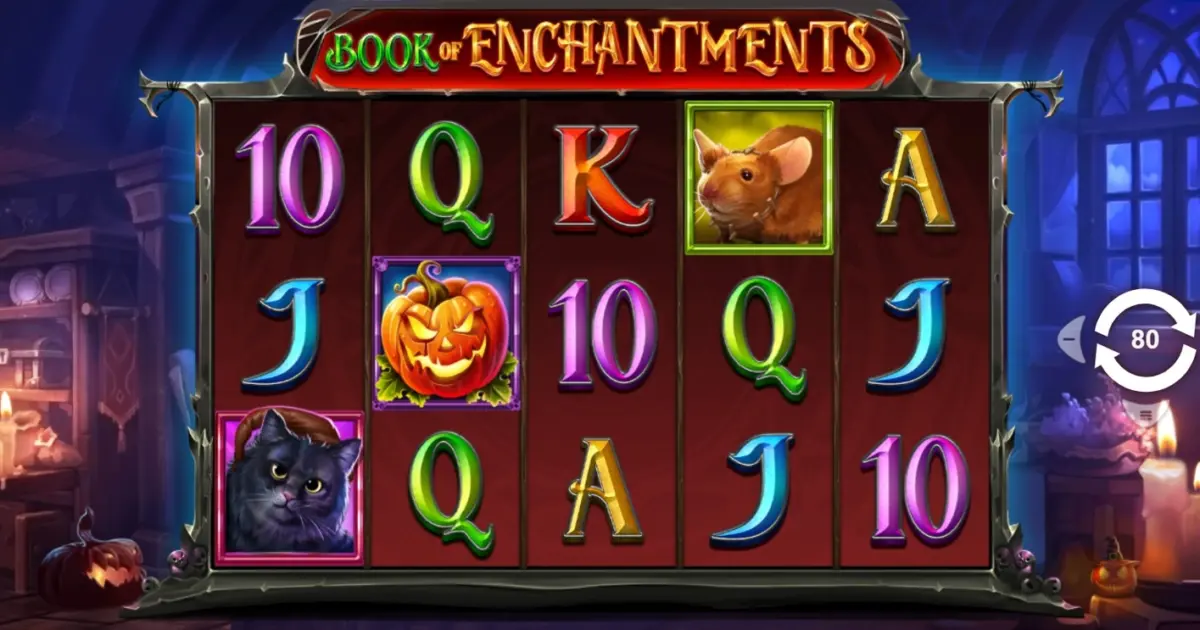
A free demo is available for Book of Enchantments, which is the most useful way to assess it given the limited published specification. Demo play lets you see the 5-reel layout in action, how wins are credited, and what the credit balance does over a few hundred spins at your chosen demo stake, all without spending funds. Search for Book of Enchantments free demo on the review site and load the no-download version where offered.
Remember what demo can and cannot do. It shows mechanics and pacing, but it does not reveal long-run RTP in a short sample and it does not predict what will happen for real money. Short-term outcomes in demo are random, just as they are with real funds, and a strong or weak demo run has no bearing on the next session because each spin is independent.
If you do move from demo to real-money play elsewhere, keep it bounded and deliberate. Only adults should play, set a budget before you start and treat that budget as the cost of entertainment, not as an investment. Use deposit or loss limits where available, take breaks, and stop if you are no longer enjoying it. If you need support, contact a recognised responsible-gambling organisation in your jurisdiction. The demo remains available to return to at any time, whether or not you decide to play with real funds.
Verdict: who should play Book of Enchantments
Book of Enchantments is best suited to players who are comfortable starting in demo and who do not need a fully published variance or payline specification to decide whether they like a 5-reel PariPlay slot. Those players will take the 94.5% RTP at face value, accept that it is below both the provider average of 95.53% and the corpus average of 95.71%, and judge the pacing themselves over a demo sample.
It is less suited to players who filter primarily on RTP or who need a stated volatility to size a bankroll with confidence. For that group, the maths points elsewhere within the same provider. Bloodshot Rising Spirit at 96.23% returns £96.23 per £100 wagered on average — £1.73 more than Book of Enchantments — while Viking Glory at 95.97% also sits above both Book of Enchantments and the corpus average. Both give you a higher long-run expectation on paper, though short-term variance can still dominate any single session.
The missing fields remain the decisive caveat. PariPlay has not published volatility, paylines, stake range or max win for this title, so any detailed claim you read outside FACTS should be treated as unverified. If you can accept that uncertainty and are happy to learn the feel in demo, Book of Enchantments is available to try free; if you cannot, shortlist better-documented alternatives and compare their published numbers side by side before choosing where to spend your budget.
| Feature | Detail |
|---|---|
| Name | Book of Enchantments |
| Provider | PariPlay (59 games) |
| RTP | 94.5% |
| Provider average RTP | 95.53% |
| Corpus average RTP | 95.71% |
| Reels | 5 |
| Themes | 5-Reels |
| Popularity rank | 2718 (86.4th percentile) |
| Free demo | Available |
Frequently Asked Questions
Can I play Book of Enchantments free before wagering real money?
Free demo play is listed as available for Book of Enchantments, so you can load it directly on the review site without a deposit. The demo shows the 5-reel layout and how wins credit at your chosen stake, but it does not predict real-money results. Use it to check pacing and stake options, then decide if it suits your budget.
What is the RTP of Book of Enchantments and what does it mean in practice?
The published RTP is 94.5%, which means the game is designed to return £94.50 for every £100 wagered averaged across millions of spins. It sits 1.21 points below the corpus average of 95.71% and below PariPlay's 95.53% average. Each spin is independent, so short sessions can finish well above or below that long-run expectation.
What volatility is Book of Enchantments and how will that affect my session?
No volatility rating has been published for Book of Enchantments in the data supplied, so there is no official low, medium or high classification. Without it you cannot model expected swing size or bankroll needs precisely. In general, higher volatility means rarer but larger swings, while lower volatility means more frequent smaller wins; treat this title as unknown until the provider publishes a figure.
Who makes Book of Enchantments and what else do they offer?
Book of Enchantments is made by PariPlay, which has 59 games in the dataset examined with an average RTP of 95.53%. Related PariPlay titles for comparison include Bloodshot Rising Spirit at 96.23%, Fortune Dragons at 94.56% and Viking Glory at 95.97%. Comparing RTPs within the same provider helps isolate the maths from theme and layout preferences.
Does playing the Book of Enchantments demo let me win real money?
Demo play does not pay real money and does not influence future real-money results. It uses the same random mechanics for illustration, but credits stay in demo balance and cannot be withdrawn. If you later play with real funds elsewhere, each spin is still independent and carries the 5.50% house edge implied by the 94.5% RTP, so set a budget beforehand.