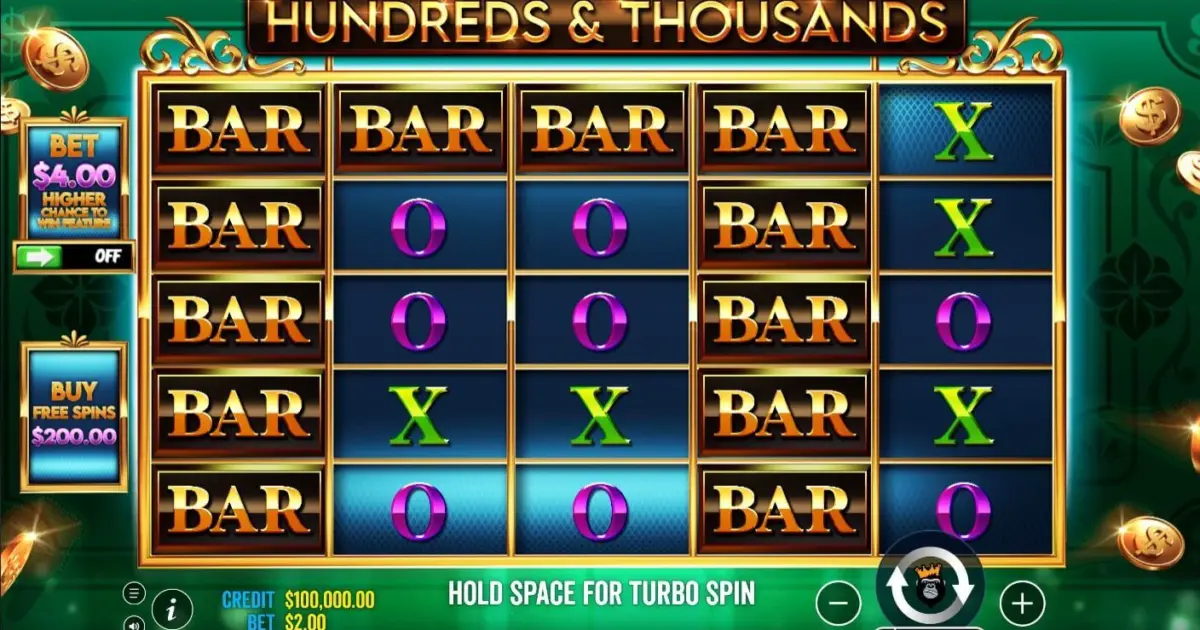
Pragmatic Play’s hundreds and thousands slot carries a published return to player of 96.52% across five reels, and a free demo version is available. That figure sits 0.81 percentage points above the 95.71% average across the games catalogued here, so on the one number that can be checked, it holds up well. What is absent matters just as much: no volatility rating, no maximum win figure and no paytable breakdown have been published for this title, which limits how far anyone can characterise how a session actually feels.
Who makes Hundreds and Thousands
Pragmatic Play is the developer, and there are 739 of its titles in this catalogue. That volume tells you something useful about the studio: it releases at a pace that makes it one of the most widely distributed suppliers in the market, and its games turn up across a very large number of operators. A catalogue that size is also uneven by nature. Some titles become fixtures, others pass with little attention, and the studio’s average published RTP across those 739 games works out at 96.32%.
This game’s popularity rank of 2723 places it in the 86.4th percentile for player interest, so it draws meaningful traffic without being one of the studio’s headline releases.
| Feature | Detail |
|---|---|
| Provider | Pragmatic Play |
| RTP | 96.52% |
| Reels | 5 |
| Theme | Money and wealth |
| Type | Slot Machine |
| Popularity rank | 2723 (86.4th percentile) |
| Free demo | Available |
Where Hundreds and Thousands sits in the Pragmatic Play catalogue
Against the studio’s best-known releases, this one lands almost exactly on par for return. Gates of Olympus publishes 96.5%, two hundredths of a point lower, and it is the title most players will have met first, so it is a natural reference point if you want a familiar benchmark before trying something quieter. Sweet Bonanza is marginally lower again at 96.51%.
The practical takeaway is that Pragmatic Play clusters a lot of its output within a tenth of a point of 96.5%, and this game is part of that cluster rather than an outlier in either direction. Choosing between them on RTP alone is close to meaningless; a 0.02 point gap is worth two pence per £100 wagered over an enormous sample and nothing you would ever notice. The differences that matter between these games are mechanical, and for this title those mechanics have not been published, which is the honest answer rather than a satisfying one.
RTP: 96.52% against a 96.32% house average
96.52% RTP means £96.52 returned per £100 wagered, averaged across a sample far larger than any individual will ever play. That leaves a 3.48% theoretical house edge. The number is a long-run statistical property of the maths model, not a promise about your session, and it does not reset, warm up or become owed. Every spin is independent of the one before it.
Scale it to realistic play. At £1 a spin over 500 spins you stake £500, and the model’s expected cost is about £17.40. But 500 spins is a tiny sample, and the spread of plausible outcomes around that expectation is enormous, which is why two people with identical stakes can walk away with wildly different results from the same game.
Against the 96.32% provider average, this title returns 0.20 points more. Against the 95.71% catalogue average, 0.81 points more. Neither gap changes a session, but both point the same direction, and choosing higher-RTP games consistently is one of the few decisions available to a player that actually shifts long-run cost.
Volatility and who it suits
No volatility rating has been published for this game, so treat any confident claim you read elsewhere with scepticism. That absence is worth knowing before you commit real money, because volatility affects a session far more visibly than a two-hundredths-of-a-point RTP difference does.
As a general principle: low volatility games pay smaller amounts more often, so balances drift rather than lurch and a modest bankroll stretches across more spins. High volatility games pay less often but larger when they do, which means long dry stretches and a bankroll requirement several times higher for the same number of spins. Medium sits between the two. Crucially, volatility does not change the RTP. Two games returning 96.52% can feel completely different while costing the same over the long run.
Without a rating, the only reliable way to gauge this game’s rhythm is to watch it yourself. A few hundred demo spins will show you roughly how often it pays and how deep the quiet stretches run, which is more informative than any label would be.
Playing the hundreds and thousands slot for free
A Hundreds and Thousands free demo is available, which means you can watch the reels behave without staking anything. That is the sensible first step here specifically because the volatility and paytable data are missing. Demo mode lets you fill those gaps by observation: how frequently wins land, how long the flat patches feel, whether the pace suits you at all.
What a demo cannot do is forecast money. Demo credits and real balances run on the same random model, so a good run in free play carries no information about what follows with cash, and neither does a bad one. The stake range for this title has not been published either, so check the limits in the game itself before deciding whether it fits your budget rather than assuming.
Slots are 18+ and are paid entertainment, not income. Decide what the session is worth to you before you open the game, stake only that, and stop when it is gone. Nothing about how a game has behaved makes the next spin more or less likely to pay.
Similar picks
Staying within the money and wealth theme, there are 549 titles in that category here, so alternatives are not scarce. Dogmasons MegaWOOF publishes 96.8%, which is 0.28 points above this game and the better figure if return is your deciding factor. Money Coming is another option in the same theme, though no RTP has been published for it, and an unpublished return is a genuine reason to be cautious rather than a neutral detail.
A theme label tells you what a game draws on, not what it plays like. Two money-themed slots can share a category and have nothing in common mechanically. Use the theme to narrow a shortlist, then compare the published numbers, and where those numbers are missing, treat the gap as part of the assessment.
Verdict
On the figure that can be verified, this game is fine. 96.52% beats the 95.71% catalogue average and edges past Pragmatic Play’s own 96.32% mean, and it sits level with the studio’s biggest releases. An 86.4th-percentile popularity rank says a reasonable number of people play it.
The reservation is how little else is on record. No volatility rating, no max win, no published stake range and no paytable detail means you are buying on RTP alone, and RTP describes cost over a sample nobody plays rather than the experience of an evening. The free demo closes some of that gap at no cost, and it is the obvious place to start. If you want a comparable return with a documented, widely discussed mechanic instead, Joker’s Jewels publishes 96.5% and is the more transparent choice.
More from Pragmatic Play
- Fire Archer — 96.07% RTP
- Fire Stampede Ultimate — 96.45% RTP
- Bigger Bass Bonanza — 96.71% RTP
- 3 Buzzing Wilds — 96.03% RTP
- Buffalo King — 96.06% RTP
- Release the Kraken — 96.5% RTP
- Big Bass Secrets of the Golden Lake — 96.07% RTP
- Extra Juicy — 96.52% RTP
Frequently Asked Questions
Can I play Hundreds and Thousands for free?
A free demo version of this Pragmatic Play title is available, so you can try the five reels without staking money. Demo mode is particularly useful here because no volatility rating has been published, and a few hundred free spins will show you how often the game pays and how long its quiet stretches run.
What is the RTP of Hundreds and Thousands?
The published RTP is 96.52%, meaning £96.52 returned per £100 wagered across a very large sample. That leaves a 3.48% theoretical house edge. The figure is 0.81 points above the 95.71% average across the games catalogued here, and 0.20 points above Pragmatic Play's own 96.32% average.
Is Hundreds and Thousands high or low volatility?
No volatility rating has been published for this game, so any figure quoted elsewhere is unverified. Volatility determines swing size and how much bankroll you need for a given number of spins, but it never changes the 96.52% RTP. Watching a few hundred demo spins is the most reliable way to judge its rhythm.
Who is Pragmatic Play?
Pragmatic Play is the studio behind this game, with 739 titles in this catalogue and an average published RTP of 96.32% across them. Its best-known releases include Gates of Olympus and Sweet Bonanza, both listed at 96.5%. That output volume makes it one of the most widely distributed slot suppliers available.
How does it compare to Dogmasons MegaWOOF?
Dogmasons MegaWOOF publishes 96.8% against this game's 96.52%, a 0.28 point advantage that works out at 28p per £100 wagered over a very large sample. Both sit in the money and wealth theme, which contains 549 titles here. Theme overlap says nothing about how similarly the two actually play.