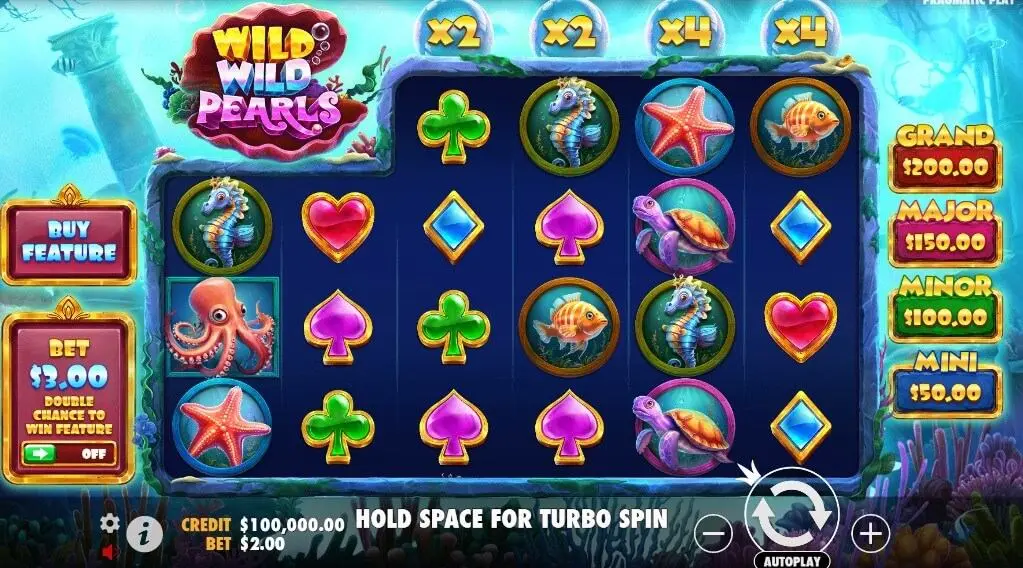
Wild Wild Pearls is a six-reel release from Pragmatic Play with a published RTP of 96.46%, and that number is the clearest reason to look at it. It sits above the studio’s own 96.32% average and well above the 95.71% average across the games catalogued here. What has not been published is a volatility rating or a maximum win figure, so a meaningful part of the risk picture is simply absent.
Is Wild Wild Pearls worth playing?
It is worth loading in demo mode if you want a six-reel game with an above-average theoretical return. It is worth skipping if you refuse to stake money on a title whose swing profile has not been documented.
The return figure does most of the work in its favour. At 96.46% RTP, this game gives back 0.14 percentage points more than the typical Pragmatic Play title and 0.75 points more than the catalogue average. Across a long enough sample, that gap is real money — though “long enough” means tens of thousands of spins, not an evening.
On popularity it sits at rank 2673, which places it in the 86.6th percentile of games tracked here. That is a respectable position rather than a headline one: plenty of players have found it, but it is not one of the handful of Pragmatic Play slots that dominate lobbies. The six-reel layout is worth noting on its own, since most slots use five. A wider grid changes how symbol combinations are counted, and the number of paylines or ways has not been published for this title, so you should check the in-game information panel before you decide how a stake translates into coverage of the grid.
| Provider | Pragmatic Play |
|---|---|
| RTP | 96.46% |
| Reels | 6 |
| Theme | Ocean and sea |
| Free demo | Yes |
| Site-wide average RTP | 95.71% |
What 96.46% RTP means over 1,000 spins
RTP is a long-run statistical average, not a promise about your session. A 96.46% figure means that across an enormous number of spins the game is designed to return £96.46 for every £100 wagered, with the remaining £3.54 forming the house edge.
Put that on a 1,000-spin session at £1 per spin. You have wagered £1,000, and the expected return is £964.60 — an expected cost of £35.40 for roughly 20 to 25 minutes of play at a fast clip, or an hour at a relaxed one. That is the number to compare against other entertainment, because it is the closest thing to a price tag a slot has.
The catch is that 1,000 spins is nowhere near enough for the average to assert itself. Real outcomes at that sample size scatter widely around the expectation, and the scatter is wider on high-variance games than on low-variance ones. Some 1,000-spin sessions finish up, most finish down, and a few finish far outside either range. The house edge does not arrive in neat instalments; it emerges over hundreds of thousands of spins pooled across every player.
What the figure does let you do is rank games. Against the 95.71% catalogue average, this one is a better-priced ride. Against the best in Pragmatic Play’s range it is mid-pack.
How volatile is the Wild Wild Pearls slot?
Unknown. Pragmatic Play has not published a volatility rating or a maximum win figure for this title, and neither number can be inferred from RTP — games at 96.46% exist at every point on the risk scale. If you see a volatility band or a max-win multiplier quoted elsewhere, treat it as somebody’s guess unless it cites the studio’s own paytable.
The distinction matters because volatility, not RTP, decides what your session feels like. Low-volatility games pay small amounts often; bankrolls drain slowly, sessions run long, and results cluster near the expected value. High-volatility games pay rarely and larger; long dry stretches are normal, and the bankroll needed to survive them is several times bigger for the same stake. Medium sits between the two.
With the rating absent, the practical move is to observe rather than assume. Play a few hundred demo spins and watch how often the balance moves at all, and how big the outliers are relative to your stake. That gives you a rough feel for the distribution. It does not give you a number, and it does not predict anything about a future session — but it does tell you whether the rhythm suits you before money is involved.
What the Ocean and sea theme brings to the game
The theme label here is Ocean and sea, one of the most heavily populated categories around with 527 games carrying the same tag. The title itself points at pearls, which fits the underwater framing, and the second tag is simply 6-Reels — a structural descriptor rather than a narrative one.
Beyond that label, there is nothing documented about the art, symbol set, soundtrack or animation, so anything you read describing specific characters or scenes is invention. What the theme genuinely tells you is about competition. In a category this crowded, a game has to justify itself on either mechanics or maths, and the maths here is the stronger card.
Theme also has no effect on outcomes. Two games can share an identical ocean setting and behave completely differently, and two visually unrelated games can run on near-identical models. Treat the setting as a preference question: if you enjoy the aesthetic, it makes the same expected cost more pleasant to absorb. If the ocean has been done to death for you, the theme is not a reason to choose this over a better-documented title elsewhere in the catalogue.
Stakes, session length and bankroll
No minimum or maximum stake has been published for this game, so check the bet selector in the game itself before your first spin. Pragmatic Play titles generally span a wide range, but the specific ceiling and floor here are not on record, and that is worth confirming rather than assuming.
The arithmetic you can do regardless. Decide your session budget first, then divide by the number of spins you want from it. A £40 budget across 400 spins means £0.10 a spin; the same £40 across 100 spins means £0.40. At 96.46% RTP the expected cost of 400 spins at £0.10 is about £1.42, though actual results will land either side of that, sometimes by a lot.
Two things to keep straight. Every spin is independent of the last, so no stake pattern, timing choice or progression alters the expected value — raising bets after losses only raises the amount at risk. And with volatility undocumented, err on the side of a smaller unit stake so a long flat stretch does not end the session early. A Wild Wild Pearls free demo run lets you test that stake-to-session ratio at no cost.
Alternatives if Wild Wild Pearls is not for you
If you want to stay with the ocean theme but get a better return, Pearls of Aphrodite publishes 96.81% RTP — 0.35 points better, which cuts the expected cost of 1,000 spins at £1 from £35.40 to £31.90. Big Bass Bonanza sits at 96.71% and is one of the most played fishing-themed titles anywhere, so it is far easier to find third-party documentation for it if the missing volatility rating here bothers you.
If the studio matters more than the setting, Gates of Olympus returns 96.50% and is one of Pragmatic Play’s most recognised games, which again means better-documented specifications. All three are comfortably inside the range you would expect from a 739-game catalogue whose average return is 96.32%.
None of these swaps changes the basic structure of the deal. You are choosing between house edges of roughly 3.2% and 3.5%, and a smaller edge only reduces the long-run cost rather than removing it. Pick on return figure, documented volatility and whether you actually enjoy the game.
Final take
A 96.46% return on a six-reel Pragmatic Play game is a reasonable, if unspectacular, proposition — better than most of the catalogue, beaten by several stablemates and by two ocean-themed rivals. The absent volatility rating and max-win figure are the real drawback, because they leave you unable to judge how a bankroll should be sized. Free demo play is available, which is the sensible first step: it costs nothing to learn the rhythm, and it tells you what the paytable actually contains rather than what a review can infer.
Slots are 18+ and priced entertainment, not income. Set a budget you are content to spend on an evening out, stop when it is gone, and never chase a losing session. Demo results have no bearing on real-money outcomes.
Frequently Asked Questions
Can you play Wild Wild Pearls for free?
A free demo is available, so you can spin the six-reel grid with virtual credits and no deposit. That is the best way to check the paytable and see how often the balance moves, since Pragmatic Play has not published a volatility rating. Demo play never pays real money.
What is the RTP of Wild Wild Pearls?
The published RTP is 96.46%, meaning a theoretical return of £96.46 per £100 wagered across a very large sample. That is above Pragmatic Play's 96.32% average and the 95.71% catalogue average. Over 1,000 spins at £1, the expected cost is about £35.40, though real results vary widely.
Is Wild Wild Pearls high or low volatility?
No volatility rating has been published for this game, and it cannot be derived from the 96.46% RTP, since games at that return exist across the whole risk scale. Ignore unsourced ratings you find elsewhere. A few hundred demo spins will give you a rough feel for the swing size.
Who makes Wild Wild Pearls?
Pragmatic Play, a studio with 739 games in this catalogue and an average published return of 96.32%. Their better-known titles include Gates of Olympus and Sweet Bonanza, both around 96.50%. This release ranks 2673 for popularity, placing it in the 86.6th percentile of games tracked here.
How does Wild Wild Pearls compare to Pearls of Aphrodite?
Pearls of Aphrodite publishes the higher return at 96.81% against 96.46%, a 0.35-point gap that trims roughly £3.50 from the expected cost of £1,000 in wagers. Both carry the Ocean and sea theme. Neither figure predicts a single session, since outcomes scatter widely at small sample sizes.