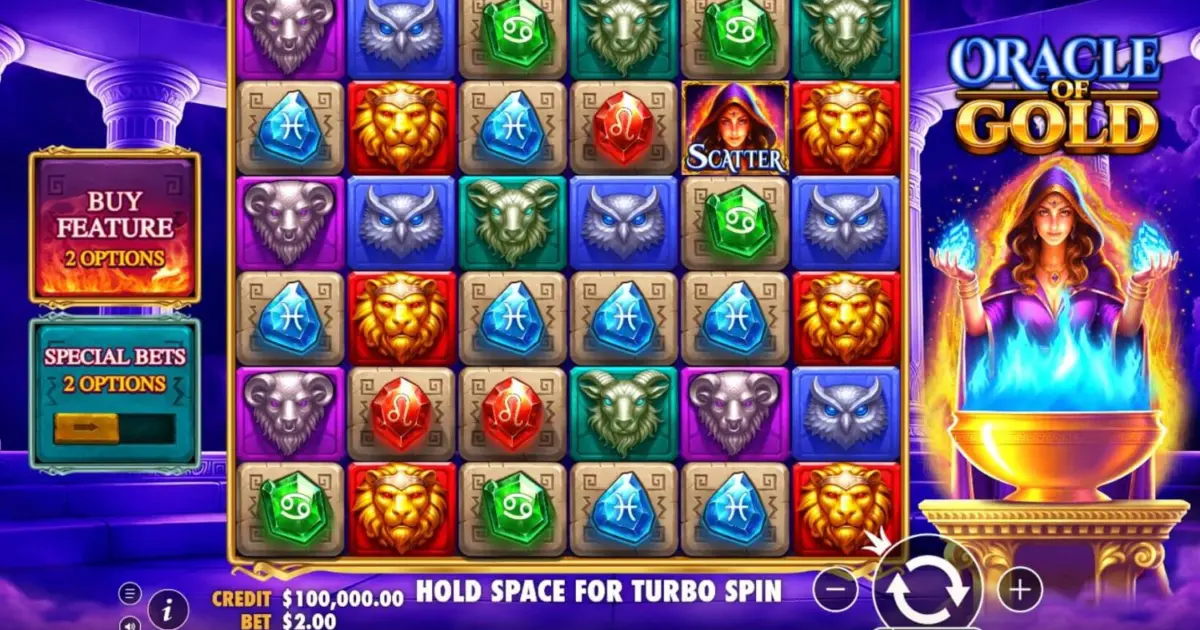
Oracle of Gold slot sits just above the average on return and popularity, with a 96.55% RTP and six reels in a Mythology setup. Ranked 2,597 in this catalogue, it is not a top-20 crowd-pleaser, but its percentile shows steady play without the hype cycle. If you want a measured, catalogue-driven view before you spin, the figures below give you a clearer starting point than any trailer.
Who makes Oracle of Gold
Pragmatic Play is the studio behind Oracle of Gold, and the size of its catalogue matters when you judge support, consistency and how often its maths models are iterated. This catalogue lists 739 Pragmatic Play titles, which puts the provider among the largest in the dataset. A large output does not guarantee quality, but it does mean you can compare mechanics, RTP spreads and presentation across many releases rather than taking one game in isolation.
The provider average RTP across those 739 games is 96.32%, which gives you a useful baseline. Oracle of Gold at 96.55% lands 0.23 percentage points above that house average, so it is not an outlier in either direction. In practical terms, you are looking at a Pragmatic Play release that tracks the studio’s typical return level rather than pushing to the high or low end of its range.
Pragmatic Play has not published a max win figure, hit frequency, payline count or volatility rating for this title in the FACTS supplied for this review, so those specifics cannot be confirmed here. That absence is itself information. When a figure is missing, treat any number you see quoted elsewhere with caution and rely on the two hard facts that are confirmed: the 96.55% RTP and the 6-reel structure. Both are fixed inputs to the maths, while the unlisted details describe distribution, not expected value.
Where Oracle of Gold sits in the Pragmatic Play catalogue
Within Pragmatic Play’s 739-game set, Oracle of Gold occupies a mid-catalogue position rather than a flagship slot. Its rank of 2,597 across the wider corpus corresponds to the 87th popularity percentile, which means it is played more than the median title but well outside the top tier of most-spun games. For comparison, that percentile leaves meaningful headroom above it for breakout hits while still indicating an active player base that has kept it in circulation.
The most direct comparison inside the same stable is Gates of Olympus at 96.5% RTP. The 0.05-point gap to Oracle of Gold is small in absolute terms, but it illustrates how tightly Pragmatic Play clusters many of its returns around the 96.5% mark. If you are choosing between the two on maths alone, Oracle of Gold has the marginally higher long-run return, though the difference will only emerge over a very large sample of spins.
Two other studio peers help anchor expectations. Sweet Bonanza at 96.51% and Joker’s Jewels at 96.5% sit within 0.05 points of Oracle of Gold, reinforcing that the studio rarely strays far from this band for its core catalogue. When related games cluster this closely, your decision is better guided by reel structure and theme preference than by hunting basis points of RTP, since variance in short sessions will dwarf those gaps. Every spin remains independent, so no ordering of these titles changes the expected value per spin.
| Figure | Value |
|---|---|
| Provider | Pragmatic Play |
| RTP | 96.55% |
| Provider average RTP | 96.32% |
| Corpus average RTP | 95.71% |
| Reels | 6 |
| Themes | Mythology, 6-Reels |
| Popularity rank | 2,597 |
| Popularity percentile | 87.0% |
| Free demo available | Yes |
RTP: 96.55% against a 96.32% house average
Return to Player is a long-run statistical average, not a promise for a single session. A 96.55% RTP means that for every £100 wagered, the game is designed to return £96.50 across a very large sample of spins, keeping £3.45 as the house margin in that theoretical run. Over 1,000 spins at £1 a stake, the total wagered is £1,000 and the theoretical return at this RTP is £965.50. Over 10,000 spins at the same stake, £10,000 wagered implies £9,655 returned in the model. Your actual result in any shorter session can be a long way above or below that line.
Against the provider average of 96.32%, Oracle of Gold gives back £0.23 more per £100 wagered in theoretical terms. Against the wider corpus average of 95.71% across all providers in this dataset, the advantage is clearer: £0.84 more per £100 wagered than the typical game in the catalogue. That 0.84-point edge is the more decision-relevant comparison if you regularly switch providers, because it shows how this title compares to the average shelf, not just to its own studio.
Those edges do not make short-term results smoother; they shift the centre of the distribution, not its spread. Without a published volatility rating or hit frequency for this game, you cannot infer whether that return arrives as frequent small hits or as rarer larger swings. What you can say is that the 96.55% figure, if accurate for the version you play, defines the long-run cost of play per unit wagered. Always check the paytable or help screen at the casino where you play, as some Pragmatic Play titles are distributed in multiple RTP configurations and the installed version may differ from the catalogue figure.
Volatility and who it suits
Volatility describes how returns are distributed around the RTP, not the RTP itself. Low volatility generally means more frequent but smaller hits and a bankroll that lasts longer at a flat stake; high volatility means longer dry spells punctuated by larger swings, requiring a larger buffer to sustain the same number of spins. Medium volatility sits between those poles. Because Pragmatic Play has not supplied a volatility classification for Oracle of Gold in the available FACTS, there is no verified label to place it on that spectrum.
That missing label limits what can be responsibly said about session planning. You cannot assume this game suits short, low-swing play, nor can you assume it is built for high-swing chases. The only structural clue present is the 6-reel format. In general terms, a 6-reel layout offers more symbol positions per spin than a 5-reel layout, which can support more paylines or ways configurations, but without a confirmed payline or ways count you should not infer a specific hit pattern from the reel count alone.
If you want volatility to guide your choice, treat the absence as a reason to test cautiously in free demo and to keep stakes modest until you see how the game behaves for you. Bankroll requirement is driven by volatility more than by RTP: two games with identical RTPs can feel very different if one pays little and often and the other pays rarely. Since no max win, hit frequency or stake range has been published for this title here, the prudent approach is to assume nothing about swing size and to avoid any staking progression that claims to change expected value. Every spin is independent, and raising stakes after losses does not recover theoretical return.
Playing Oracle of Gold for free
Free demo is available for this title in this catalogue, which lets you see the 6-reel structure and the Mythology presentation without wagering. The Oracle of Gold free demo mode uses the same reel layout and the same 96.55% RTP setting as listed for the real-money version in the supplied data, but demo play does not predict what will happen when you play with real money. Short-term outcomes remain random, and a good or bad run in demo has no memory when you switch modes.
Use demo to answer practical questions: does the pace suit you, can you read the paytable comfortably, and does a given stake level give you the session length you want? Because no stake range is listed in FACTS, check the in-game controls to see the minimum and maximum bets on the version you are playing, then map that to a simple budget. For example, decide in advance on a total amount you are comfortable spending as entertainment and a time limit, then stop when either is reached, regardless of results.
Keep play in the entertainment frame. You must be 18+ to gamble in the UK. Set a budget before you start, use deposit or time limits if you find them helpful, and treat slots as paid entertainment, not as a way to make money. If you feel play is no longer fun, use a self-exclusion tool or speak to a support organisation. Free demo is a useful way to learn the layout without cost, but the responsible-gambling approach is the same in both modes: decide what you will spend, stick to it, and step away when the session ends.
Similar picks
If you like the Mythology label, the catalogue lists 801 games with that theme, so you have a wide field for comparison. A useful way to compare is to hold return and popularity side by side rather than relying on theme alone.
1 Reel – Demi Gods 7 shares the Mythology grouping but sits lower on return at 95.42% RTP, which is 1.13 points below Oracle of Gold. In theoretical terms that is £1.13 less per £100 wagered over a very large sample, so on maths alone Oracle of Gold has the edge if the versions you access match the catalogue figures. The single-reel structure also signals a different cabinet style from the 6-reel layout here, so expect a different rhythm even before considering any other mechanics.
At the other end of the Mythology return range, 9 Arrows of Odysseus is listed at 94.0% RTP, fully 2.55 points below Oracle of Gold. That gap is material in long-run modelling — £2.55 per £100 wagered — and underscores why checking the exact RTP of the installed version matters more than the theme match. Theme tells you the subject matter draws on mythology; it does not tell you how the maths behaves.
Verdict
Oracle of Gold is a 6-reel Mythology entry from a very large studio, priced at 96.55% RTP — a shade above Pragmatic Play’s 96.32% house average and 0.84 points above the wider corpus average of 95.71%. That positions it as a slightly better-than-average return in the catalogue without being an outlier. The 87th popularity percentile and rank of 2,597 suggest steady but not headline-level traction.
The missing fields are the caveat. Without published volatility, hit frequency, payline or ways count, stake range or max win in the supplied FACTS, you cannot model session variance or bankroll needs with precision. Use the confirmed numbers — 96.55% return and six reels — as your anchors, verify the RTP on the paytable where you play, and let a short free-demo look tell you whether the pace suits you before you commit funds.
More from Pragmatic Play
- Magician’s Secrets — 96.51% RTP
- Gates of Heaven — 98.0% RTP
- Fruit Party 2 — 96.53% RTP
- Mochimon — 96.5% RTP
- Book of Tut Megaways — 96.0% RTP
- 5 Lions — 96.5% RTP
- Bigger Bass Bonanza — 96.71% RTP
- Forge of Olympus — 96.25% RTP
Frequently Asked Questions
Can I play Oracle of Gold for free without wagering real money?
Yes, the FACTS for this catalogue list free demo as available for Oracle of Gold. Demo lets you view the 6-reel, Mythology layout and check the paytable at 96.55% RTP, but outcomes remain random and demo runs do not predict real-money results. Always confirm the free-play option at the casino you use.
What is the RTP of Oracle of Gold and what does 96.55% mean in practice?
The listed RTP is 96.55%, meaning the game is modelled to return £96.55 per £100 wagered over a very large sample. Over 1,000 spins at £1, the theoretical return is £965.50 on £1,000 staked. Short sessions can vary widely above or below that average, and the installed version may differ, so check the help screen.
What volatility is Oracle of Gold and who does it suit?
No volatility rating is supplied in FACTS, so there is no verified low, medium or high label to report. That means you cannot infer whether it suits longer, lower-swing sessions or higher-swing play. Use free demo at a modest stake to gauge rhythm, keep a fixed entertainment budget, and remember each spin is independent.
Who makes Oracle of Gold and what else do they offer?
Oracle of Gold is by Pragmatic Play, credited with 739 titles in this catalogue and a provider average RTP of 96.32%. The studio's range includes Gates of Olympus at 96.5% and Sweet Bonanza at 96.51%, both close to Oracle of Gold's 96.55%. The Mythology theme appears across 801 games in the wider set.
How does Oracle of Gold compare to Gates of Olympus on return?
Oracle of Gold at 96.55% is 0.05 points above Gates of Olympus at 96.5%, which is £0.05 more per £100 wagered in long-run theory. The difference is small and will be invisible in short sessions where variance dominates. Choose between them on reel structure and theme preference rather than this narrow RTP gap.