The decision on this one comes down to a single figure: 94% RTP. That is 1.71 percentage points below the 95.71% average across the games catalogued here, and even below ELK Studios’ own house average of 94.92% across their 138 titles. If you want the lowest-cost-per-hour maths available, the nitropolis 5 slot is not it.
What it does offer is a free demo, a six-reel layout, and a popularity ranking of 2,596 that places it in the 87th percentile of titles here. Plenty of people are playing it. Below is what the published numbers support, and what they do not.
The 6-reel grid explained
Six reels is wider than the three- and five-reel layouts that dominated slot design for decades. The practical effect of an extra column is more symbol positions per spin, which gives a designer more room to build combinations that need length — chains of four, five or six matching symbols across the grid.
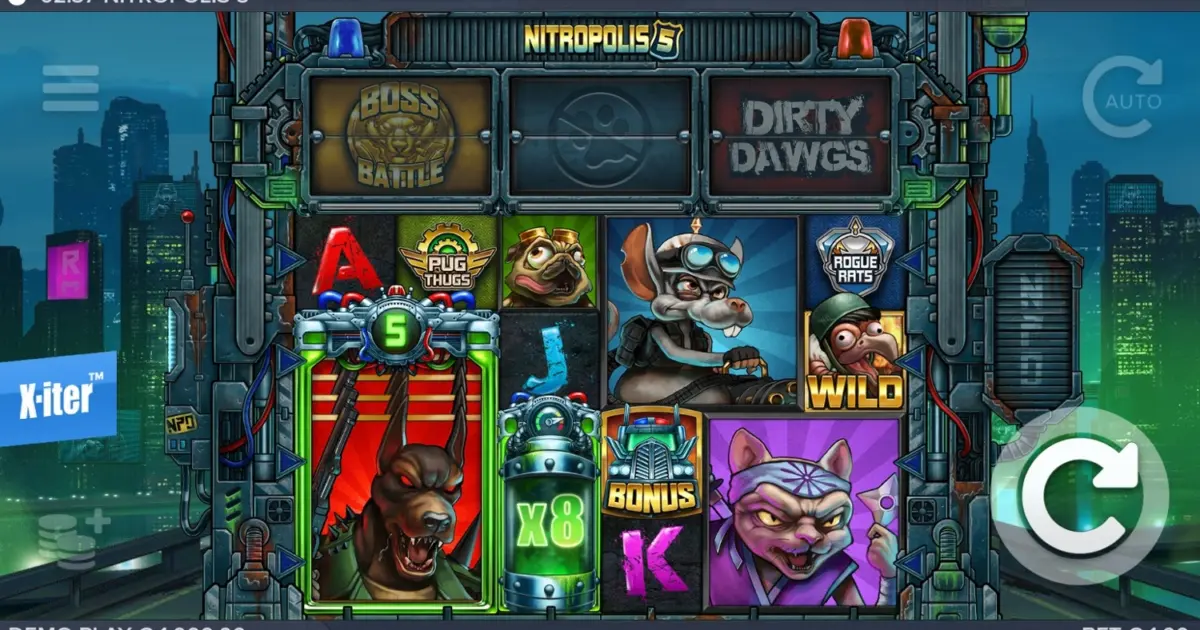
ELK Studios have not published a row count or a grid shape for this title in the data available here, so the exact number of positions is unknown. That matters more than it sounds. A six-reel grid can be three rows deep or seven, and the total position count drives how often anything lands at all. Without it, you cannot calculate the grid size yourself.
What you can take from the reel count is a general expectation: wider grids usually mean the game is built around either long left-to-right chains or a cluster or ways structure rather than a small fixed set of lines. Many six-reel releases go the ways route. That is a pattern across the format, not a confirmed fact about this game. The demo will show you the real layout in a few seconds, which is the fastest way to resolve it.
| Provider | ELK Studios |
|---|---|
| RTP | 94.0% |
| Reels | 6 |
| Theme | Technology |
| Max win | 50,000x |
| Free demo | Yes |
| Site-wide average RTP | 95.71% |
Paylines, ways and how the Nitropolis 5 slot pays
No payline or ways figure has been published for this title in the available data. That is a genuine gap, because the payline structure is the single thing that tells you how a win is formed.
In general terms, slots resolve wins one of three ways. Fixed paylines run set paths across the reels, and a symbol only counts if it sits on one. Ways or “all ways” systems count every combination of matching symbols on consecutive reels from the leftmost column, which produces a large headline number — 15,625 ways on a six-reel, five-row grid, for example. Cluster systems ignore lines entirely and pay for groups of adjacent symbols.
Each structure feels different to play even at identical RTP. Fixed-line games tend to produce more frequent, smaller returns. Ways and cluster games often concentrate value in fewer, larger outcomes. Since none of these is confirmed here, treat any site that states a specific ways count for this game as unverified.
The same applies to features. Wilds, scatters, free-spin rounds and buy features are standard tools across modern slots, but nothing in the published data confirms which, if any, appear in this release. No maximum win multiplier has been published either — the figure in the source data is malformed and unusable, so any “max win” number you see quoted elsewhere deserves scepticism until ELK Studios publish one.
94% RTP put in context
Return to player is a long-run statistical average, not a session forecast. At 94%, the theoretical return is £94 for every £100 wagered across a very large sample of spins — millions, not hundreds. Your own results over an evening will scatter widely either side of that, in both directions.
The useful way to read it is as a cost estimate. Wager £1 per spin for 500 spins and you have staked £500; the theoretical house edge of 6% puts the expected cost of that session at around £30. Compare that with a 96% game, where the same £500 carries an expected cost of £20. The gap grows with volume.
Context from the numbers here: this sits level with ELK Studios stablemates Pirots 3 and the earlier Nitropolis 4, both also at 94%. That consistency suggests a deliberate studio choice rather than an outlier. If the return figure is your deciding factor, Peak Power publishes 96.02% — two full points better, which roughly halves the theoretical cost per £100 staked.
Volatility and hit patterns
No volatility rating has been published for this title, and no hit frequency either. Both are absent from the data, so the honest answer is that the swing profile is unknown until you watch it run.
What volatility describes is the shape of the distribution around the RTP figure. Low volatility means frequent small returns, a balance that drifts down gradually, and sessions that last a long time on a modest bankroll. High volatility means long stretches with nothing followed by occasional outsized outcomes; the same bankroll can empty in a fraction of the time, and the RTP figure only asserts itself over far more spins. Medium sits between.
Two games with identical 94% returns can therefore feel nothing alike. That is why the demo is worth twenty minutes before you commit money — you can observe the rhythm directly rather than trusting a label.
One thing to be clear on regardless of volatility: every spin is an independent event. A run of dead spins does not build anything up, and a good run does not use anything up. No slot is ever due, warm or cold, and no pattern in past spins carries information about the next one.
Choosing a stake between the game’s minimum and maximum
The stake range is not published in the data available, so specific minimum and maximum bet figures for this title cannot be quoted. The demo screen will display the actual range in the bet selector.
The method for choosing within whatever range you find is straightforward arithmetic. Decide the total you are willing to spend first, then decide roughly how long you want it to last, then divide. A £60 budget across an intended 300 spins points at £0.20 per spin. A £60 budget at £2 a spin gives you 30 spins before variance decides everything.
At a 94% return the expected cost scales directly with stake size, so doubling your bet doubles the theoretical cost per hour without changing the underlying percentage. Stake size controls exposure, not odds. No progression, sequence or timing of bets alters the expected value of a single spin, because the maths of each spin is fixed and independent of the last.
Demo play versus real money
A free demo is available for this title, playable in a browser with no download. The demo runs the same mathematical model as the real-money version, which makes it a legitimate way to learn the grid, the symbol set and the pace before any money is involved.
What it cannot do is predict your real-money results. Demo credits carry no value and cannot be withdrawn or converted, and a good or bad run in demo mode tells you nothing about what follows when you switch. Variance does not carry across, because there is nothing to carry.
Slots are paid entertainment, not income. This is 18+ only. Set a budget before you start that you would be comfortable losing entirely, treat it as the price of the session rather than a stake you expect back, and stop when it is gone rather than topping up.
Verdict on Nitropolis 5
The clearest fact about this release is its 94% return, and it is the one worth weighing hardest. Against a 95.71% catalogue average, you are accepting a higher theoretical cost per hour than most alternatives offer, and the gap is wide enough to notice over a few hundred spins.
Beyond that, the published record is thin. No volatility rating, no payline or ways count, no stake range, no usable maximum win figure. That is not a criticism of the game itself, but it does mean the demo carries more weight than usual here — it is the only reliable way to see how the six reels actually behave.
Play it free, watch the swing pattern, and decide whether the design earns the two-point RTP concession you are making against titles like Peak Power. If it does, you have an informed choice. If it does not, there are 137 other ELK Studios titles and a full catalogue averaging better returns.
Sources. Volatility, max win: Bigwinboard, checked 27 Nov 2026.
More from ELK Studios
- Pirots — 94.0% RTP
- Pirots 3 — 94.0% RTP
- Nitropolis 4 — 94.0% RTP
- Katmandu X — 95.0% RTP
- Nitropolis 3 — 95.0% RTP
- Pirots 4 — 94.0% RTP
Frequently Asked Questions
Can I play Nitropolis 5 for free without downloading anything?
A free demo of Nitropolis 5 is available and runs in a browser, so there is no download or install required. It uses the same 94% RTP model as the paid version, which makes it a useful way to see the six-reel grid and the pace of play before committing any money.
What does the 94% RTP on Nitropolis 5 actually mean for me?
It means a theoretical return of £94 per £100 wagered, measured across a very large sample of spins rather than a single session. Practically, the 6% house edge implies an expected cost of about £30 on 500 spins at £1. Your individual results will vary widely either side of that.
How volatile is Nitropolis 5?
ELK Studios have not published a volatility rating for this title, so the swing profile is unknown from the data alone. Volatility determines whether returns arrive as frequent small amounts or rare larger ones, and two 94% games can feel completely different. Watching the demo for twenty minutes is the practical way to gauge it.
Who are ELK Studios and what else do they make?
ELK Studios are the developer behind this release and have 138 titles catalogued here, averaging 94.92% RTP. Their range includes the Pirots series — Pirots, Pirots 3 and Pirots 4 all publish 94% — plus the earlier Nitropolis 4, also at 94%. That consistency points to a deliberate studio-wide return setting.
How does Nitropolis 5 compare to Peak Power?
Peak Power publishes 96.02% RTP against 94% here, a gap of just over two percentage points. On £500 staked, that is roughly £20 expected cost versus £30. Peak Power shares the Technology theme grouping, so if return figures drive your choice, it is the stronger option on paper.