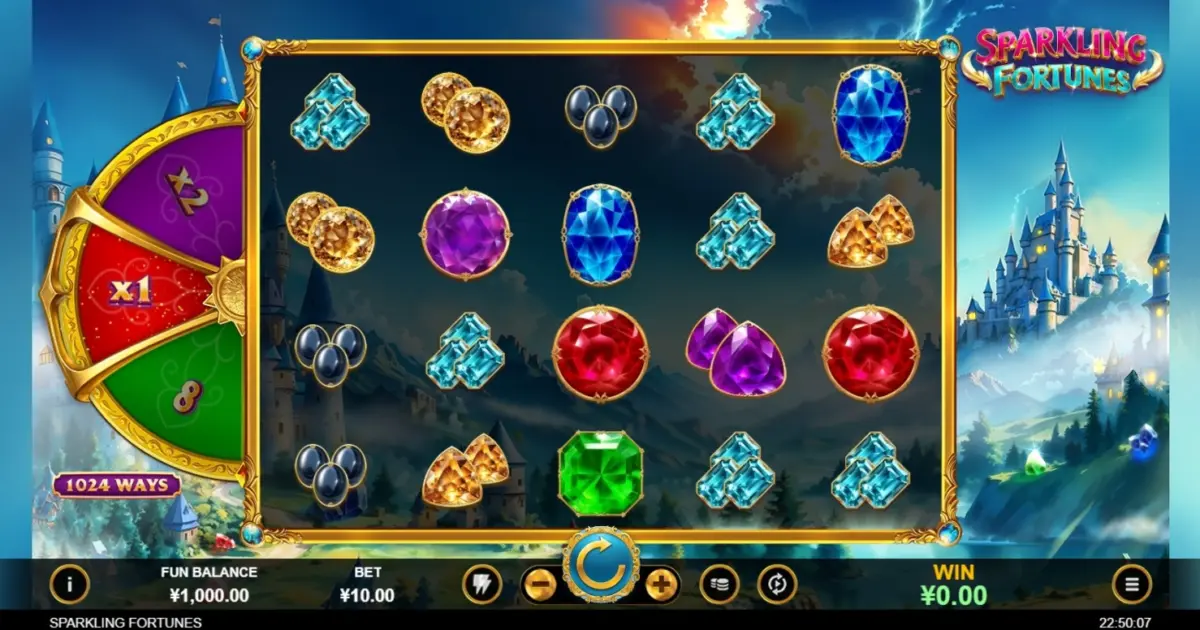
The honest answer on the sparkling fortune slot is that you are being asked to play without the two numbers that matter most. RTG Slots has not published an RTP percentage or a volatility rating for this title, so there is no way to say what it returns over a long sample or how violently your balance will swing. What you do get: five reels, a gems and diamonds theme, and a free demo you can run at zero cost.
That makes it a reasonable game to try and a difficult game to commit real money to. Below is everything FACTS actually supports, plus the maths you can apply yourself.
Sparkling Fortune versus the average slot
Across the games catalogued on this site, the average published RTP sits at 95.71%. RTG Slots’ own published average across its titles is 95.75% — effectively the same figure, four hundredths of a percentage point apart. Neither number tells you anything reliable about this specific release, because this specific release has no published RTP at all.
It is worth being precise about what that gap would mean if it applied. At 95.71%, a very large volume of wagering returns about £95.71 for every £100 staked. At 95.75%, about £95.75. Over 10,000 spins at £1 a spin, that difference amounts to roughly £4 in theoretical return — statistically real, practically invisible next to normal variance.
The more useful comparison is not against an average but against games that publish their figures. A slot advertising 97.1% has a theoretical house edge of 2.9%; an unpublished slot could sit anywhere. If you value knowing your terms before you stake, an untested unknown is a weaker proposition than a mid-table known quantity, regardless of how the unknown eventually turns out.
RTP breakdown: the sparkling fortune slot figure in context
There is no figure to break down. RTG Slots has not published a return-to-player percentage for this game, so any number you see quoted for it elsewhere should be treated as unsourced until the studio confirms it.
Here is what to do with that. RTP is a long-run theoretical average, calculated across millions of simulated spins. It is not a promise about your session, your hour, or your hundred spins. A 96% game and a 94% game can both take your bankroll in twenty spins, and both can pay above expectation over a short run. The percentage only asserts itself across sample sizes far larger than any individual plays.
So a missing RTP does not mean the game is unfair. It means you cannot compare it on the one dimension that is directly comparable between slots. Many operators display RTP inside the game’s information panel even when the studio does not publish it publicly, so check the paytable screen in the demo before assuming the figure is unavailable everywhere.
| Feature | Detail |
|---|---|
| Game name | Sparkling Fortune |
| Provider | RTG Slots |
| Reels | 5 |
| Type | Slot Machine |
| Primary theme | Gems and diamonds |
| Other theme tags | 5-Reels, Fortune |
| Published RTP | Not published by RTG Slots |
| Published volatility | Not published by RTG Slots |
| Provider average RTP | 95.75% across 32 titles |
| Site-wide average RTP | 95.71% |
| Popularity rank | 2,552 (87.2nd percentile) |
| Free demo | Available |
Volatility profile
Also unpublished. No low, medium or high rating has been assigned to this game, and there is no hit frequency figure either, so your bankroll planning has to be based on observation rather than a label.
The categories still matter, so it is worth knowing what you are looking for. Low volatility generally means frequent small returns, long sessions from a modest balance, and few results far above your stake. High volatility means long stretches returning nothing, punctuated by larger results, and a bankroll requirement several times higher for the same number of spins. Medium sits between, which is where most five-reel releases land.
You can estimate the profile yourself in the demo. Run 200 spins at a fixed stake and count how many return anything at all. Roughly one in three or better suggests a lower-variance design; closer to one in five or worse points the other way. Note the largest single result relative to your stake as well — a game whose best outcome in 200 spins is 8x your bet behaves very differently from one that produced 60x.
One caveat: 200 spins is a small sample, and every spin is an independent event. Your estimate is a rough sketch, not a specification.
RTG Slots as a studio
RTG Slots has 32 titles catalogued here, with a published average RTP of 95.75% — marginally above the 95.71% site-wide average, which puts the studio squarely in the middle of the pack rather than at either extreme. A 32-game library is modest; large studios run into the hundreds.
The pattern visible in the studio’s catalogue is a preference for straightforward slot machine builds across familiar theme territory. Cash Chalet is another RTG Slots release with no published RTP figure, which suggests the missing data here is a studio-wide documentation habit rather than something specific to this game.
Practically, that gives you two options. Either you accept the studio average of 95.75% as a loose expectation and understand it carries no guarantee for this individual title, or you stick to games that publish per-title figures. Neither choice is wrong. The first trades certainty for access to the catalogue; the second narrows your options but lets you compare house edges directly before you stake anything.
Three Gems and diamonds alternatives worth comparing
The gems and diamonds category runs to 484 titles on this site, so there is no shortage of comparison points — including several that publish the numbers this one does not.
Love Gems Hold and Win publishes 97.1% RTP, the strongest figure of the three and roughly 1.4 percentage points above the site-wide average. On £100 of turnover that is about £1.40 more in theoretical return; across 5,000 spins at £1 it is closer to £70. Joker’s Jewels publishes 96.5%, still comfortably above the 95.71% average and a well-known reference point in the gems category. Gemonex sits in the same theme bracket but, like this game, has no published RTP, so it faces the same limitation.
The takeaway is not that the higher-RTP games will pay you more this session. Variance dominates any individual run. The takeaway is that a 2.9% house edge is a better published set of terms than an unstated one, and you can see that before committing a penny.
Getting the most out of the free demo
The Sparkling Fortune free demo runs on play-money credits, which makes it the right place to answer the questions the missing data leaves open. Check the paytable for an in-game RTP statement. Note the stake range the game actually allows, since that determines whether your real bankroll supports the session length you want. Count hit frequency over a few hundred spins and watch how far the balance drifts between returns.
What the demo cannot do is predict real-money results. Demo credits carry no cash value, and a strong or dreadful demo run tells you nothing about the next session, because each spin is independent of every spin before it. No stake pattern, timing choice or progression alters the mathematics.
Slots are 18+ entertainment. Decide what the session is worth to you before you start, treat that amount as the price of the entertainment rather than an investment, and stop when it is gone. If it stops feeling like a choice, that is the signal to step away and look into support options.
Should you play Sparkling Fortune?
Try the demo; think twice before staking. The gap between those two positions is the whole review. A free run costs you nothing and answers several of the questions RTG Slots has left blank, so there is no downside to loading it.
Real money is a different calculation. You would be staking without knowing the house edge or the variance profile, on a game from a 32-title studio averaging 95.75%. Its rank of 2,552 places it in the 87.2nd percentile by popularity here, so it is not obscure, but popularity is not a substitute for a published RTP.
If you want documented terms, the gems category offers them — 97.1% and 96.5% options are one click away. If you are happy to judge a game on how it plays rather than what it prints, the demo is waiting and the numbers you gather there are your own.
Frequently Asked Questions
Can I play Sparkling Fortune for free?
A free demo is available, running on play-money credits rather than cash. It is the practical way to inspect a game that publishes neither an RTP nor a volatility rating, since you can check the in-game paytable, note the stake range and count how often spins return anything before deciding whether to stake real funds.
What is the RTP of Sparkling Fortune?
RTG Slots has not published an RTP figure for this title, so treat any percentage quoted elsewhere as unsourced. For context, the studio averages 95.75% across its 32 games and the site-wide average is 95.71%. Neither figure applies to this specific release, though the in-game paytable may state one.
Is Sparkling Fortune high or low volatility?
No volatility rating has been published, and there is no hit frequency figure either. You can estimate it in the demo: run a couple of hundred spins at a fixed stake, count how many return anything, and note the largest result relative to your bet. Small samples give rough sketches only.
Who makes Sparkling Fortune and what else do they produce?
RTG Slots, a studio with 32 titles catalogued here and a published average RTP of 95.75% — fractionally above the 95.71% site-wide average. Their catalogue leans toward straightforward slot machine builds; Cash Chalet is another release that, like this one, carries no published RTP figure.
How does Sparkling Fortune compare to Joker's Jewels?
Joker's Jewels publishes 96.5% RTP, roughly 0.8 percentage points above the site-wide average, while this game publishes no figure at all. That makes the comparison one of documentation rather than performance: you can calculate the theoretical house edge on one and not the other before staking anything.