The short answer: this is a five-reel Push Gaming release with a published RTP of 96.47%, and a free demo is available, so you can look at it without staking anything. That RTP sits above both the studio’s own 96.32% average and the 95.71% average across every game in our database. What is not published is the volatility rating or the stake range, and that absence matters more for session planning than most single numbers do.
The rest of this review sticks to what is documented. Where the data stops, it says so, because a gap in a provider’s published figures is information too. If you want a run-down of the boss bear slot numbers before anything else, the table further down collects them in one place.
The 5-reel grid explained
Five reels is the default shape of the modern video slot, and it has been since the format moved off mechanical drums. The reel count on its own tells you very little about payouts, but it does tell you something about structure. Five columns give a designer enough horizontal space to run left-to-right combinations of three, four and five matching symbols, which is why five-reel games typically have a wider spread of small, medium and large wins than a three-reel machine, where a line either hits or it does not.
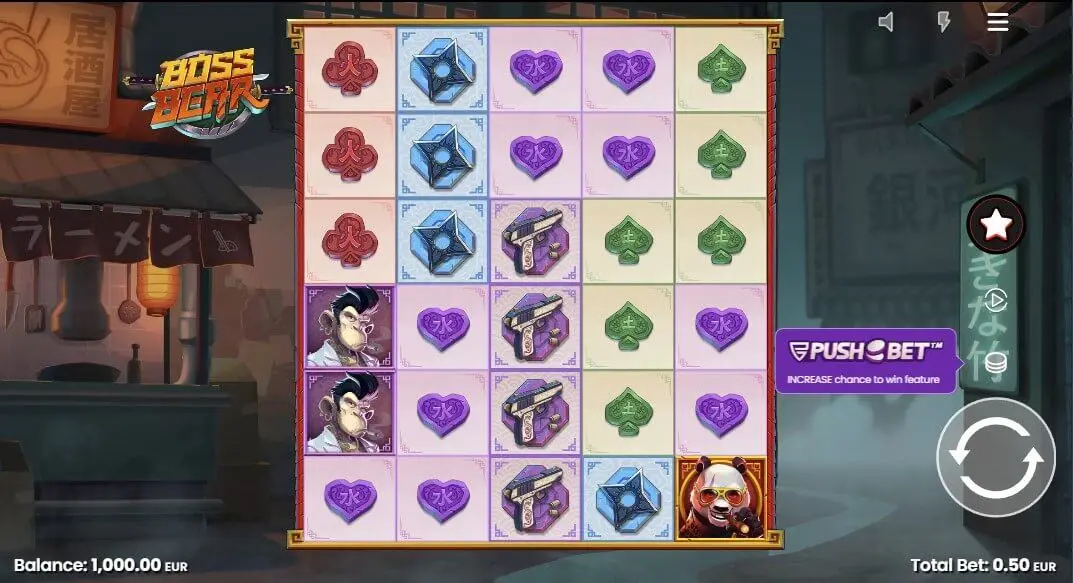
Push Gaming has not published the row count for this title, so the total number of grid positions is unknown. That is a genuine limitation. A five-reel game with three rows behaves differently from a five-reel game with four or five rows: more positions generally mean more possible symbol combinations per spin, and designers usually rebalance symbol frequencies to compensate. Without the row count, you cannot reconstruct the grid from the reel count alone.
What the five-reel label does confirm is that this is a conventional spinning-reel format rather than a cluster or cascading grid. Beyond that, the demo is the only reliable way to see the layout.
| Provider | Push Gaming |
|---|---|
| RTP | 96.47% |
| Reels | 5 |
| Theme | Asian |
| Free demo | Yes |
| Site-wide average RTP | 95.71% |
Paylines, ways and how Boss Bear Slot pays
The payline count for this game is not in the published data, so anything specific about how combinations are counted here would be a guess. What can be said is how these systems work in general, because the mechanics are standardised across the industry.
Fixed-payline games define a set number of paths across the reels. A combination pays only if matching symbols land on one of those defined paths, and you stake across all of them on every spin. “Ways” or “all-ways” games drop the path concept entirely: any matching symbols in adjacent columns pay, regardless of vertical position, which is where numbers like 243 ways or 1,024 ways come from. Cluster games ignore columns and pay on groups of touching symbols.
Many five-reel slots also include wilds that substitute for standard symbols, scatters that pay from any position, and a free-spins round triggered by a set number of scatters. Some modern releases add a buy-feature option. None of those are confirmed features of this title, and you should not assume any of them are present. The demo will show you the paytable, which is the only authoritative source for the payline structure, symbol values and any features the game actually contains.
96.47% RTP put in context
Return to player is a long-run statistical average, not a session promise. A 96.47% figure means that across a very large number of spins, the game is modelled to return £96.47 for every £100 wagered, leaving a house edge of 3.53%. Over 1,000 spins at £1 a spin, £1,000 wagered would return about £965 on average — but the spread around that average is wide, and a thousand spins is a small sample in statistical terms. Every spin is independent of the last, and no number of previous results makes any particular outcome more likely.
The comparative picture is favourable. The average RTP across all 69 Push Gaming titles in our database is 96.32%, so this release is marginally above the studio’s own norm. Against the 95.71% average for every game we hold, it is 0.76 percentage points better, which over £10,000 of total wagering is roughly £76 less expected loss. That is a real difference, though a small one next to the variance of individual sessions.
Within the studio’s catalogue, Retro Tapes is published at the identical 96.47%, while Fat Banker runs marginally lower at 96.43%. If a higher headline number is what you are after, the Asian-themed Wong Choy is listed at 96.74%.
Volatility and hit patterns
No volatility rating has been published for this game, and no hit frequency either. That is worth stating plainly rather than glossing over, because volatility affects your experience more directly than RTP does. Two games can share a 96.47% return and feel nothing alike.
Low-volatility games pay small amounts often. Balances drift rather than lurch, sessions last longer on a given bankroll, and the biggest available outcomes are modest. High-volatility games pay rarely but larger. Long stretches with no return are normal rather than exceptional, and a bankroll that survives an hour of a low-variance game can be gone in ten minutes. Medium volatility sits between the two.
Because the rating here is unknown, treat the game as if it could be high variance until the demo tells you otherwise. Practically, that means a smaller unit stake than you would otherwise pick, so that a dry run of fifty or a hundred spins does not end the session. Watching the demo balance move over a few hundred spins gives you a rough feel for the swing size, though it is not a measurement and it will not predict anything.
Choosing a stake when the range is unpublished
Push Gaming has not published minimum or maximum bet figures for this title, so treat any stake range you see quoted elsewhere with caution and check the game’s own bet menu instead. Ranges also vary by operator and by currency, so even a correct figure from one site may not match what you see.
The planning method does not depend on knowing the range in advance. Decide the total you are willing to spend first, then divide. If you want a session of around 200 spins, your unit stake is your budget divided by 200. A £20 budget gives £0.10 a spin; a £100 budget gives £0.50. If the game’s minimum is above the figure you arrive at, your budget is too small for a session of that length, and the honest response is to shorten the session or pick a different game, not to raise the stake.
Stake size does not alter the 3.53% house edge. It scales the amounts up and down proportionally, and larger stakes mean the expected cost per hour rises in step. No staking pattern, progression or timing changes the expected value of a single spin.
Demo play versus real money
A free demo is available for this game, which means you can see the paytable, the grid layout, any features and the actual bet range without funding an account. That is the most efficient way to fill the gaps this review has had to flag. Demo mode runs the same mathematical model, so it is honest about mechanics — but it cannot predict your real-money results, and a good or bad demo run tells you nothing about what follows. It also removes the one thing that changes behaviour most: money at risk.
If you do move to real stakes, slots are 18+ and are paid entertainment, not a way to make money. Set a budget you are comfortable losing before you start, treat it as the price of the session, and stop when it is gone rather than topping up. If it stops being enjoyable, close it.
Verdict on Boss Bear
The case for playing is the return figure. At 96.47%, this sits above the studio average and comfortably above the wider average for the games we track, and it matches the best-published number in Push Gaming’s catalogue. On the maths alone it is a reasonable pick, and popularity backs that up: it ranks 2,518th overall, placing it in the top 13% of titles by traffic.
The case for caution is the missing data. Without a volatility rating, a row count, a payline structure or a stake range, you cannot plan a session from the published figures alone. The free demo closes that gap in a couple of minutes, which is where anyone seriously considering this game should start. For a like-for-like alternative within the same studio, Dinopolis is listed at 96.40% and lands within the same narrow RTP band, so the choice between them comes down to how each one plays rather than to the numbers.
More from Push Gaming
- Retro Sweets — 96.49% RTP
- Dinopolis — 96.4% RTP
- Razor Ways — 96.36% RTP
- Retro Tapes — 96.47% RTP
- Fat Banker — 96.43% RTP
- Mystery of the Nile — 96.35% RTP
- Bison Battle — 96.4% RTP
Frequently Asked Questions
Can I play Boss Bear for free?
A free demo is available for this game, so you can see the paytable, grid layout and bet menu without depositing. The demo runs the same mathematical model as the real-money version, including the 96.47% RTP, but it awards no cash and results from a demo run do not predict real-money outcomes.
What is the RTP of Boss Bear and is it good?
The published RTP is 96.47%, meaning a modelled return of £96.47 per £100 wagered across a very large sample and a house edge of 3.53%. That is above Push Gaming's 96.32% studio average and 0.76 points above the 95.71% average across all games in our database, so it compares well.
Is Boss Bear high or low volatility?
Push Gaming has not published a volatility rating for this title, so there is no confirmed answer. Because a game at 96.47% RTP can be built as low or high variance, the safer approach is to assume high variance and size your stake so a hundred spins fits inside your budget until the demo suggests otherwise.
Who makes Boss Bear and what else do they produce?
Push Gaming developed it. We hold 69 of their titles, with an average published RTP of 96.32%. Their catalogue includes Retro Tapes at 96.47%, Fat Banker at 96.43% and Dinopolis at 96.40%, so this release sits at the upper end of a fairly tight RTP band across the studio's output.
How does Boss Bear compare to Wong Choy?
Wong Choy carries the higher published RTP at 96.74% against 96.47% here, a difference of 0.27 points, or about £27 in expected return per £10,000 wagered. Both are Asian-themed five-reel games. Neither has a published volatility figure in our data, so the demos are the only way to compare how they actually play.