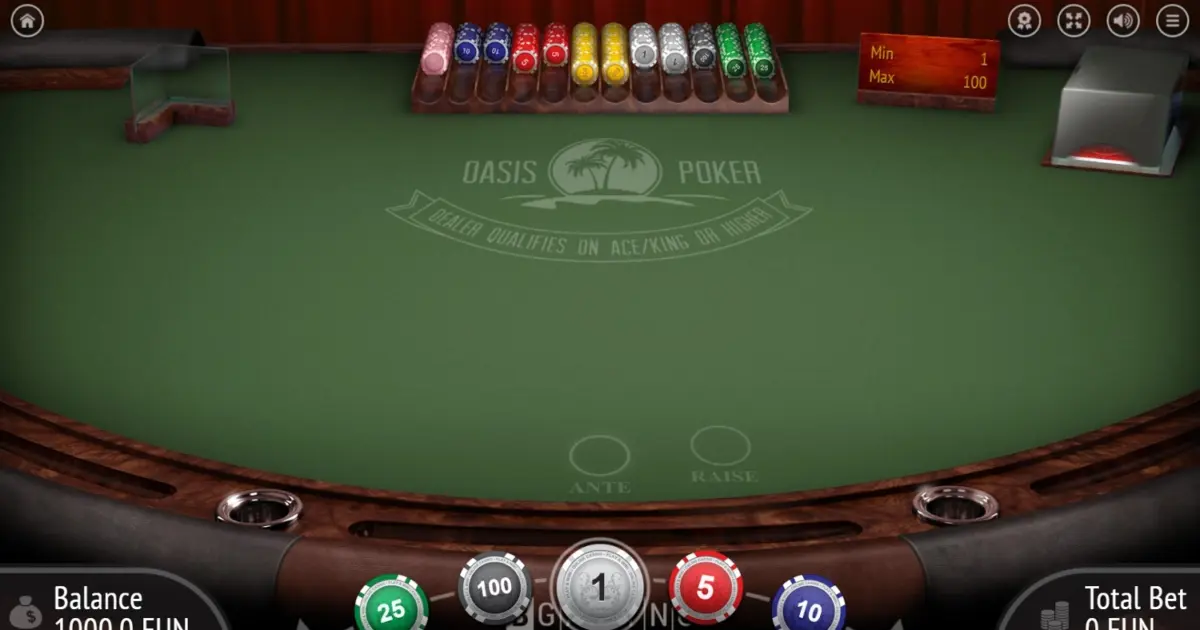
If you want a five-card poker game you can open and learn without staking anything, oasis poker (bgaming) is playable in free demo mode, which is the honest starting point here. What this listing does not give you is the RTP figure or the paytable, and in video poker those are not decorative details — they are the whole return calculation. Treat the demo as your chance to photograph the pay chart before you decide whether the real-money version deserves your budget.
That absence is not a reason to avoid the game. It is a reason to do thirty seconds of reading inside the game client first, which is more than most players do.
Oasis Poker (BGaming) and the BGaming game range
BGaming has four titles in the video poker section of this site, which makes it a focused rather than sprawling range. This one sits at rank 22 overall and in the 85th percentile for popularity, so it gets played, but it is not the studio’s headline poker product.
The name is worth reading carefully. Oasis Poker is normally a table-style five-card poker format played against a dealer, with an ante, a call decision and — in most rulesets that carry the name — the option to exchange a card for an extra fee. That is a different shape from a solitaire draw machine, where you hold and discard against a fixed pay chart. Because this listing does not spell out which ruleset BGaming has implemented, the safe reading is: the title tells you the family, not the exact rules table.
If you want a straight draw-poker baseline to compare against, Jacks or Better (BGaming) is the reference point, since Jacks or Better is the most solved and most documented paytable in the category. Caribbean Poker (BGaming) is the closer relative in format, being another dealer-versus-player five-card game, and it is the useful side-by-side if you want to see how the same studio handles a similar decision set.
The unpublished RTP figure and the strategy it assumes
There is no RTP number in this listing for this game. For context, the average across the video poker titles catalogued on this site is 97.5%, but that is a corpus average and tells you nothing reliable about this specific table.
Here is why the gap matters more than it would for a slot. A published video poker RTP is always a conditional figure: it is the return you get if you play every hand to the mathematically optimal decision chart for that exact paytable. Play the same game casually and your realised return sits below the quoted number, sometimes by more than a percentage point. The figure is not a promise, it is a ceiling attached to a specific standard of play.
The second half of the condition is the paytable itself. Change one payout line and the whole calculation moves. So a quoted RTP without a paytable is only half a fact, and a paytable without an RTP is at least something you can reason about. Since this listing gives neither, the in-game pay chart is your only source. Open the demo, find the help or paytable screen, and read the payout schedule and the ante or exchange costs before you commit money.
Which hands to hold, in general terms
In a draw-poker machine, optimal play is a published hold/discard chart. It ranks every possible five-card deal and tells you which cards to keep. Nothing about it is secret or proprietary — it is solved maths, and it changes which cards you keep, never the odds inside the deck.
The general shape of those charts is consistent across paytables. Made hands that already pay get kept. Four cards to a royal flush usually outrank a made flush, because the top prize is large enough to justify breaking a smaller win. Four to a straight flush is a strong hold. Low pairs are typically kept over three cards to a straight. Single high cards are the fallback when a deal has nothing else. Discarding all five is correct more often than beginners expect.
What shifts between paytables is the ordering at the margins, and that is exactly where the money is. In dealer-versus-player formats like Oasis Poker, the decision set is different again: you are choosing whether to call, fold or pay to exchange a card, and the correct threshold for each depends on the ante-to-call ratio and the exchange price. Those numbers live in the pay chart, not in the game’s name.
Wild cards, bonuses and how they change the maths
The title does not identify a wild-card variant. Nothing here suggests deuces wild, a joker, or a bonus schedule paying extra for specific four-of-a-kind ranks, and this listing does not state that any of those features exist. So do not assume them.
It is still worth knowing what those features do, because it explains why the pay chart is the document that matters. Deuces Wild makes all four 2s substitute for any card and pays only from three of a kind upward, which produces frequent small results and a strategy chart built entirely around holding wilds. Joker Poker adds a joker as wild or as a bonus card depending on the ruleset. Bonus and Double Bonus paytables pay premiums on particular quads, which changes which four-card draws are worth chasing. Every one of those features is funded by trimming payouts elsewhere on the chart.
That is the pattern to watch for. A headline feature that looks generous is usually paid for by a quieter reduction on a common hand like the full house or the flush — and common hands hit far more often than headline ones, so the trade is rarely as good as it looks.
Why the paytable matters more here than variance in slots
Video poker is dealt from a freshly shuffled 52-card deck every hand. There is no reel weighting and no hidden symbol frequency, which is the structural difference from a slot: you can count the outs yourself. Every deal is independent, so no deck is ever due, warm or cold, and nothing in a previous hand carries forward.
The classic illustration of how much the pay chart matters: Jacks or Better on a 9/6 schedule — nine-for-one on the full house, six-for-one on the flush — returns roughly 99.5% with perfect play. The same game on 8/5 falls to about 97.3%. On 6/5 it drops below 95%. Two numbers, more than four percentage points of swing.
| Hand | Jacks or Better 9/6 | Jacks or Better 8/5 |
|---|---|---|
| Full house | 9 for 1 | 8 for 1 |
| Flush | 6 for 1 | 5 for 1 |
| Straight | 4 for 1 | 4 for 1 |
| Three of a kind | 3 for 1 | 3 for 1 |
| Approximate optimal return | 99.5% | 97.3% |
Those figures are the well-known general benchmarks for Jacks or Better, not this game’s numbers. They are here to show you the size of the effect you are checking for.
On variance: poker variants swing harder than their RTP suggests, because a large share of the return sits in rare top hands. Multi-hand formats do not change the per-hand return at all — they change how fast your bankroll moves and how many hands you play per session.
Playing responsibly
Video poker is 18+ and it is entertainment you pay for, not income. Set a budget before you open the game, decide what you are willing to spend on the session, and stop there whether the cards have been kind or not. No staking pattern changes expected value — not doubling after a loss, not raising after a win, not switching bet size on a hunch. The deck does not know what you staked last hand.
Demo play is genuinely useful for learning a decision set and reading a pay chart, and it costs nothing. It does not predict real-money outcomes, and a good or bad run in the demo tells you nothing about the next session.
Verdict on Oasis Poker (BGaming)
Worth a look in demo, with a specific job to do while you are there. Oasis Poker (BGaming) is free to play without download, sits comfortably in the top quarter of this section by popularity, and comes from a studio with a small, four-title poker range. What it does not come with, in this listing, is an RTP figure or a paytable — and in a category where the return is fully determined by those two things plus your decision quality, that is the gap you need to close yourself.
So the practical sequence is: open the demo, find the pay chart, note the payout schedule and the cost of any card exchange, and play enough hands to understand the decision points without money involved. If the numbers on that chart look reasonable next to the general benchmarks above, you have a game you can play informed. If the pay chart is hard to find or vague, that is useful information too.
For a more documented starting point in the same studio’s range, Wild Texas is another poker-format title worth comparing on feel and pace before you settle on one.
Frequently Asked Questions
Can I play Oasis Poker (BGaming) for free?
Yes. Free demo mode is available for this title, and it needs no download. The demo is the practical place to read the in-game pay chart, learn the ante, call and card-exchange decisions, and get comfortable with the pace before you decide whether to stake real money on it.
What is the RTP of Oasis Poker (BGaming)?
This listing does not include an RTP figure for the game. For context, the video poker titles catalogued here average 97.5%, but that average says nothing reliable about this table. In video poker, return is set by the paytable plus optimal decision-making, so check the in-game pay chart directly.
Which poker variant is this and how is it played?
The name identifies it as an Oasis Poker format, normally a five-card game played against a dealer with an ante, a call-or-fold decision and, in most rulesets carrying that name, a paid option to exchange a card. The exact rules and costs for this version are not stated in this listing.
Why does the paytable matter so much in video poker?
Because it fully determines the return, alongside your play quality. Jacks or Better pays around 99.5% on a 9/6 schedule and roughly 97.3% on 8/5 — the same game, two changed numbers, more than two percentage points. No other casino game category is this sensitive to the pay chart.
How does it compare to Jacks or Better (BGaming)?
Jacks or Better is a solitaire draw machine where you hold and discard against a fixed pay chart, and its optimal strategy is the most thoroughly documented in the category. Oasis Poker is a dealer-versus-player format with different decisions. Neither game's RTP is published in this listing, so compare their in-game pay charts.