This is a playable free demo of the most-studied game in the casino, from a provider with a very small video poker catalogue. The one thing that matters most here is missing: FBM Digital Systems has not published the paytable or the return figure for this exact table. That is not a reason to skip the demo, but it is a reason to open the in-game pay chart before you ever bet real money, because in this game the pay chart is the return.
What kind of video poker is Jacks or Better?
The name does the work. Jacks or Better is the baseline five-card draw format: you are dealt five cards from a freshly shuffled 52-card deck, you choose which to hold, the discards are replaced, and the final hand is paid according to a fixed schedule. The defining rule is in the title — a pair only pays if it is jacks, queens, kings or aces. A pair of tens or lower returns nothing, which is why so many hands in this variant end as a push or a loss and why the game feels tighter than wild-card formats.
Because it is the plainest variant, Jacks or Better is also the one with the cleanest solved strategy. There is a published hold/discard chart for every version of the paytable, and following it is simply a matter of reading the right row. What that chart cannot tell you is what this specific table pays. FBM Digital Systems lists three video poker games in total and has not attached a payout schedule to this one, so the variant is identified but the numbers are not.
The maths of a single hand
Each deal starts from a full, freshly shuffled deck. There is no reel weighting, no symbol frequency table and nothing hidden behind the cards — the probability of being dealt any particular five-card combination is fixed by the deck itself and identical on every hand. That is what makes video poker unusually transparent compared with a slot: the randomness is fully specified, and the only variable left is what the machine agrees to pay you for each result.
Your decision on the draw is where skill enters. Holding four cards to a flush instead of a low pair, or breaking a made pair to chase a royal, changes your expected return by a measurable amount. Deviating from the optimal chart costs you money over time, but it does not change the deck and it cannot make a hand more or less likely to arrive. No hand is ever due. A long run without a straight does not raise the chance of the next one, and a recent four-of-a-kind does not lower it. Each deal is independent of every deal before it.
That independence also means no staking pattern alters your expected value. Raising your bet after a losing hand, or after a winning one, changes only how much money moves per hand and how quickly your session can swing.
Where the RTP comes from
FBM Digital Systems has not published an RTP for this table, so there is no figure to quote — and the honest answer is that quoting one from the variant name would be guesswork. In Jacks or Better the return is fully determined by two things: the paytable, and whether you follow the optimal strategy chart written for that exact paytable.
The scale of the paytable’s effect is larger here than in almost any other casino game category. The classic reference points come from just two lines on the chart, the full house and the flush payouts. A “9/6” schedule — nine coins for a full house, six for a flush, per coin bet — returns roughly 99.5% with perfect play. Change those two numbers to “8/5” and the same game, same deck, same strategy family, drops to about 97.3%. A “6/5” schedule falls well below 95%. Nothing else about the game changes. Two numbers move, and more than four percentage points of return moves with them.
For context, the average across the video poker titles listed on this site sits around 97.5%, which is the sort of figure a mid-tier paytable produces. Where this particular table lands is not something the listing can tell you.
Reading the pay chart before you bet real money
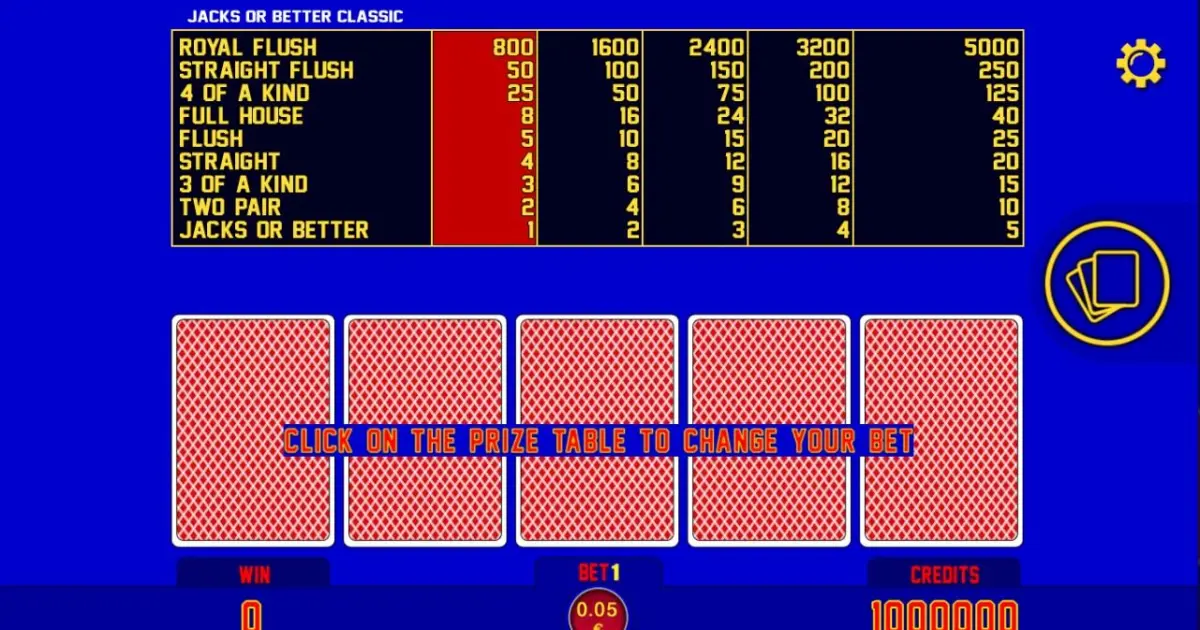
Open the pay chart in the game and read the full house and flush rows first. Those two lines will tell you more about the return than any review can. Then check the royal flush payout at maximum coins, since most Jacks or Better schedules pay a bonus on the royal only when all five coins are bet, and playing short-coin quietly costs you a chunk of the return.
The table below shows the two best-known reference schedules for this variant, in coins paid per coin bet. These are the general industry benchmarks, not this game’s confirmed numbers — use them as a yardstick against whatever the in-game chart shows you.
| Hand | 9/6 schedule | 8/5 schedule |
|---|---|---|
| Full house | 9 | 8 |
| Flush | 6 | 5 |
| Straight | 4 | 4 |
| Three of a kind | 3 | 3 |
| Two pair | 2 | 2 |
| Jacks or better | 1 | 1 |
If the chart in front of you pays less than five on a flush or less than eight on a full house, you are looking at a version well under the category average, and you should know that before your first real-money hand rather than after your fiftieth.
How Jacks or Better compares to other games
The two other video poker titles from this provider take the variance in opposite directions. Deuces Wild makes all four 2s wild and pays nothing below three of a kind, which produces far more frequent big hands and a much rougher ride between them — its strategy chart is built entirely around when to keep a deuce. Bonus Poker stays closer to this game but pays enhanced amounts on specific four-of-a-kind ranks, which changes which hands are worth breaking on the draw. Neither provider table publishes a return figure either.
If you want a same-variant comparison with a confirmed number, Jacks or Better (Red Rake Gaming) publishes a 99.55% return, which is a full-pay figure and a useful upper reference for how good this format can get. Same rules, same deck, same strategy — a documented return instead of an unknown one. This FBM Digital Systems table sits at rank 29 by popularity, in the top fifth of the video poker list here, but popularity is not a paytable.
Free demo and staying in control
A free demo is available, with no download and no account, and it is genuinely useful for this variant in a way it is not for a slot. You can drill the hold/discard decisions until the common spots become automatic, and you can read the pay chart at your own pace. What the demo cannot do is predict real-money results: the deck is random, so a good or bad demo run tells you nothing about what comes next.
Video poker is 18+. Decide what the session is worth to you before you start, treat that number as the price of the entertainment rather than a stake you expect back, and stop when it is spent. The game is something you pay to play, not a source of income.
Final verdict
As a place to learn or practise jacks or better video poker for free, this table does the job — the rules are the standard ones, the strategy is solved and publicly available, and the demo costs nothing. As a real-money proposition it is an open question, because the one number that decides the return has not been published. Open the pay chart, read the full house and flush lines, compare them against the 9/6 and 8/5 benchmarks above, and decide from there. If the numbers are good, this is one of the lowest-edge games on any casino floor. If they are not, a Jacks or Better table with a documented full-pay schedule is a better use of the same bankroll.
Frequently Asked Questions
Can you play Jacks or Better by FBM Digital Systems for free?
Yes, a free demo is available with no download and no account required. It is a useful way to practise the hold and discard decisions, since Jacks or Better has a solved optimal strategy chart. Demo results are random and do not predict real-money outcomes, so treat it as practice rather than a preview.
What is the RTP of this Jacks or Better video poker game?
FBM Digital Systems has not published an RTP figure for this table. In video poker the return is set entirely by the paytable and by playing the optimal strategy for that exact paytable, so the in-game pay chart is the only reliable source. For reference, video poker games listed here average around 97.5%.
Why does the paytable matter so much in Jacks or Better?
Because two lines on the chart can move the return by more than four percentage points. A 9/6 schedule, paying nine for a full house and six for a flush, returns about 99.5% with perfect play. The same game at 8/5 returns roughly 97.3%, and 6/5 versions fall below 95%.
What is the optimal strategy for Jacks or Better?
Jacks or Better pays only on a pair of jacks or higher, and every paytable has a published hold/discard chart telling you which five cards to keep in each situation. Following it maximises your return. It changes your decisions on the draw only, never the odds behind the freshly shuffled 52-card deck.
How does it compare to Deuces Wild from the same provider?
Deuces Wild makes all four 2s wild and pays nothing below three of a kind, giving it much higher variance and a completely different strategy chart. Jacks or Better is the steadier format, paying small returns on high pairs. Neither FBM Digital Systems table publishes a return figure, so check both pay charts.