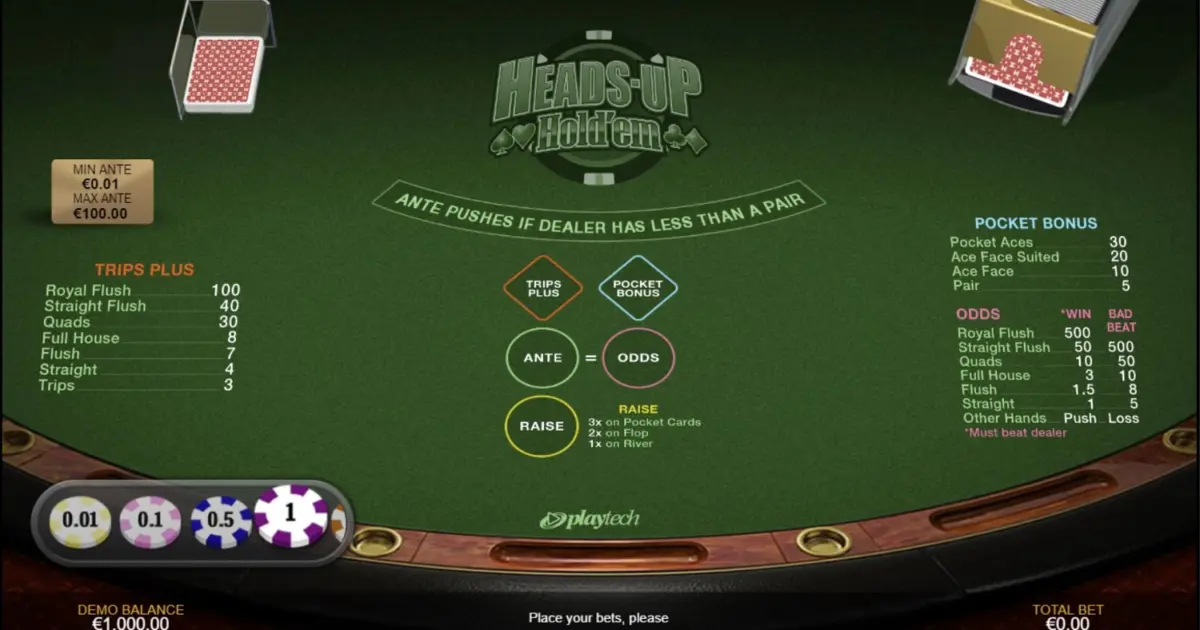
If you want a poker-hand game with a published return, heads-up hold’em video poker gives you one: Origins (Playtech) states an RTP of 97.64%, marginally above the 97.5% average across the video poker titles listed here. It is also free to play in demo mode, which is the sensible place to learn the hand rankings and the decision points.
What the listing does not give you is the pay chart. In this game category that matters more than almost anywhere else, so treat the 97.64% figure as a headline that the in-game rules screen needs to confirm.
What kind of video poker is Heads-Up Hold’em?
The title names hold’em rather than one of the classic draw variants, so do not assume Jacks or Better mechanics. Names like Jacks or Better, Deuces Wild, Joker Poker or Double Bonus Poker tell you a lot on sight: Jacks or Better pays only from a pair of jacks up; Deuces Wild makes every 2 wild and pays from three of a kind, with far higher variance; Joker Poker adds a joker as wild or bonus; Double Bonus and Bonus Poker pay extra for specific four-of-a-kind ranks, which changes which cards are worth keeping.
Origins has not published a rules breakdown for this exact table in the listing available here, so the specific decision structure, the hand ranks that qualify for a payout and the wager steps all need reading in-game. What is universal is the source of the cards: a freshly shuffled 52-card deck each hand, with no weighting behind individual cards and no hidden symbol frequencies of the kind a slot uses. Every card that can appear has the same chance of appearing as any other card left in the deck.
This is one of four video poker games from Origins (Playtech) on the site, and it sits in the 97th percentile for popularity here.
The maths of a single hand
Poker-hand games are the most transparent maths in the casino because two published things fully determine the return: the payout schedule for each hand rank, and whether you play the mathematically optimal hold or discard decision for that exact schedule. Nothing else is hidden in the model.
Optimal strategy in video poker is a solved chart, not a betting system. It tells you which cards to keep from the five in front of you, and that is all it changes. Deviating from it lowers your long-run return; it does not alter the deck, the shuffle or the odds of drawing any given card. No staking pattern of any kind changes expected value either, whether you flat-bet or vary the size of your wager.
Each deal is independent. A deck that has not produced a flush in two hundred hands is not more likely to produce one on the next deal, and a machine is never due, hot or cold. The card you draw is drawn from a full shuffle with no memory of what came before.
Where formats differ is variance. Multi-hand and multi-play layouts deal one set of cards and run your held cards across several independent decks at once. That multiplies the number of hands you play per session and widens the swings in both directions, but the per-hand return stays exactly what the paytable says it is.
Where the 97.64% comes from
The 97.64% figure is a long-run average across a very large number of hands, assuming correct play. It means roughly 2.36% of total wagered money is retained by the house over that span. It is not a session forecast, and short runs will land far above or far below it in both directions.
That number does the work of two components you cannot see separately here. The first is the payout schedule for each hand rank. The second is the assumption that you make the best hold decision available on every deal. If the stated return assumes optimal play and you play by feel instead, your actual return sits below 97.64%, and the gap can be large.
For context, Origins (Playtech) averages 97.82% across its four video poker titles listed here, so this game sits slightly below its own provider average while running 0.14 points above the 97.5% corpus average. Those are small margins. The bigger risk to your return is not the difference between 97.6% and 97.8%, it is playing a table whose pay chart you never checked.
Reading the pay chart before you bet real money
Here is the reason paytables dominate this category. In classic Jacks or Better, the 9/6 schedule pays 9-for-1 on a full house and 6-for-1 on a flush and returns about 99.5% with perfect play. The same game on 8/5 returns roughly 97.3%. On 6/5 it falls well below 95%. Two numbers on the chart move the return by more than four percentage points.
| Hand (per coin, Jacks or Better example) | 9/6 schedule | 8/5 schedule | 6/5 schedule |
|---|---|---|---|
| Full house | 9 | 8 | 6 |
| Flush | 6 | 5 | 5 |
| Straight | 4 | 4 | 4 |
| Three of a kind | 3 | 3 | 3 |
| Approximate return | ~99.5% | ~97.3% | below 95% |
Those figures are the well-known general Jacks or Better reference, not this game’s chart. Origins has not published the paytable for this exact version, and the paytable is what decides the return here far more than in most casino games, so open the in-game pay chart before you play for money and check what each hand rank actually pays.
How Heads-Up Hold’em compares to other games
Within the same studio, Deuces Wild is the higher-return option at 98.91%, though its wild-card structure means a strategy chart built around the 2s and noticeably choppier results. If you want a published draw-poker paytable and a gentler risk shape, Jacks or Better (Origins) is listed at 97.3%, close to the classic 8/5 return.
For a table-poker feel rather than a machine draw, Caribbean Stud Poker sits at 97.44%, a fraction under this game. The spread across all four Origins poker titles here is roughly 1.6 percentage points, and the highest return in the group is the Deuces Wild table.
Free demo and staying in control
Heads-Up Hold’em free demo play is available, and it is the right place to read the pay chart, learn which hands qualify and get comfortable with the decision points before any money is involved. Demo results tell you nothing about real-money outcomes, though; each deal is independent, and a good or bad demo run carries no information forward.
Play only if you are 18 or over. Set a budget before you start, and treat it as money you have already spent on entertainment rather than as income you expect back. A 97.64% return means the game is designed to keep a share of what you wager over time.
Final verdict
The 97.64% return is fine for the category, comfortably above the 97.5% average here and within a fifth of a point of the Origins house average. Popularity is high, and the free demo removes any reason to learn it with cash on the table.
The honest caveat is the missing pay chart. Without published payouts per hand rank, you cannot verify where the return comes from or work out the correct hold strategy from this listing alone. Open the rules screen in the demo, read the payouts, and if the higher published return matters more to you than format, the Deuces Wild table is the stronger number in this provider’s set.
Frequently Asked Questions
Can I play Heads-Up Hold'em for free without downloading anything?
Yes. A free demo of Heads-Up Hold'em is available with no download required, so you can read the in-game pay chart and get used to the hand ranks before wagering. Demo play uses the same shuffled deck logic, but past demo results say nothing about future real-money sessions.
What is the RTP of Heads-Up Hold'em Video Poker?
Origins (Playtech) lists 97.64%, a long-run average across a very large number of hands. In poker-hand games that figure comes from two things only: the payout schedule for each hand rank and whether you play the optimal hold decision every deal. Play by feel and your real return drops below 97.64%.
Which video poker variant is Heads-Up Hold'em?
The name points to hold'em rather than a classic draw variant, so it should not be assumed to follow Jacks or Better rules. Origins has not published the rules breakdown or paytable in this listing, so check the in-game rules screen for which hands qualify and how the decision points work.
Why does the paytable matter so much in video poker?
Because it fully determines the return alongside optimal play. Jacks or Better on a 9/6 chart returns about 99.5%, the same game on 8/5 roughly 97.3%, and on 6/5 below 95%. Two numbers move the return by four points, so verify the chart before betting.
How does Heads-Up Hold'em compare to Deuces Wild from the same provider?
Deuces Wild is listed at 98.91% against 97.64% here, so it returns more per wagered unit. The trade-off is variance and strategy: every 2 is wild, payouts start at three of a kind, and the hold chart is built around the wild cards, producing much choppier results.