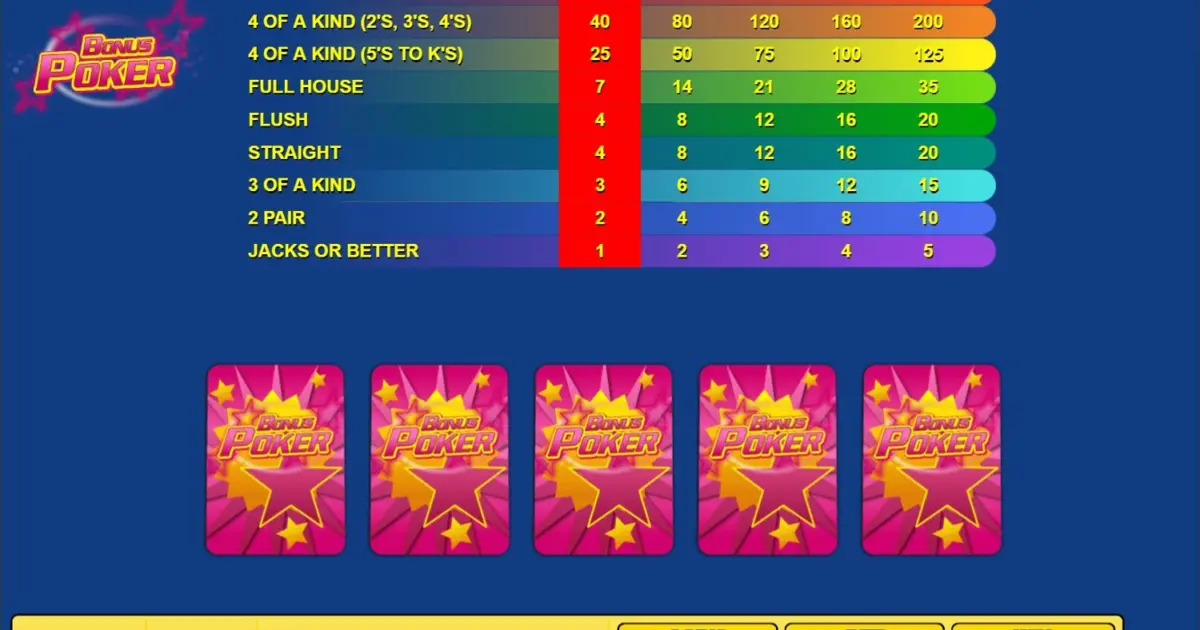
Bonus Poker (Habanero) sits inside the Bonus family of video poker variants, a group defined by elevated payouts on specific four-of-a-kind hands rather than a flat 25-for-1 return on quads of any rank. If you have played the standard nine-six Jacks or Better paytable and found the variance too gentle, Bonus Poker’s hand-ranking tweaks make it a worthwhile next stop. Habanero, a studio behind twelve video poker and table-game titles in our catalogue, has not published the exact pay schedule for this version, which is the single most important missing piece of information for a player deciding where to stake money.
Bonus Poker (Habanero) in one minute
The game deals five cards from a freshly shuffled 52-card deck, you choose which to hold, and the discarded positions are replaced. Your final five-card poker hand determines the payout according to the paytable displayed on-screen. Bonus Poker differs from Jacks or Better in its four-of-a-kind payouts: quads of aces pay the most (commonly 80 coins on a five-coin max bet), quads of 2s through 4s pay a middle tier (commonly 40), and quads of 5s through kings pay the standard 25. The royal flush, when played at maximum coins, pays a large fixed prize rather than a progressive jackpot. Because the variant sits between the low-variance Jacks or Better and the high-variance Deuces Wild, it attracts players who want meaningful top-end payouts without wild cards complicating the strategy chart.
Habanero’s implementation follows the single-deal, five-card format typical of their video poker portfolio, which you can compare against Joker Poker (Habanero), where a fifth wild joker reshapes both the strategy and the variance profile entirely.
What perfect strategy actually means here
In Bonus Poker the optimal hold/discard chart differs from Jacks or Better in one critical way: the enhanced four-of-a-kind payouts change the break-even thresholds for holding partial hands. A pair of aces, for instance, becomes significantly more valuable than a pair of twos, because holding aces with a kicker gives you a realistic shot at the premium 80-coin quads, while holding low pairs only reaches the 40-coin tier at best. The general hierarchy you memorise from a Bonus Poker strategy chart looks roughly like this:
- Royal flush, four-of-a-kind, full house, flush, straight (held complete)
- Three-of-a-kind, two pair, four cards to a royal flush
- Four cards to a straight flush (consecutive vs. gapped), one pair of jacks or better
- Three cards to a royal flush with a high card, four cards to a flush
- Two cards to a royal flush with a high card, three cards to a straight flush
- Any pair, four cards to a straight (open-ended vs. inside)
Deviating from this order costs roughly one to two percentage points of return over thousands of hands. The chart does not change the deck or the odds of any specific deal; it only determines how efficiently you convert the cards you are given. A solved strategy chart for a Bonus Poker paytable can be published in tabular form and is freely available online; the exact version for this game depends on its paytable, which Habanero has not made public.
Where the RTP comes from
This listing does not include a published RTP figure for Bonus Poker (Habanero). The corpus average across Habanero’s video poker titles sits near 97.5%, but that average is a rough reference and not a promise about this particular game. Video poker returns are entirely determined by two inputs: the paytable numbers and whether the player follows the correct strategy. Without the paytable, no one can calculate this game’s exact RTP, and any figure quoted in a review without checking the in-game schedule is a guess.
What you can do is open the demo, navigate to the paytable screen, and compare it to known Bonus Poker configurations. If the full house pays 9 and the flush pays 6, the return with optimal play lands near 99.2% for the standard eight-one-four-zero-eight paytable structure. Drop the full house to 8 and the flush to 5, and the return falls below 97%. This swing of two-plus percentage points is larger than most other casino game categories will move on a single design decision. Until Habanero publishes the schedule, treat the game as “verify before you wager.”
Paytable differences that change everything
Below is the commonly published Bonus Poker paytable structure for a five-coin-max-bet game. Use it as a reference to compare against whatever this game displays on-screen. If the numbers differ, the return changes accordingly.
| Hand rank | 1 coin | 2 coins | 3 coins | 4 coins | 5 coins |
|---|---|---|---|---|---|
| Royal flush | 250 | 500 | 750 | 1000 | 4000 |
| Straight flush | 50 | 50 | 50 | 50 | 50 |
| Four of a kind (aces) | 80 | 80 | 80 | 80 | 80 |
| Four of a kind (2-4) | 40 | 40 | 40 | 40 | 40 |
| Four of a kind (5-K) | 25 | 25 | 25 | 25 | 25 |
| Full house | 9 | 9 | 9 | 9 | 9 |
| Flush | 6 | 6 | 6 | 6 | 6 |
| Straight | 4 | 4 | 4 | 4 | 4 |
| Three of a kind | 3 | 3 | 3 | 3 | 3 |
| Two pair | 2 | 2 | 2 | 2 | 2 |
| Jacks or better | 1 | 1 | 1 | 1 | 1 |
The critical comparison is against All American Poker, a sibling variant that shifts money away from four-of-a-kind toward straights and flushes (both typically paying 8 or 7 respectively). Players who prefer frequent mid-tier hits gravitate toward All American; those who want the spikes of premium quads prefer Bonus Poker.
Multi-hand and multi-play formats, explained
Some video poker implementations offer a “multi-hand” or “multi-play” mode: you deal one initial five-card hand, choose your holds, and the same held cards are then drawn against across ten, fifty, or one hundred independent decks simultaneously. Each sub-hand resolves from its own shuffled 52-card deck, so the per-hand return is identical to single-play. What changes is variance: the distribution of outcomes across a session becomes wider because your results now depend on many correlated first-deal decisions playing out in parallel. If you hold a pair of jacks and draw ten hands, you will hit something on most of them; if you hold nothing and draw ten hands, you are exposed to ten independent no-win outcomes.
Habanero has not indicated in this listing whether Bonus Poker (Habanero) includes a multi-hand mode. If it does, the same paytable rules apply to each sub-hand, and the strategy chart does not change. If it does not, you are looking at a straightforward single-hand-per-deal game with lower per-session variance and longer stretches between premium hands. Either format is mathematically honest about its per-hand return; neither hides a house advantage behind correlated reels or weighted spins.
Trying the demo first
Free play for this game is available on this site, which is the most efficient way to read the paytable without risking money. Load the demo, press the paytable button, and note the full-house and flush payouts. Those two numbers alone tell you whether the game is competitive or whether the studio has quietly reduced the schedule to boost the house edge. Compare what you find against the reference table above or against Jacks or Better (Red Rake Gaming), whose published 99.55% return makes a useful high bar.
The demo does not predict real-money outcomes; it shows you the game’s structure. Set a session budget before you ever transition to real money, treat the game as paid entertainment rather than income, and stop when the budget is gone regardless of what the next deal looks like. Every hand is independent of the last.
Who should play Bonus Poker (Habanero)
This variant suits players who already understand Jacks or Better strategy and want a game that rewards memorising a slightly more nuanced hold chart with larger spikes on four-of-a-kind aces. If you are willing to open the game, read the paytable yourself, and accept that the return is unknown until you do, Habanero’s implementation is a reasonable candidate to compare against other video poker titles in their catalogue. Players who want a guaranteed high RTP without doing any homework are better served elsewhere; players who enjoy the puzzle of optimising decisions against a known paytable will find Bonus Poker more engaging than flat-payout variants. The absence of a published RTP is not a disqualifier on its own, but it is a reason to verify before wagering.
Frequently Asked Questions
Is Bonus Poker (Habanero) available to play for free?
Yes. This site offers a free demo of the game with no download required. You can open the paytable screen inside the demo to read the exact payout values before deciding whether to play for real money, since Habanero has not published the schedule on a separate page.
What is the RTP of Bonus Poker (Habanero)?
No RTP figure is published for this specific game. Video poker returns are determined entirely by the paytable and optimal strategy. Habanero's video poker titles in this catalogue average around 97.5%, but that average says nothing about this individual game. Verify the paytable in-game.
How does Bonus Poker differ from Jacks or Better?
Bonus Poker pays more for four-of-a-kind aces (typically 80) and four-of-a-kind low cards (typically 40) than the flat 25-for-1 quads in Jacks or Better. This changes the strategy chart: pairs of aces become more valuable to hold, and the overall variance profile is slightly higher.
Why does the paytable matter more in video poker than in slots?
In a slot, the house edge is baked into hidden reel weightings you cannot see or verify. In video poker, the entire mathematical structure is laid out in a visible paytable. Two "identical" video poker games with different full-house or flush payouts can differ by over two percentage points in return, a swing far larger than most other casino categories produce on a single design change.
Is there a betting pattern that improves my odds in Bonus Poker?
No. The only decision that affects your expected return is which cards you hold on each deal, and that is governed by the strategy chart for the specific paytable. Progressive bet increases, loss-chasing staking, or any other pattern does not change the deck or the house edge. Play max coins only to unlock the royal flush payout tier.