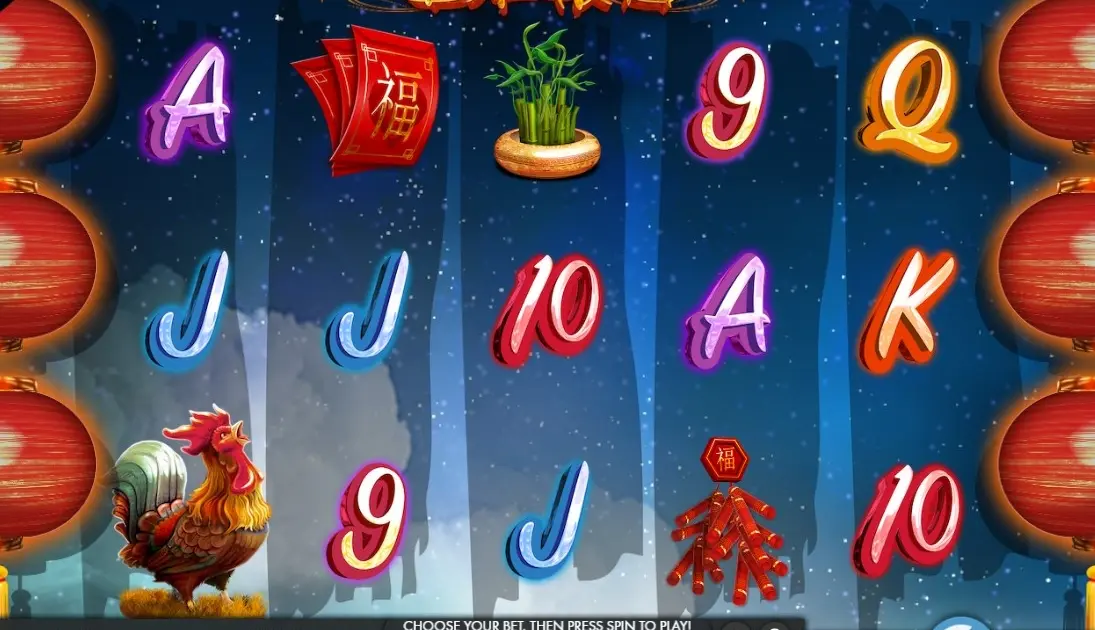
Year of the Rooster is worth a look if you filter by return first and theme second. Its 97.16% RTP sits 1.45 points above the site-wide average of 95.71% and above its own provider average, which makes it mathematically one of the stronger demo options to compare before you risk any budget. You can try the year of the rooster slot in free demo form here with no account needed, and use the numbers below to decide if it fits the kind of session you want.
| Item | Detail |
|---|---|
| Game | Year of the Rooster |
| Provider | Genesis Gaming |
| Type | Slot Machine |
| RTP | 97.16% |
| Provider average RTP | 96.88% |
| Corpus average RTP | 95.71% |
| Popularity rank | 2411 |
| Free demo | Available |
Who makes Year of the Rooster
Year of the Rooster is made by Genesis Gaming, a studio with 100 titles listed in this catalogue. That count matters because a catalogue of that size gives you a usable baseline for what the provider typically pays back. Genesis Gaming’s average RTP across those 100 games is 96.88%, which is already above the corpus average of 95.71% calculated across all providers on the site.
A house average is not a promise about any single game, but it tells you whether a studio tends to price its maths more or less tightly. At 96.88%, Genesis Gaming sits on the more generous side of the market norm. Year of the Rooster, at 97.16%, is even a little above its own house norm, by 0.28 points.
Provider identity also helps you set expectations about support and availability. Large catalogues tend to be widely distributed for demo play and stay available longer, and because free demo play is confirmed for this title, you can inspect its structure without registration or deposit. What you cannot infer from the provider name alone is the specific feature set. The FACTS block for this review does not list paylines, reel layout, wilds, scatters, free spins, multipliers or a buy feature, so none of those should be assumed to be present or absent. When a studio has not published a max win, volatility rating or hit frequency for a title, treat any numbers quoted elsewhere with caution and rely only on the published RTP and your own demo observations for general feel.
If you like to compare within a single provider before branching out, Genesis Gaming is a practical place to do it. You have enough siblings to contrast RTP, and you can see whether you prefer to chase the absolute highest return in the range or trade a small amount of return for a different theme.
Where Year of the Rooster sits in the Genesis Gaming catalogue
Within Genesis Gaming’s 100-game range, Year of the Rooster sits near the top on RTP alone. At 97.16%, it ranks above the provider average of 96.88% and above several close siblings. For context, Galapagos Islands is listed at 97.07% and The Boom Squad at 97.06%, both a fraction below Year of the Rooster. That 0.09 to 0.10 point gap is small over a short session, but over a large sample it is a real mathematical edge, however modest.
Another sibling for direct comparison is Tres Huevos at 97.10%. Here the gap narrows to 0.06 points in favour of Year of the Rooster. When differences are this tight, your choice will come down to which theme you prefer to spend time with, since the long-run expected return is almost identical and every spin remains independent.
Rank gives a second way to place the game. Year of the Rooster holds rank 2411 in the full corpus, with a popularity percentile of 87.9. Rank reflects how often players open the demo or detail page relative to everything else on the site, not how well it pays. A high percentile means many players have sampled it, which helps when you want community familiarity, but it does not make a game more likely to pay in any given session.
The useful takeaway is narrow: if your first filter is RTP within Genesis Gaming, Year of the Rooster clears the bar. If your first filter is volatility, hit rate or features, you will need more published data than FACTS provides for this title. Missing data is itself information — it tells you not to base decisions on assumed bonuses or on volatility labels that have not been confirmed.
RTP: 97.16% against a 96.88% house average
RTP is a long-run statistical average, not a forecast for tonight. A 97.16% RTP means that for every £100 wagered, the game is designed to return £97.16 across a very large number of spins — millions, not dozens. Over 1,000 spins at £1 a spin, the theoretical average return would be £971.60 from £1,000 staked, leaving a theoretical average loss of £28.40. Over 10,000 spins at the same stake, the theoretical totals scale to £9,716 returned from £10,000 staked. These are averages with variance around them; actual sessions swing above and below.
Against the Genesis Gaming house average of 96.88%, Year of the Rooster is 0.28 points higher. Put differently, its theoretical loss rate is 2.84% versus 3.12% for the average Genesis Gaming title — about a 9% reduction in expected loss per unit wagered. Against the wider corpus average of 95.71%, the gap is larger: 1.45 points higher, which cuts the theoretical loss rate from 4.29% to 2.84%, roughly a third lower.
Those comparisons are useful for planning, but they do not change the independence of each spin. A higher RTP does not make a win due, and it does not shorten the time to a bonus if a bonus exists. It simply means that, if you were to repeat the same bet an enormous number of times, the average cost per spin trends lower than on a lower-RTP peer.
Because no volatility figure is published in FACTS for this title, you cannot tell from RTP alone whether that 97.16% is delivered via many small returns or fewer larger ones. Both can produce the same long-run average with very different session experiences. The other missing fields — stake range, paylines or ways, and max win — are not in FACTS either, so bankroll sizing must be driven by the stakes you actually see in the demo lobby rather than by an assumed range.
Volatility and who it suits
No volatility rating is published for Year of the Rooster in the FACTS block, so there is no official low, medium or high label to quote. That absence matters more than it seems, because volatility shapes how a bankroll behaves even when RTP is fixed.
In general terms, low volatility tends to mean more frequent but smaller wins, which stretches session length on a fixed budget and reduces the chance of a rapid drawdown. High volatility tends to mean fewer hits with larger gaps between them, which demands a larger bankroll for the same number of spins and a higher tolerance for swings. Medium volatility sits between. These are concepts that apply across slots; they are not claims about this specific game.
Without a confirmed rating, you have two honest options. First, treat bankroll planning conservatively: assume a swingier experience until your demo time suggests otherwise, and size your stake so that 200 to 300 spins fit comfortably within a budget you are happy to spend as entertainment. Second, use demo play only to get a feel for cadence, not to predict real-money results. Demo and real-money versions run the same maths where offered, but short samples are noisy, and no sample makes the next spin more likely to win.
Who suits what, in plain terms: if you want longer, steadier demo sessions and you dislike seeing long dry spells, you generally prefer lower-volatility designs. If you prefer the possibility of larger, less frequent spikes and can accept longer stretches without a return, you gravitate to higher-volatility designs, with the understanding that the price is more busts. Since Year of the Rooster has not disclosed where it falls, let the RTP be the firm fact and let any volatility impression remain provisional until the provider publishes it.
Playing Year of the Rooster for free — year of the rooster slot
Free demo play for Year of the Rooster is available, which lets you load the game directly and spin with play credits. That is the cleanest way to check basic usability, layout and pacing before you decide whether to stake real money elsewhere. Demo spins do not pay real money and do not create an advantage for later real-money play; each spin is independent, whether in demo or for cash.
Use demo with a plan. Set a time limit, pick a stake that mirrors what you would actually spend, and run a fixed number of spins — for example 200 — then stop and review how the balance moved. This turns demo from random clicking into a comparison tool. Because stake range is not listed in FACTS, confirm the minimum and maximum you see in the lobby itself; do not rely on third-party stake tables that may be outdated.
Playing for free also removes pressure to chase. If you do move to real-money play on any site, keep the same discipline you used in demo. Only adults 18+ should gamble, always set a budget before you start and treat spend as the cost of entertainment, not as a way to make money. If you feel you are chasing losses, increasing stakes to recover, or playing longer than planned, pause and use the responsible-gambling tools offered by the casino — deposit limits, time-outs and self-exclusion — or contact a support organisation in your jurisdiction. Staying within a pre-set budget is the only way to keep the session affordable, regardless of RTP.
Similar picks
This catalogue lists zero other games under the same theme tag for Year of the Rooster, so there are no direct theme siblings to link here. That is not a flaw in the game; it means theme is not a useful filter for finding alternatives in this specific data set.
The more productive comparison is by maths. All three Genesis Gaming peers close to this RTP are within 0.10 points, so if you want to stay in the same return band you do not sacrifice much by switching. The absence of published volatility, paylines and features for Year of the Rooster makes it hard to match on experience, so any alternative you try should be judged on the figures that are actually published and on how its demo feels at a comparable stake.
If you are building a shortlist purely on RTP, keep Year of the Rooster at the top of your Genesis Gaming trial list and use the peers as backups when you want a change of scene. If you later find confirmed feature details for any of them — such as free spins, wild mechanics or hit frequency — re-rank on those, because features drive session texture more than a few hundredths of a percent in RTP.
Verdict
Year of the Rooster’s case is simple and numeric. At 97.16% it beats both the Genesis Gaming average of 96.88% and the site-wide average of 95.71% by a clear margin, which lowers theoretical cost per spin over a large sample without promising anything about the next spin. That is enough to put it on a value-first shortlist, especially when you can verify the experience in a free demo first.
The caveat is equally simple: key textured details are unpublished in the data provided. No confirmed volatility, no stake range, no payline or ways count, and no feature list in FACTS. You cannot responsibly claim it is low or high variance, or that it has a particular bonus structure, because that would be invention. For now, judge it on what is firm — provider, RTP, rank and demo availability — and treat everything else as unconfirmed until Genesis Gaming publishes it.
If you want a straightforward, above-average RTP option from a large, established provider and you are happy to let demo time fill in the blanks that the spec sheet does not, Year of the Rooster is a sensible demo to queue next. If you need a known volatility profile or a specific feature set to enjoy a session, pick a title where those figures are actually disclosed.
Frequently Asked Questions
Can I play Year of the Rooster for free without wagering real money?
Free demo play for Year of the Rooster is listed as available, so you can spin with play credits and no deposit. Demo does not pay real money and does not affect future results, but it is useful for checking pace and layout before you consider staking elsewhere.
What is the RTP of Year of the Rooster and what does it mean?
The RTP is 97.16%, meaning the game is designed to return £97.16 per £100 wagered over a very large sample. Over 1,000 £1 spins that averages £971.60 returned, but short sessions vary widely and every spin is independent, so actual results differ.
What volatility does Year of the Rooster have?
No volatility rating is published in the FACTS data for Year of the Rooster, so there is no official low, medium or high label to rely on. In general, low volatility favours smaller, more frequent returns and high volatility favours larger, rarer swings at the same RTP.
Who makes Year of the Rooster and what else do they offer?
Year of the Rooster is made by Genesis Gaming, which has 100 titles in this catalogue and an average RTP of 96.88%. That catalogue scale gives a solid baseline for comparison and helps you contrast Year of the Rooster's 97.16% against its siblings.
How does Year of the Rooster compare to Tres Huevos?
Year of the Rooster is at 97.16% and Tres Huevos at 97.10%, a gap of 0.06 points in favour of Year of the Rooster. Over many spins the higher RTP has a slightly lower theoretical loss rate, but in short sessions the difference is small and each spin stays independent.