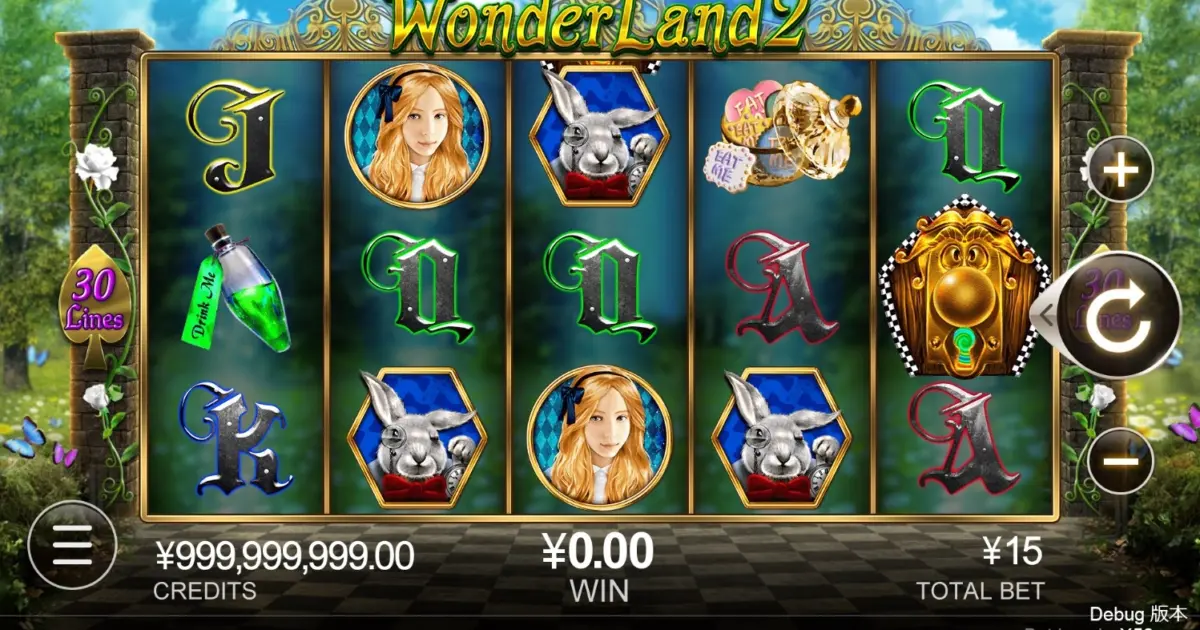
The wonder land 2 slot is a 5-reel Nature title from CQ9 Gaming with no published RTP or volatility, so you are choosing on structure and theme rather than disclosed maths. That lack of numbers is not a deal-breaker, but it means you should use the free demo to judge pace for yourself. If you prefer games with fully transparent figures upfront, you will want to compare carefully before committing a bankroll.
Wonder Land 2 at a glance
This is a 5-reel Slot Machine listed under the Nature and 5-Reels themes, supplied by CQ9 Gaming as part of a 133-game catalogue. Its popularity rank is 2742, which puts it at the 86.3rd percentile in the wider corpus — meaning it sits below the most-played titles but remains visible among nearly three thousand games tracked. CQ9 Gaming has not published a max win figure for this title, so treat any number you see quoted elsewhere with caution.
What is published paints a useful context picture. The provider’s average RTP across its catalogue is 95.97%, slightly above the corpus average of 95.71% calculated across all tracked slots. With 822 games sharing the Nature theme, this title competes in a crowded field where many alternatives do disclose their maths. Knowing that can help you decide whether to explore on theme alone or to prioritise games that publish every figure.
Who suits it best at this stage is someone who likes straightforward 5-reel play and is comfortable evaluating a game by feel in demo mode rather than by a disclosed model. If you need a published RTP and volatility rating to plan stake and session length in advance, the missing data here is itself the most important fact.
| Detail | Value |
|---|---|
| Provider | CQ9 Gaming |
| Reels | 5 |
| Themes | Nature, 5-Reels |
| Category | Slot Machine |
| Popularity rank | 2742 (86.3rd percentile) |
| Provider catalogue | 133 games, average RTP 95.97% |
| Corpus average RTP | 95.71% |
| Nature theme count | 822 games |
| Free demo | Available |
What RTP actually returns
No RTP has been published for Wonder Land 2, so there is no official percentage to work through. That absence matters because RTP is the only standardised way to compare long-run return across slots. Without it you cannot calculate an expected loss or return for a set number of spins, and you should not infer a figure from related titles or from the theme.
To show what a published RTP would mean, consider the general maths that applies to any slot. RTP is a statistical average over millions of spins, not a promise for a single session. If a game had, for example, a 96% RTP, the long-run expectation would be to return £96 for every £100 wagered, with the remaining £4 as the house edge. Over a short sample such as 1,000 spins at £0.20 — £200 staked in total — the average outcome at 96% would be around £192 returned, but actual results would vary widely because each spin is independent.
Because this title has no disclosed figure, the closest contextual benchmarks are the provider average of 95.97% and the corpus average of 95.71%. If Wonder Land 2 were to sit near either level, the long-run expectation would be roughly £95.71 to £95.97 returned per £100 wagered across a very large sample. That is slightly below the 96% level many players use as a mental benchmark, but the difference over a small sample is modest — about 29p per £100 between the two averages. Until CQ9 Gaming publishes a specific figure, treat those averages as context only, not as a substitute for this game’s own maths.
Undisclosed volatility and what your session will feel like
Volatility, sometimes called variance, has not been disclosed for Wonder Land 2. Without a rating you cannot know from the fact sheet whether the game is designed to pay smaller amounts more often or larger amounts less often. The rating matters because it shapes bankroll requirements and how long a session is likely to last at a given stake, even when RTP is identical.
In general terms, low volatility tends to produce steadier, smaller swings. Your balance moves in narrower steps, which can extend play time on a fixed budget but rarely produces large single-spin changes. High volatility does the opposite: longer quiet stretches punctuated by bigger swings when wins land, which usually demands a larger bankroll or a lower stake to cover the gaps. Medium volatility sits between those extremes, blending moderate swing size with moderate hit regularity.
Because many slots use features such as wilds, scatters or free spins to deliver their volatility profile, it is tempting to assume how Wonder Land 2 behaves. Do not. Those are common mechanics across the industry, but they are not confirmed for this specific title in the facts available. With no volatility and no feature list published, the only reliable way to sense the pace is to observe it in the Wonder Land 2 free demo over a meaningful number of spins, remembering that demo play shows mechanics but does not predict real-money outcomes and every spin remains independent.
The 5-reel layout and how wins are counted
Wonder Land 2 uses a 5-reel layout, the most common reel count in modern video slots. Five reels give designers room for varied symbol combinations and multiple paylines or ways, without changing the basic principle that each reel spins independently and stops on a random position determined by the game’s random number generator.
How wins are counted depends on the payline or ways system, which has not been specified in the available facts for this title. In general, a payline game pays when matching symbols land on consecutive reels along a defined line, while a ways game pays for matching symbols on consecutive reels regardless of exact position. Both systems still require the first symbol to start on the leftmost reel in most cases, but the number of active lines or ways changes how often combinations can form and how the paytable is read.
For you as a player, the practical point is to check the paytable inside the game itself before you stake. That is where any payline count, ways count and symbol values would be listed if they are disclosed. If you want a point of comparison within the same Nature theme, Buffalo King at 96.06% RTP and Great Rhino Megaways at 96.47% RTP both publish their figures and openly describe their ways mechanics, which makes it easier to compare structure and long-run return side by side with Wonder Land 2.
Stake range and sizing a bankroll
No minimum or maximum stake has been published for Wonder Land 2 in the facts supplied, so a specific bankroll plan cannot be built from a disclosed range. When a stake range is missing, the safest step is to open the game and read the stake controls directly, noting the lowest increment the game allows and the highest it permits. Those two numbers determine how finely you can scale your total spend.
As a general planning principle, total staked amount is simply stake per spin multiplied by number of spins. If you set a session budget first — say £20, £50 or £100 as pure entertainment spend — you can then decide how many spins that budget should cover. Dividing the budget by the desired spin count gives the stake that fits the plan, provided the game allows that stake. This does not change expected value; every spin is independent and the house edge, whatever the undisclosed RTP implies, applies equally at any allowed stake.
Because volatility is also undisclosed, allow extra margin. A common approach is to size the bankroll so that 100 to 200 spins at your chosen stake fit comfortably within the budget you are happy to spend, which helps absorb normal swings without chasing. Among Detective Dee2 and other Wild Country titles from the same provider and theme groups, you will see different published ranges, so checking the in-game controls for Wonder Land 2 before you commit remains the most reliable method.
Playing the Wonder Land 2 slot demo before you commit
The free demo for Wonder Land 2 is available and is the most useful tool you have given the missing RTP, volatility and stake details. Demo play loads the same reel layout and paytable presentation as the real-money version, letting you see how wins are evaluated, how the controls feel, and how quickly balance moves at the stakes you select. It does not change the maths and it does not predict what will happen with real money; it simply lets you evaluate fit without spending.
Use the demo with a clear purpose. Set a hypothetical budget and a fixed number of spins, then watch how often the balance steps up or down and whether the pace matches the session length you enjoy. If you find yourself needing to raise the stake to feel engagement, that is a signal to pause rather than to increase risk. For broader context on what CQ9 Gaming makes, browsing other CQ9 Gaming slots can show how this provider typically presents information, even though each title’s maths is independent.
Keep play as entertainment. You must be 18+ to gamble in the UK. Set a budget before you start, use deposit and time limits if you play for real, and treat any money staked as the cost of entertainment, not a way to make money. If you feel play is no longer fun, use self-exclusion tools or speak to a support organisation. Demo play is a good place to practise those limits with no financial consequence.
Verdict: who should play Wonder Land 2
Wonder Land 2 will appeal most to players who like the Nature theme on a familiar 5-reel format and who are comfortable trying a game whose key maths figures have not been published. The free demo makes that exploration possible without risk, and the provider context — 133 games at an average 95.97% RTP — suggests CQ9 Gaming operates near the corpus average, even if this specific title’s figure remains undisclosed.
The case for caution is equally clear. Without a published RTP you cannot compare long-run return precisely, without a volatility rating you cannot anticipate swing size, and without a disclosed stake range you cannot plan bankroll from the fact sheet alone. Those gaps do not make the game unplayable; they make advance comparison harder than with titles like Great Rhino Megaways or Buffalo King, where the numbers are public and the mechanics are fully described.
If you decide to try it, do so in demo first, check the in-game paytable for any lines or ways information, and keep stakes modest until you have seen enough spins to judge whether the pace suits the session length you want. If full transparency is your priority, you may prefer to choose a game that publishes every figure upfront. If theme and hands-on feel matter more than a fact sheet, the demo gives you everything you need to make an informed, low-pressure choice.
Frequently Asked Questions
Can I play Wonder Land 2 for free without risking real money?
Yes, the Wonder Land 2 free demo is available on this site and lets you spin with play money. Demo play shows the 5-reel Nature presentation and controls, but every spin remains random and demo results do not predict real-money outcomes.
What is the RTP of Wonder Land 2 and what does it mean for my session?
CQ9 Gaming has not published a specific RTP for Wonder Land 2, so no official return percentage can be quoted. For context, the provider averages 95.97% and the wider corpus averages 95.71%, meaning a 96% game would return about £96 per £100 wagered over millions of spins.
What is the volatility of Wonder Land 2 and how will it feel to play?
No volatility rating has been disclosed for Wonder Land 2, so the swing size and hit pattern cannot be confirmed from the facts. In general, low volatility favours smaller, steadier swings and longer sessions, while high volatility brings longer gaps with larger potential swings, but you must gauge this title in demo.
Who makes Wonder Land 2 and what else do they offer?
Wonder Land 2 is made by CQ9 Gaming, a studio with 133 games in the tracked catalogue and an average RTP of 95.97%. Related titles from the same provider include Detective Dee2, Diamond treasure and Warrior Legend, each with its own independent maths model.
What stake should I use for Wonder Land 2 and how should I size my bankroll?
No minimum or maximum stake is published for Wonder Land 2, so you should check the in-game controls for the allowed range. Set a total entertainment budget first, then divide it by the number of spins you want — for example, a £50 budget allows 250 spins at £0.20 — remembering each spin is independent.