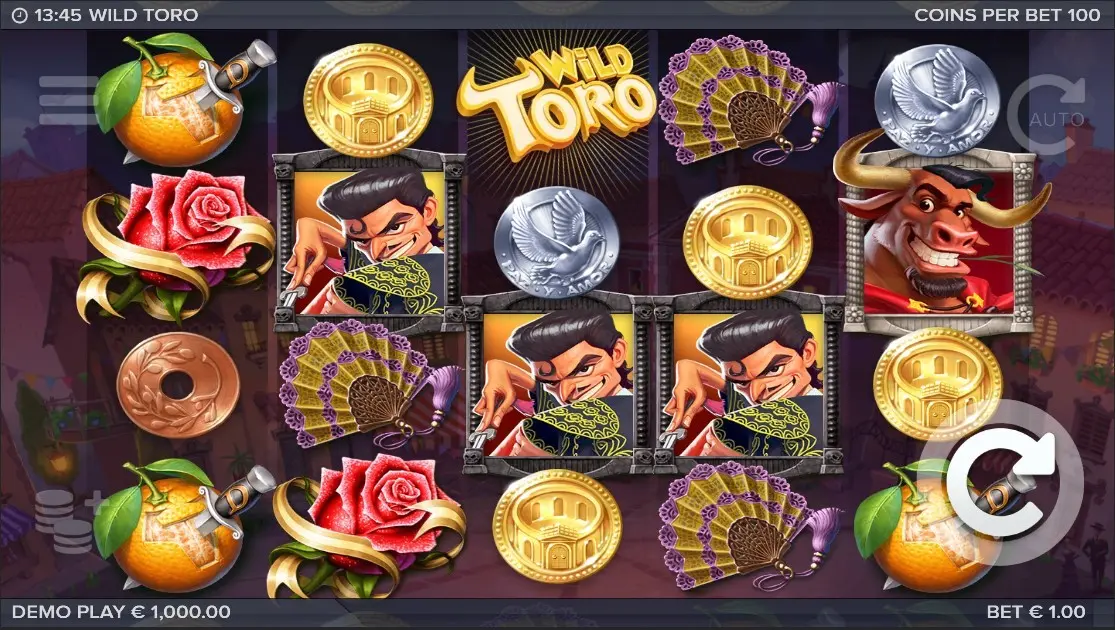
The clearest reason to open the wild toro slot is its return figure: 96.3%, against an ELK Studios average of 94.92% across the studio’s 138 catalogued games. That is a meaningful gap by the standards of a single provider’s library, and it is the one number in this review that is worth carrying with you. A free demo exists, which means you can test the pace and the stake steps without depositing.
Is Wild Toro worth playing?
If you care about published return percentages, yes — it is one of the better-returning games in its own studio’s catalogue. If you are hoping this review will tell you about specific bonus features, no, because ELK Studios has not published those details in the data available here.
Here is what is actually on record. Five reels. A 96.3% RTP. A popularity rank of 1671, which places it in the 91.6th percentile of the games tracked here — high enough that a reasonable number of people have gone looking for it, rather than it being an obscure title nobody plays. The corpus average RTP sits at 95.71%, so this game runs 0.59 percentage points above the typical slot in the wider sample.
What is not on record matters too. There is no published paylines or ways count in the available data, no max win figure, no volatility rating, no hit frequency, and no stake range. If you see a specific maximum win multiplier quoted for this game elsewhere, treat it as unverified rather than as a fact from the studio. The honest summary: strong return figure, thin feature documentation.
| Figure | Value |
|---|---|
| Game | Wild Toro |
| Provider | ELK Studios |
| RTP | 96.3% |
| Reels | 5 |
| Type | Slot Machine |
| Theme label | 5-Reels |
| Popularity rank | 1671 (91.6th percentile) |
| Provider average RTP | 94.92% across 138 games |
| Corpus average RTP | 95.71% |
| Free demo | Available |
What 96.3% RTP means over 1,000 spins
RTP is a long-run average, calculated over a sample far larger than any session you will ever play. A 96.3% figure means that across a very large number of spins, the game is modelled to return £96.30 for every £100 wagered. The other £3.70 is the house edge.
Apply that to 1,000 spins at £1 a spin: £1,000 wagered, a modelled return of £963, an expected cost of £37. That is the arithmetic. What it is not is a prediction of your evening. Over only 1,000 spins the variance around that average is wide — you can finish well ahead or lose the lot, and both outcomes are entirely consistent with a 96.3% game. The average only asserts itself over hundreds of thousands of spins.
The comparison is where the number earns its keep. At 96.3% the expected cost of 1,000 £1 spins is £37. At the ELK Studios average of 94.92% it would be about £51. At the corpus average of 95.71% it would be roughly £43. Same wager, different structural cost. Over a long relationship with a game, that gap compounds; over one session it is noise. Every spin is independent, so nothing that happened on the last spin shifts the odds on the next one.
How volatile is Wild Toro?
No volatility rating is published for this game in the data available, so anyone telling you it is “high volatility” or “low variance” is guessing. That absence is worth knowing, because volatility affects your session far more directly than RTP does.
The general principle: volatility describes the shape of the return, not its size. Two games can both pay 96.3% over the long run and feel completely different. A low-volatility game pays smaller amounts more often, so your balance drifts down gradually and sessions last longer on a given bankroll. A high-volatility game pays rarely and larger, which means long stretches of nothing punctuated by occasional bigger returns, and a much greater chance of your bankroll running out before any of those bigger returns arrive.
Since the rating is not published, the practical move is to use the free demo to read the game’s behaviour yourself. Play a few hundred demo spins at a fixed stake and watch how often anything lands and how deep the dry spells run. That gives you a rough feel for the swing pattern. It will not tell you what real-money sessions will do — demo results predict nothing about future play, and the two are not linked — but it does tell you whether the rhythm suits your patience and your budget.
What the 5-Reels theme brings to the game
The only theme label attached to this game is “5-Reels”, which is a structural descriptor rather than a subject. It tells you the grid layout and nothing about setting, characters, art style or soundtrack. There is no mythology tag, no fruit tag, no adventure tag — nothing that would let anyone describe what this game looks like honestly.
So treat any detailed visual description you read elsewhere with scepticism unless it cites the studio. What the label does confirm is the format: five reels, the most common layout in modern slots, and the one most players will already find familiar in pace and structure.
The available data also does not include a paylines or ways figure. That matters more than theme, because the number of ways a game can pay shapes how often something lands and how much of your stake each line represents. Many five-reel games run anywhere from 10 fixed lines to several thousand ways, and the difference in feel is substantial. Without that figure, the demo is again your best source: check the paytable in-game, where the studio publishes the line count, the symbol values and whatever features exist. That is a primary source. This review is not, on those points.
Stakes, session length and bankroll
No stake range is published in the available data, so check the bet selector in the demo before you plan anything. Once you know the minimum and maximum, the maths is straightforward.
Divide your session budget by your stake to get your maximum spin count if nothing pays back at all. A £50 budget at £0.20 a spin gives you 250 spins as a floor; the same £50 at £2 gives you 25. In practice partial returns extend both, but the floor is the useful figure because it is the worst case you have already accepted. Work backwards from how long you want to play and set the stake to fit, rather than picking a stake and hoping.
Two things not to do. Do not raise stakes after losses to “recover” — every spin is independent and the 3.7% house edge applies identically to every one of them, so no staking pattern changes your expected result. And do not treat a demo balance as a rehearsal for a real one; the demo has no financial consequence, which changes how people bet in ways that do not transfer.
Alternatives if Wild Toro is not for you
Within ELK Studios’ catalogue, the closest documented alternatives all sit lower on return. Pirots publishes 94.0% RTP, which is 2.3 percentage points below this game — on 1,000 £1 spins that is roughly £60 expected cost against £37. Worth knowing before you switch on the basis of preferring a different game style.
Its sequels hold the same figure. Pirots 3 and Pirots 4 are both listed at 94.0% RTP, so moving between them changes the game but not the structural cost. If return percentage is your deciding factor, none of the three improves on 96.3%, and all three sit below the 95.71% corpus average as well.
The broader point for anyone browsing ELK Studios slots: the studio’s 94.92% average across 138 games means the title you are reading about is an outlier upward within its own library, not a typical example of it. Check the published RTP on every game you consider rather than assuming a provider-wide standard.
Final take
Wild Toro’s case rests on one verifiable strength — 96.3% RTP, against 94.92% across ELK Studios’ 138 games and 95.71% across the wider sample. That is a genuinely favourable structural position, and it is the kind of figure worth prioritising if you play the same game repeatedly. Its 91.6th-percentile popularity rank suggests it has found an audience.
Against that, the documentation is thin. No published volatility rating, no paylines count, no max win, no stake range. Those gaps do not make the game worse, but they do mean this review cannot tell you how it plays — only what it returns. The free demo is the answer to every one of those open questions, and it costs nothing to use.
Slots are 18+ and priced entertainment, not income. Decide what the session is worth to you before you start, stake so that the budget covers the number of spins you want, and stop when it is gone rather than topping it up. The 3.7% house edge is the price of playing, and no approach to betting removes it.
More from ELK Studios
- Hula Balua — 94.0% RTP
- Pirots 3 — 94.0% RTP
- Tropicool 2 — 94.0% RTP
- Nitropolis 4 — 94.0% RTP
- Nitropolis 3 — 95.0% RTP
- Pirots 4 — 94.0% RTP
- Coba — 95.0% RTP
Frequently Asked Questions
Can you play Wild Toro for free?
A free demo is available for this game, so you can spin it without depositing. The demo is the practical way to check the details the published data omits — the paylines count, the stake range and the feature set are all in the in-game paytable. Note that demo results have no bearing on what real-money play would return.
What is the RTP of Wild Toro?
The published RTP is 96.3%, meaning a modelled return of £96.30 per £100 wagered across a very large sample. That sits 1.38 percentage points above the ELK Studios average of 94.92% and 0.59 above the 95.71% corpus average. Over 1,000 £1 spins the expected cost is about £37.
Is Wild Toro high or low volatility?
No volatility rating is published for this game in the available data, so treat any confident claim about its variance as unverified. Volatility shapes session length and swing size independently of RTP, so it matters. Running a few hundred demo spins at a fixed stake gives you a rough read on the game's rhythm.
Who makes Wild Toro?
ELK Studios developed it. The studio has 138 games in this catalogue with an average published RTP of 94.92%, which puts this title above its own house standard. Other ELK Studios titles include Pirots, Pirots 3 and Pirots 4, all three listed at 94.0% RTP — noticeably lower than 96.3%.
How does Wild Toro compare to Pirots?
On published return it is clearly ahead: 96.3% against 94.0% for Pirots, a gap of 2.3 percentage points. On 1,000 £1 spins that is roughly £37 expected cost versus £60. Pirots 3 and Pirots 4 also list 94.0%, so the comparison holds across the series. Feature differences are not documented here.