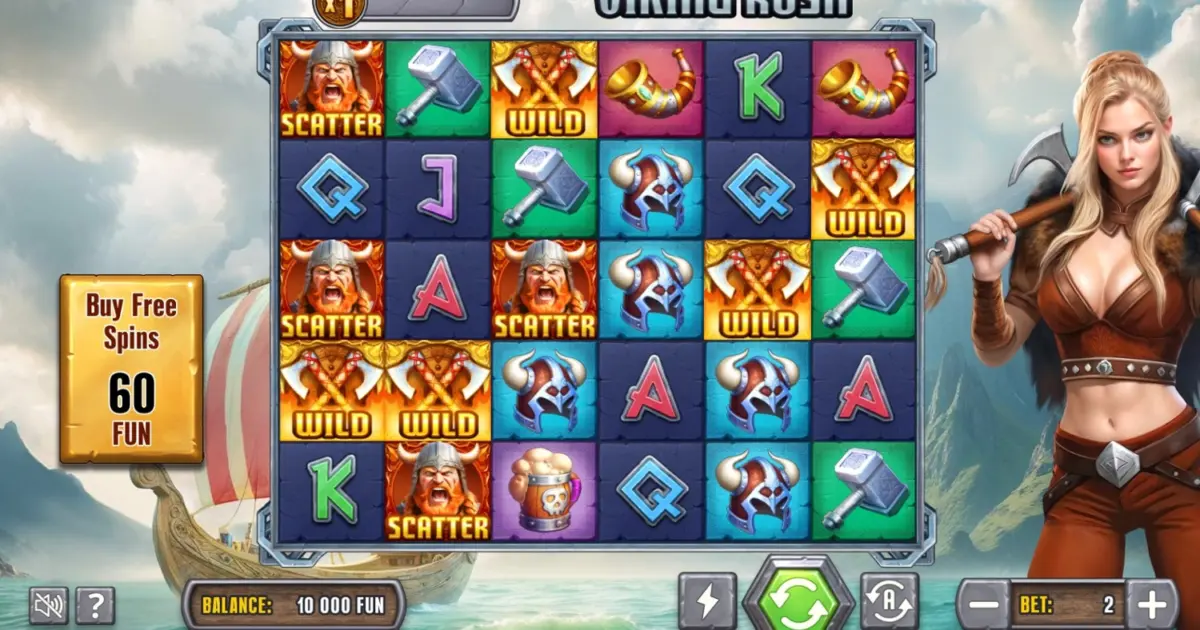
If you want the short version: the viking rush slot runs a published RTP of 95.73% on a six-reel layout from Dream Play, and a free demo is available so you can see the game move before any money is involved. That RTP sits marginally above the 95.71% average of the slots catalogued on this site and roughly half a point above Dream Play’s own 44-game average of 95.18%. Dream Play has not published volatility, payline count, bet limits or a max win for this title, so parts of this review are about what those gaps mean rather than what the numbers say.
| Figure | Value |
|---|---|
| Game | Viking Rush |
| Provider | Dream Play |
| RTP | 95.73% |
| Reels | 6 |
| Theme | Vikings |
| Type | Slot Machine |
| Popularity rank | 2356 (88.2nd percentile) |
| Provider average RTP | 95.18% across 44 games |
| Site average RTP | 95.71% |
| Free demo | Available |
The 6-reel grid explained
Six reels is one column wider than the classic five-reel arrangement, and that extra column changes the arithmetic of the game more than it changes the look of it. Every additional reel multiplies the number of possible symbol combinations, which widens the range of outcomes a single spin can produce. In practice, designers use that extra width in one of two directions: either to spread wins out into longer, less frequent combinations, or to raise the number of ways a result can form so that small returns land more often.
FACTS does not tell us which route Dream Play took here, and guessing would be worthless to you. What the six-column format does tell you is that symbol positions per spin are higher than on a five-reel game, so the visual read of a near-miss is different: you can watch matching symbols land across four or five columns and still finish short. That is a design consequence, not a signal about the machine’s state. Each spin is resolved independently by the random number generator, so a run of five-column near-misses tells you nothing about the next one.
Paylines, ways and how the viking rush slot pays
Dream Play has not published a payline or ways figure for this game, so treat any specific number quoted elsewhere as unverified. That absence matters, because the payline model is the single biggest determinant of how a session feels at a fixed stake.
Speaking generally, six-reel slots usually settle into one of three payment models. Fixed paylines award a win when symbols land on defined positions reading left to right. “Ways” or “all ways” systems count any combination of matching symbols across adjacent reels, which typically produces many small returns per unit staked. Cluster models pay for grouped symbols regardless of column. Many slots also include wilds that substitute for regular symbols, scatters that trigger free spins, and in some markets a paid feature entry. None of those are confirmed features of this title and you should not assume any of them are present.
The practical takeaway: load the demo and read the in-game paytable before deciding anything. It is the authoritative source for this game’s mechanics, and it costs nothing to open. If you prefer to know the mechanics in advance, Vikings Thunder is a Norse-themed alternative with a documented 96.18% RTP.
95.73% RTP put in context
RTP is a long-run average, not a promise about your session. A 95.73% figure means that across an extremely large number of spins, the game is modelled to return £95.73 for every £100 staked, leaving a house margin of 4.27%. The word to hold onto is “extremely”. Over 1,000 spins at £0.20, you would stake £200 and the theoretical return is £191.46, but real 1,000-spin samples scatter widely around that centre. The number only tightens over hundreds of thousands of spins, which is far more than any individual plays.
Relative to its peers, 95.73% is unremarkable in a useful way. It clears the 95.71% site average by 0.02 percentage points, which is a rounding difference rather than an advantage. Against Dream Play’s own 95.18% average across 44 games, it is 0.55 points better, so within this studio’s catalogue it is on the stronger side. Compared with Dream Turtles at 95.35%, the margin here is narrower. If RTP is your main filter, Stormforged returns 96.41%, a 0.68-point improvement in house edge terms.
Volatility and hit patterns
No volatility rating has been published for this game, so nobody outside Dream Play can tell you with confidence whether wins arrive in small frequent doses or rare large ones. Hit frequency is likewise unpublished. That is a genuine information gap, and it is worth knowing before you commit a bankroll to a longer session.
What volatility actually governs is the shape of your results, not their average. Low-volatility games tend to return small amounts often, which keeps a balance moving steadily downward or sideways and makes short sessions predictable. High-volatility games pay less often but in larger amounts, which means deeper drawdowns between results and a bankroll requirement several times larger for the same number of spins. Medium sits between the two. Critically, volatility does not change RTP: two games at 95.73% with opposite volatility profiles have the same long-run expectation and the same 4.27% house margin.
Because the rating is missing, the demo is the cheapest diagnostic available. A few hundred demo spins at a consistent stake will show you roughly how often results land and how large they tend to be, which is enough to judge whether the rhythm suits you.
Choosing a stake when the bet range is unpublished
Minimum and maximum bet figures are not listed in the data for this title, so check the stake selector in the game itself before your first real-money spin. Six-reel releases commonly span something in the region of a few pence to tens of pounds per spin, but that is a genre observation, not a statement about this game.
The method for choosing a stake does not depend on knowing the range in advance. Decide your total budget first, then decide how many spins you want that budget to cover, then divide. A £40 budget aimed at 400 spins points to £0.10 per spin. If the game’s minimum is above your division, the honest conclusion is that the game is too expensive for that budget, not that you should shorten the session. Nothing about bet sizing alters expected value: staking more per spin raises both your average loss rate and the size of your swings in the same proportion. No stake pattern, timing choice or progression changes the 4.27% margin.
Demo play versus real money
The Viking Rush free demo runs on the same game maths as the paid version, so it is a reliable way to learn the paytable, check the bet range and get a feel for how often results land. What it cannot do is predict your real-money outcomes. Demo results are just another short sample from the same random process, and a good or bad run in practice mode carries no information about what follows when real stakes are involved.
One practical note: playing for free removes the financial consequence of variance, which can make a high-variance game feel tamer than it is. Watch the size of the demo balance swings, not just the outcome.
Slots are paid entertainment, priced at roughly 4.27% of everything you stake here. Play only if you are 18 or over, set a budget before you start and treat it as spent the moment you sit down. If the amount you are staking would matter elsewhere in your month, it is too much.
Verdict on Viking Rush
A reasonable, unspectacular option within Dream Play’s range. The 95.73% RTP is the game’s clearest strength in relative terms: better than most of this studio’s 44 titles and level with the wider average, which puts the house edge at a middling 4.27%. Its 2356th popularity rank places it in the 88.2nd percentile, so it gets meaningful traffic among the 159 Viking-themed games listed here.
The reservation is disclosure. With volatility, payline structure, bet limits and max win all unpublished, you are buying into a game whose risk profile you can only estimate by playing it. That is a fair trade when the demo is free and costs you nothing but time. If you want documented numbers and a higher return before you start, Olaf Viking sits at 95.5% within the same theme, and the higher-RTP options listed above are worth a look first.
Frequently Asked Questions
Can I play Viking Rush for free without downloading anything?
A free demo is available for this title, and it runs in the browser with no download required. The demo uses the same 95.73% RTP maths as the paid version, so it is a fair way to check the paytable, the stake selector and how often results land before you decide whether to stake real money.
What does the 95.73% RTP on Viking Rush actually mean?
It means the game is modelled to return £95.73 for every £100 staked across an extremely large number of spins, leaving a house margin of 4.27%. Short sessions scatter widely around that figure. The number only becomes meaningful over hundreds of thousands of spins, far more than any individual will play.
How volatile is Viking Rush?
Dream Play has not published a volatility rating for this game, so no reliable figure exists outside the studio. Hit frequency is also unpublished. Volatility governs the size and spacing of results rather than the long-run average, so it would not change the 95.73% RTP. A few hundred demo spins will show you the rhythm.
Who is Dream Play and what else do they make?
Dream Play is the studio behind this release and has 44 games catalogued here, with an average RTP of 95.18%. That makes Viking Rush one of their stronger titles on return. Other Dream Play slots include Dream Turtles at 95.35% and Future Sevens at 95.00%, both below this game's figure.
How does Viking Rush compare with Vikings Thunder?
Vikings Thunder returns 96.18% against 95.73% here, a 0.45-point advantage that cuts the house margin from 4.27% to 3.82%. Both sit in the same Viking theme, one of 159 such games listed. Within that theme, Stormforged is higher again at 96.41%, so Viking Rush is mid-pack on return.