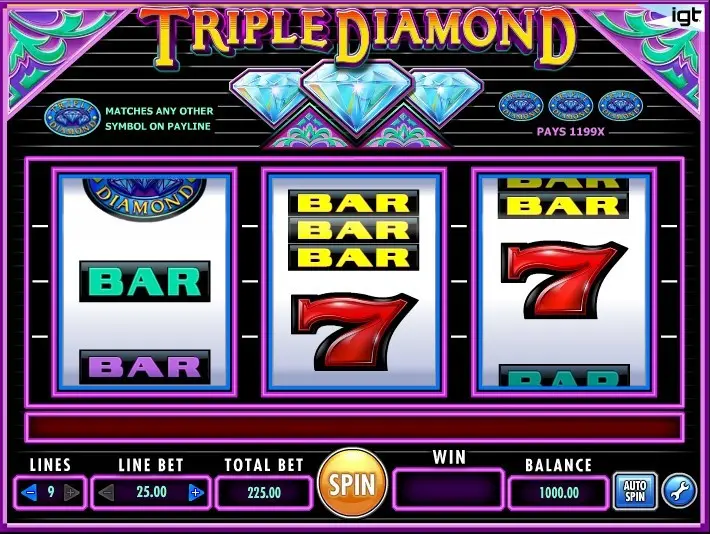
Triple Diamond is a three-reel classic from IGT that sits well below the current market average on return-to-player while ranking in the 98th percentile for popularity. That combination tells you something useful before you spin: a large number of players chose this game despite its maths, likely because of its simplicity and brand recognition. If you are comparing it against modern titles, you will find better RTP figures elsewhere, so this review is for readers who value straightforward three-reel play over statistical edge.
Triple Diamond at a glance
This game draws on gems and diamonds, placing it in the classics and retro category with a three-reel format. Here are the figures IGT has published:
| Specification | Value |
|---|---|
| Provider | IGT |
| RTP | 95.06% |
| Reels | 3 |
| Primary theme | Gems and diamonds |
| Popularity rank | 318 (98.4th percentile) |
| Free demo available | Yes |
| Volatility | Not published |
| Max win | Not published |
| Stake range | Not published |
Several important fields are absent from IGT’s published data for this title. Volatility, maximum win, and stake range are not listed, which means you cannot model a full session with confidence before playing. A free demo is available, which partly compensates for the missing figures.
What a 95.06% RTP actually returns
RTP is a long-run theoretical return. A 95.06% figure means that across a very large number of spins, the game returns 95.06 units for every 100 wagered. In practice, no individual session comes anywhere close to that percentage. Over a short run of 100 or even 1,000 spins, your actual return will vary enormously.
To make the number concrete: if you played 1,000 spins at a hypothetical £1 per spin, the expected return would be £950.60, leaving an expected cost of £49.40 for that stretch of play. The same sample at £2 per spin would cost roughly £98.80. These are averages across millions of simulated outcomes, not predictions of any single session.
The corpus average RTP across reviewed slots sits at 95.71%, and IGT’s own portfolio averages 95.64%. Triple Diamond falls 0.65 percentage points below the corpus and 0.58 below its provider’s own mean. That gap means for every £100 wagered on Triple Diamond compared to an average slot, you lose approximately 65 extra pence over the very long run. It is not a catastrophic difference, but it is a consistent one. Among IGT’s catalogue of 114 games, this is on the lower end of return.
Volatility and what your session will feel like
IGT has not published a volatility rating for Triple Diamond. This is a meaningful gap for anyone planning a session, because volatility determines whether your balance will swing wildly between small wins or grind along with rare but larger hits.
In the absence of a stated figure, you can observe volatility directly in the free demo: track how often wins land over 200–300 spins. If hits come frequently but pay small amounts, the game behaves like a low-volatility title. If long stretches of nothing end with occasional larger payouts, expect high-volatility characteristics. Many three-reel classics in the gems-and-diamonds theme lean toward low-to-medium volatility because they rely on a small number of paylines and straightforward symbol matches, but I cannot confirm that for this specific title without published data.
Treat any volatility claim you see on third-party sites with caution when the provider has not confirmed the number itself.
The 3-reel layout and how wins are counted
Triple Diamond uses three reels, which places it in the oldest format still common in online play. Three-reel layouts typically carry fewer paylines than five-reel video slots, and wins are usually counted across horizontal lines running left to right across the reel strips. The name “Triple Diamond” strongly suggests that three matching diamond symbols form a top-paying combination, which is a standard mechanic in classic slots.
The simplicity matters for session planning: fewer reels and fewer ways to form combinations generally mean fewer winning spins per hundred, which is the flip side of the volatility question. With 484 games in the gems-and-diamonds theme across the corpus, this format is heavily represented. If you want a three-reel layout with a documented volatility rating and better return, Joker’s Jewels sits at 96.5% RTP and may suit readers who want a similar visual style with higher maths.
Stake range and sizing a bankroll
IGT has not published the minimum or maximum stake for Triple Diamond in the available data. This omission affects bankroll planning directly, because your minimum exposure per spin depends entirely on the game’s floor.
General guidance applies: a common bankroll rule is to hold at least 200 times your chosen stake. At a hypothetical £1 per spin, that means £200 to survive an unlucky stretch without exhausting your balance. Without knowing the actual minimum, you cannot determine how many spins your budget buys. The free demo is the fastest way to discover the stake range: open it, attempt to set the lowest possible bet, and note the result before committing real money.
If you find the minimum stake is higher than your budget can sustain for a reasonable session, look at games with confirmed lower floors from the same provider. Cleopatra is another IGT classic at 95.02% RTP that may share a similar stake structure while offering a different bonus mechanic.
Playing the Triple Diamond demo before you commit
A free demo version of Triple Diamond is available. Demo play lets you observe the game’s rhythm, identify its hit frequency, and understand how the three-reel layout behaves in practice — none of which published data can replicate. Demo results carry no financial consequence, and they do not predict real-money outcomes, because the random number generator operates independently each spin regardless of mode.
Use the demo to test a specific question: how long does your chosen budget last at a given stake? Count your spins and track your balance over 300 plays. That exercise gives you a realistic picture of session length that no RTP figure can provide.
When you do transition to real-money play, treat Triple Diamond as paid entertainment with a fixed cost. Set a budget before you start, accept that the 95.06% RTP means the house holds roughly 4.94% over the very long run, and stop when that budget is spent. You must be 18 or older to play for real money.
Verdict: who should play Triple Diamond
Triple Diamond suits players who want a recognisable, no-frills three-reel spin without caring about cutting-edge maths. Its 98.4th-percentile popularity confirms that a very large audience makes that choice. But the published return of 95.06% places it below both the corpus average and IGT’s own portfolio mean, so if you are optimising for expected value, better options exist.
For readers drawn to the gems-and-diamonds aesthetic who want stronger returns, Love Gems Hold and Win publishes a 97.1% RTP — more than two full percentage points higher, which translates to roughly £2.04 saved per £100 wagered over a very large sample. If you want a different IGT classic with a comparable profile, Da Vinci Diamonds at 94.94% trades a slight additional RTP cost for cascading-reel mechanics and a more modern feature set.
The missing volatility and max-win data is the most significant gap. A player who cannot confirm the risk profile of a game before staking real money should use the demo extensively, and should not expect the free-play session to mirror the results they will see on a live bet.
Frequently Asked Questions
What is the RTP of Triple Diamond?
Triple Diamond returns 95.06%, which is 0.65 percentage points below the corpus average of 95.71% and 0.58 points below IGT's own portfolio average of 95.64%. That gap means the game is a below-average return option within its provider's 114-game catalogue.
Is Triple Diamond available to play for free?
Yes, a free demo of Triple Diamond is available. Demo play lets you observe the three-reel layout's behaviour and test stake ranges without financial risk, though no demo session can predict real-money outcomes since each spin is independent.
What volatility does Triple Diamond have?
IGT has not published a volatility rating for Triple Diamond. Without this data, you cannot model swing sizes or session-length expectations before playing. The free demo is the most reliable way to observe hit patterns and infer whether the game behaves like a low, medium, or high-volatility title.
Who makes Triple Diamond and what else does this provider offer?
Triple Diamond is developed by IGT, a provider with 114 games in the reviewed corpus. Other well-known IGT titles include Cleopatra at 95.02% RTP and Da Vinci Diamonds at 94.94% RTP, both of which also sit below the provider's 95.64% average.
How does Triple Diamond compare to similar gems-and-diamonds slots?
Triple Diamond's 95.06% RTP falls below several competitors in the same theme. Joker's Jewels returns 96.5% and Love Gems Hold and Win returns 97.1%, meaning those games theoretically retain less of your stake over a very large sample than this three-reel IGT classic.