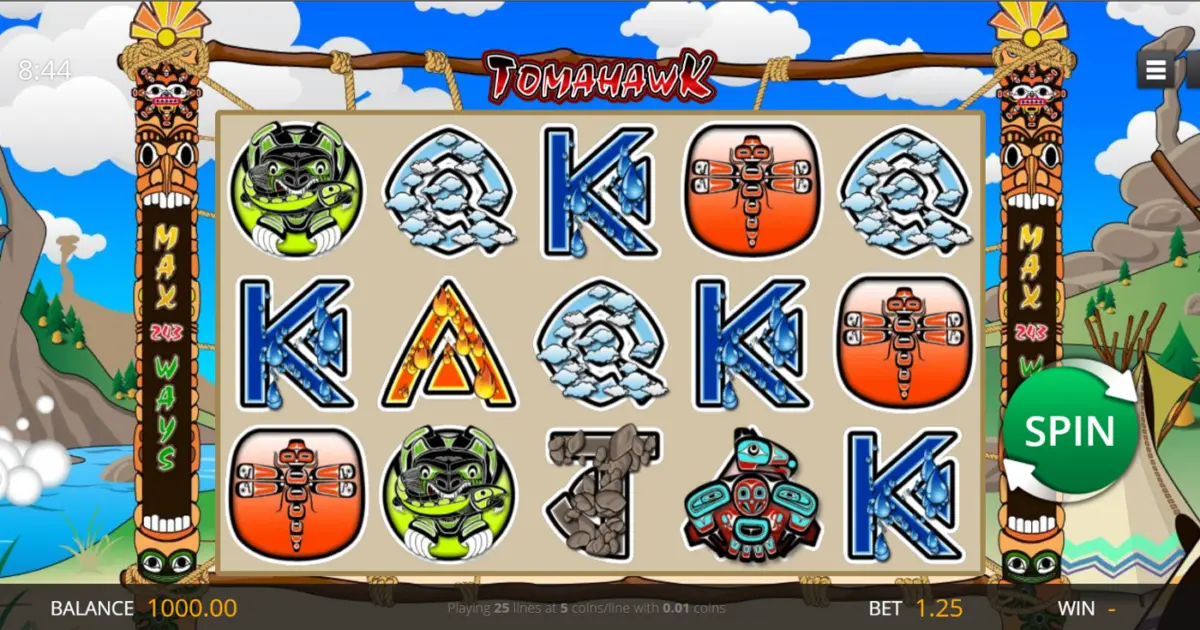
Tomahawk is a Genii slot that sits in the middle of the pack for popularity but leaves a key question unanswered: no RTP has been published for this title. That absence matters more than it sounds, because without a verified return-to-player figure you cannot benchmark long-run value or compare it cleanly to other games. The tomahawk slot is best approached as a try-before-you-judge game — the free demo is available, so you can check pace and fit without committing a bankroll.
Tomahawk versus the average slot
Most slot comparisons start with RTP versus the corpus average, but Tomahawk does not give you that starting point. The site’s corpus average RTP across all tracked slots is 95.71%, which represents the expected return of £95.71 per £100 wagered across a very large sample if each game were weighted equally. Genii’s own portfolio averages 95.93% across its 68 titles, slightly above the corpus mean by 0.22 percentage points.
Tomahawk itself has no RTP figure published in FACTS, so there is no rtp_vs_corpus value to report. That is not a rounding issue — it means the provider has not disclosed a verifiable percentage for this specific game in the data set supplied here, and you should treat any number quoted elsewhere as unverified unless Genii confirms it directly.
Popularity gives a different kind of context. Tomahawk is ranked 2942 and sits on the 85.3rd popularity percentile. In practical terms that places it above roughly six out of seven tracked titles for player interest, even without a public RTP to anchor expectations. It does not tell you whether the game pays often or rarely, but it does suggest you will find discussion and demo access more easily than for niche releases.
When RTP is missing, the honest comparison is to say what you cannot infer. You cannot calculate an expected loss per 100 spins, you cannot rank it against the 95.71% corpus average on value, and you cannot say whether its long-run price is higher or lower than a typical slot. Use the demo to evaluate feel and structure instead, and treat bankroll planning as provisional until a figure is published.
RTP breakdown: No published figure in context
Normally this section would translate a stated RTP into concrete numbers: £96.00 per £100 wagered across millions of spins at 96%, for example, or a £3 higher expected return per £100 versus a 93% game over a very large sample. Those translations are useful because RTP is a long-run statistical average, not a promise for any session, and every spin remains independent.
For Tomahawk, Genii has not published an RTP in the FACTS supplied, so no such breakdown can be made accurately. The table below therefore omits an RTP row rather than inserting a placeholder — missing data is itself information, and inserting an estimate would mislead you about expected value.
What you can do with an RTP when it is available is still worth stating clearly, so you know what to look for if the figure appears later. A higher RTP lowers the theoretical house edge over a huge sample (100% minus RTP), while a lower RTP raises it. Over 1,000 spins at £1, the difference between 96% and 95% is about £10 in expected return across the sample, but variance means any single session can finish well above or below that average. Many slots also offer multiple RTP configurations depending on jurisdiction or operator, so a single headline figure should always be checked against the version you are playing.
Until Genii publishes a figure for Tomahawk, approach any third-party RTP claim with caution. If you see a number on another site, ask whether it cites Genii directly and whether it specifies the exact version. Without that verification, treat the game as unbenchmarked for value and focus your evaluation on structure, stake range if disclosed, and how the pacing feels in free play.
| Item | Detail |
|---|---|
| Game | Tomahawk |
| Provider | Genii |
| Type | Slot Machine |
| Popularity rank | 2942 |
| Popularity percentile | 85.3rd |
| Provider portfolio size | 68 games |
| Provider average RTP | 95.93% |
| Corpus average RTP | 95.71% |
| RTP for this title | Not published |
| Free demo | Available |
Volatility profile
Volatility is the part of the maths that shapes how a session feels, separate from RTP. Low volatility typically means smaller, more frequent swings and longer average session length on a fixed bankroll. High volatility typically means larger swings, longer dry spells, and a higher bankroll requirement to weather the variance for the same stake. Medium volatility sits between those two trade-offs.
Genii has not disclosed a volatility rating for Tomahawk in FACTS, so no low, medium or high label can be assigned here. That matters for planning: without a published profile you cannot safely assume how quickly balance moves or how many spins a given budget might sustain.
In general terms, the interaction with bankroll is straightforward. If you bring £50 to a game and stake £0.50, you have 100 betting units before accounting for wins and losses. A more volatile game will chew through those units faster on average during losing runs, while a less volatile game will tend to stretch them. Because every spin is independent, no pattern of stakes, timing, or bet sizing changes the underlying expected value — it only changes how quickly you are exposed to variance.
With Tomahawk, use the free demo to observe the tempo that volatility would normally describe: how often wins occur, how far apart larger results feel, and whether the pacing suits the session length you prefer. Those observations do not predict real-money results, but they help you decide whether you would need a larger or smaller unit budget if you later play with cash and a verified stake range.
Genii as a studio
Genii is a studio with 68 games tracked in this data set, and its portfolio average RTP of 95.93% sits just above the corpus average of 95.71%. That 0.22-point edge is modest across a portfolio — it suggests Genii titles on average price slightly closer to the player than the overall market mean, but individual games can still sit above or below that line, and Tomahawk cannot be placed without its own figure.
A portfolio of this size usually indicates a mix of mechanics and themes rather than a single signature format. What you can reliably infer from the average is breadth, not consistency: an average near 95.9% does not mean every Genii game clusters tightly around it.
For direct comparison within the same studio, consider Roll up! Roll up! if you want to stay inside the Genii catalogue and see how another of their builds is presented. Pieces of Eight offers a second Genii reference point for layout and information depth, while Mrs Green’s Plant Emporium provides a third example from the same provider to compare documentation and demo availability. None of these three has an RTP listed in FACTS either, which reinforces the pattern: Genii has not published verifiable RTPs for these specific titles in this data set, so cross-title value comparisons within the studio remain provisional.
Three alternatives worth comparing
FACTS does not include a theme label for Tomahawk and lists theme_game_count as 0, so there is no theme-based set to rank as direct alternatives here. The related_theme list is also empty in the data supplied, which means no curated theme mates can be surfaced with confidence rather than guessing.
That absence is useful to state plainly: without a theme tag, describing Tomahawk as a mythology, fruit, or adventure title in visual detail would be invention, and it would not help you choose a substitute. Instead, the most honest way to find alternatives is to pivot to what is known — provider and popularity context — and to use the demo to define what you like about the pacing before picking a comparator.
If you want alternatives, shop by maths and proven information rather than assumed visuals. Filter for games that do publish RTP and volatility so you can make an apples-to-apples decision, then test two or three in free play to see which tempo you prefer. You can still browse the Genii set above for studio-consistent options, but for true theme-based substitutes wait until a verified theme and feature sheet is published rather than relying on unverified summaries elsewhere.
Getting the most out of the free demo
Tomahawk free demo access is listed as available, so you can try the game with no download required in many browsers. The cleanest way to use free play is as a controls and pacing check, not as a predictor of real-money outcomes. Demo and real-money versions run on the same random number generation logic where certified, but results do not carry over and short samples tell you nothing about long-run averages.
Set a specific purpose before you launch. Check how the interface handles stake selection, autoplay limits, paytable access, and sound and speed toggles. Note how quickly 50 to 100 demo spins pass at the stake you would actually use, and whether that pace feels comfortable for the session length you prefer. If you try the Tomahawk no download demo, keep the window to a fixed number of spins — for example 100 — and stop there, so you evaluate on a defined sample rather than drifting.
Because every spin is independent, demo streaks do not signal that a game is hot, cold, or due. A good habit is to treat demo credits as entertainment units with no cash value and to close the session when you have your answer about fit.
When you move from demo to real money, if you choose to, keep the same discipline you use for any paid entertainment. You must be 18+ to play, set a budget before you start, and stick to it regardless of results. Treat deposits as the price of the session, not as funding for expected returns, and use operator tools like deposit limits or time-outs if you find yourself chasing. If play stops feeling like entertainment, pause and seek support from a recognised responsible-gambling resource in your jurisdiction.
Should you play Tomahawk?
Tomahawk makes sense to try if you like sampling Genii’s catalogue and you are comfortable evaluating a game without a published RTP. The 85.3rd percentile popularity suggests it is not an obscure release, demo access lets you test without commitment, and the studio’s portfolio average of 95.93% sits a fraction above the wider market.
The trade-off is transparency. Without a verifiable RTP and without a disclosed volatility profile or stake range in FACTS, you cannot anchor expectations for long-run value, swing size, or unit budget with numbers. That does not make the game good or bad — it makes it unbenchmarked. If having those figures disclosed is important to how you choose, prioritise titles that publish them and compare Tomahawk only on feel after you have tested it in the free demo.
Frequently Asked Questions
Can I play Tomahawk for free before wagering real money?
A free demo for Tomahawk is listed as available in FACTS, so you can try it without a deposit where offered. Free play uses demo credits with no cash value and does not predict real-money results, since every spin is independent. Use it to check pace and controls, then decide if it suits your session style.
What is the RTP of Tomahawk and what does it mean?
Genii has not published a verified RTP for Tomahawk in the data set used here, so no percentage can be reported. When an RTP is available, it means the theoretical return per £100 wagered across millions of spins — for example 95.71% corpus average implies £95.71 per £100 long-run. Treat any third-party number as unverified until Genii confirms it.
What is the volatility of Tomahawk?
No volatility rating is disclosed for Tomahawk in FACTS, so it cannot be labelled low, medium or high here. Volatility normally describes swing size and session length — higher means larger, less frequent swings and a bigger buffer needed. Test the demo for pacing, but remember observations do not predict future real-money variance.
Who makes Tomahawk and what else does the studio offer?
Tomahawk is made by Genii, a studio with 68 games tracked and a portfolio average RTP of 95.93%, slightly above the 95.71% corpus average. Related Genii titles in FACTS include Roll up! Roll up!, Pieces of Eight and Mrs Green's Plant Emporium, though none lists a verified RTP in this data set for direct value comparison.
Does playing the Tomahawk demo mean I will win if I play for real?
Demo play pays no real money and does not change expected value, because each spin is random and independent. A strong demo run does not make real-money wins more likely. If you move to cash play, you must be 18+, set a fixed budget, and treat the stake as the price of entertainment.