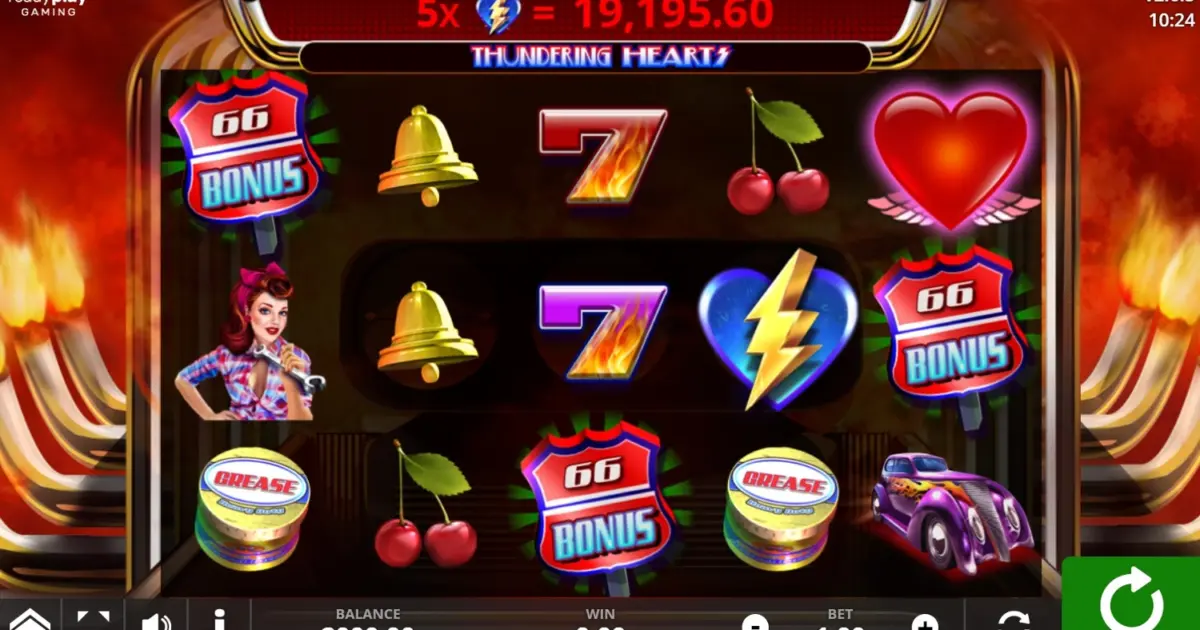
The decision point on the thundering hearts slot is its published return: 92.11%. That is 3.6 percentage points below the 95.71% average across the games catalogued on this site, and more than two points below Ready Play Gaming’s own 94.63% house average across 57 titles. A free demo is available, so you can look at the reels without staking anything.
What follows sticks to the figures Ready Play Gaming has actually published, plus the maths that applies to every five-reel game ever built. Where the data sheet is blank, this review says so rather than filling the gap with invention.
First look at Thundering Hearts
This is a five-reel release from Ready Play Gaming, filed under the Slot Machine subcategory. It sits at rank 2431 for traffic across the catalogue, which places it in the 87.8th percentile for popularity — better known than most, but a long way from the front page.
The published data set is thin. Ready Play Gaming has listed the reel count and the return figure, and nothing else. There is no paylines or ways count on record, no stake range, no volatility rating, no maximum win multiplier, no hit frequency, and no release date. That absence matters in a practical way: it means anyone quoting a max win or a bonus-buy price for this title is working from something other than the studio’s own published figures, and you should treat those numbers with caution until the studio confirms them.
| Figure | Value |
|---|---|
| Provider | Ready Play Gaming |
| RTP | 92.11% |
| Reels | 5 |
| Category | Slot Machine |
| Popularity rank | 2431 (87.8th percentile) |
| Provider average RTP | 94.63% across 57 games |
| Catalogue average RTP | 95.71% |
| Free demo | Available |
How a round plays out
Five reels is the standard modern layout, and the mechanical rhythm is the same everywhere: you set a stake, the reels resolve into a fixed grid, and the game checks the result against its paytable. Each spin is resolved independently of the one before it. Nothing carries over unless the game explicitly says it does, and no sequence of losses makes the next outcome more likely.
Beyond that, the honest answer is that the published data does not describe the feature set. Many five-reel slots use wild substitutions, scatter symbols that trigger a free-spin round, or a paid feature-entry option — those are common conventions across the genre, not confirmed elements of this game. Because the paylines or ways figure is not on record either, there is no way to say from the data whether wins are evaluated across 10 lines, 25 lines, or a ways-style mechanic that counts symbol clusters per reel.
This is exactly the situation a demo is for. Load it, watch the paytable, and read the mechanics off the screen rather than off a review. The in-game help file is the authoritative source for feature behaviour, and it costs nothing to open.
Reading the 92.11% return figure
Return to player is a long-run statistical average, not a session promise. At 92.11%, the game is modelled to return £92.11 for every £100 wagered across a very large sample of spins — millions, not hundreds. The remaining £7.89 per £100 is the theoretical house margin.
Put that in session terms. Wager £1 per spin for 500 spins and you have staked £500; the modelled return on that volume is about £460, an expected cost of roughly £40. Over 2,000 spins at the same stake you have wagered £2,000, with a modelled shortfall near £158. Your actual result will scatter widely around those numbers in both directions, because variance dominates over short runs. The average only asserts itself over sample sizes no individual player reaches.
The comparison is what makes 92.11% notable. Against the 95.71% catalogue average, the margin here is roughly 1.8 times larger — 7.89% versus 4.29%. Per £1,000 wagered, that is about £36 more in expected cost. Ready Play Gaming’s Jungle Fever Super Reels publishes 95.05%, and Lucky Turtle lists 95.04%, so the studio’s own shelf holds materially better returns than this one.
Why unpublished volatility changes your bankroll maths
No volatility rating has been published for this title, and that gap is worth understanding rather than guessing around. Volatility describes how the return arrives, not how much of it arrives. Two games can both hold 92.11% and feel nothing alike.
A low-volatility build pays small amounts often. Balances drift down gently, sessions last a long time on a given bankroll, and results cluster fairly close to the modelled average even over a few hundred spins. A high-volatility build does the opposite: long stretches of nothing, punctuated by occasional larger payouts, and a much wider spread of possible outcomes. On the same bankroll, the high-variance game can empty it well before the modelled average has any chance to show up.
Without the rating, size your bankroll for the harsher case. A common approach is to treat your session budget as a fixed number of spins rather than a target — decide you are spending £30 across 300 spins at 10p, and accept that figure as the cost of the entertainment. Because the return figure is below average here, the same budget buys fewer expected spins of play than it would on a 96% game.
Bet sizing from the unpublished minimum upwards
Ready Play Gaming has not published a stake range for this game, so the minimum and maximum bet will show on the game’s own bet panel rather than on any spec sheet. Check it in the demo before you commit real money — it is the single most useful number the data sheet is missing.
The arithmetic that matters does not depend on the exact floor. Your stake multiplied by your spin count is your total exposure, and the 7.89% margin applies to that total, not to your starting balance. Someone spinning 20p for 400 spins has wagered £80 and faces a modelled cost near £6.30. Someone spinning £2 for the same 400 spins has wagered £800 and faces a modelled cost near £63. Ten times the stake is ten times the expected cost and ten times the swing size.
Two things to avoid. Do not raise stakes to recover a loss: the outcome distribution is identical on the next spin regardless of what came before, so a larger bet simply increases both the possible recovery and the expected cost. And do not treat demo results as a guide. Free play uses the same mathematics but carries no money, so a good or bad demo run tells you nothing about what a funded session will do.
Where the thundering hearts slot sits among 5-Reels slots
Within the five-reel field, this one competes on recognition rather than numbers. The 87.8th popularity percentile says people do find it; the 92.11% return says they are paying more per spin than the field average to play it. No other games in the catalogue currently carry the same theme tag, so the most useful comparisons are inside the studio’s own range.
Ready Play Gaming slots run to 57 titles at a 94.63% average. Spin Carnival sits exactly on that average at 94.63%, which makes it a clean like-for-like from the same studio at 2.5 points better return. Jungle Fever Super Reels and Lucky Turtle both clear 95%, close to the wider catalogue norm. If the appeal for you is the studio rather than this specific game, those three are the obvious first stops.
None of that makes this title unplayable. It makes it expensive relative to its neighbours, which is a different claim. A player who enjoys the presentation and plays small stakes for a short session is paying a few extra pounds for that preference — a legitimate trade, as long as it is a choice rather than an accident.
The honest verdict
92.11% is the number that decides this one. It is below the catalogue average, below Ready Play Gaming’s own average, and below all three of the studio stablemates listed above. Combined with a data sheet that omits paylines, stake range, volatility and max win, there is not much here to argue for it on numbers alone.
What the game does have is a free demo and enough traffic to suggest people like playing it. That is a reasonable basis for a look, and the Thundering Hearts free demo is the right way to take that look — you can read the paytable, see the bet range, and judge the feel without exposure. If the presentation wins you over and you are content with the higher margin, play it small and play it short.
Slots are 18+ entertainment, and the honest way to budget for them is as a purchase rather than an investment. Decide what the session is worth to you before you start, stake only that, and stop when it is gone. If the amount you are spending stops feeling like the price of an evening, that is the signal to step away.
The short version: play the demo, compare the return against the 95%-plus options from the same studio, and make the call with the actual figure in front of you.
Frequently Asked Questions
Can you play Thundering Hearts for free?
A free demo is available for this title, so you can spin the five reels with no money staked. The demo runs on the same mathematics as the funded version, including the 92.11% published return, but no result in it can pay out. Use it to check the bet panel and paytable, both of which are absent from the published data.
What is the RTP of Thundering Hearts?
The published return to player is 92.11%, meaning a modelled £92.11 back per £100 wagered across a very large sample of spins. The theoretical house margin is 7.89%. That sits 3.6 points below the 95.71% average across the games catalogued here, so expect a higher cost per £100 staked than on a typical five-reel release.
Is Thundering Hearts high or low volatility?
Ready Play Gaming has not published a volatility rating for this game, so any figure you see quoted elsewhere is not from the studio. Because the risk profile is unknown, plan your bankroll for the harsher scenario: a fixed spin count at a small stake, with the budget treated as spent. Volatility affects swing size, not the 92.11% return.
Who makes Thundering Hearts and what else do they produce?
Ready Play Gaming developed it, and the studio has 57 titles in this catalogue at an average return of 94.63%. Alternatives from the same developer include Spin Carnival at 94.63%, Lucky Turtle at 95.04% and Jungle Fever Super Reels at 95.05% — all three publish better returns than this game does.
How much does it cost to spin Thundering Hearts?
No minimum or maximum stake has been published, so you will need to read the bet range off the game's own panel. Whatever the floor is, total exposure equals stake multiplied by spins: 400 spins at 20p is £80 wagered, carrying a modelled cost near £6.30 at 92.11%. Raising stakes never improves that ratio.