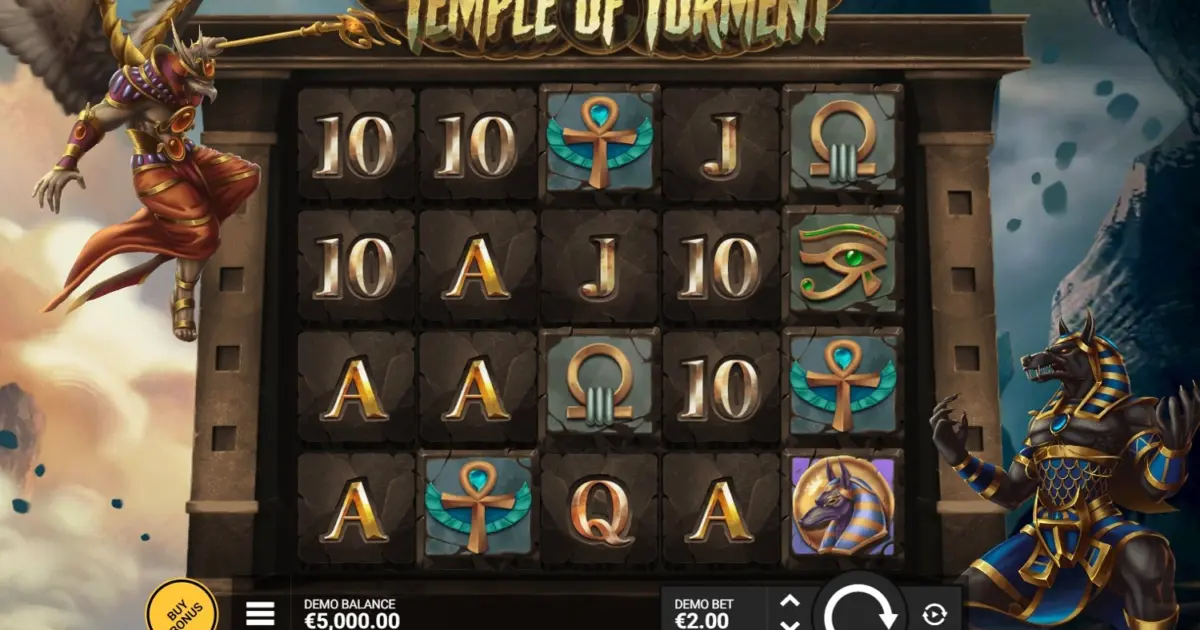
Temple of Torment slot sits above average in the RTP table but lacks published volatility data, so you cannot size a session from the numbers alone. The free demo lets you find out how it behaves without risking a penny. That combination makes it a reasonable pick for players who prefer to feel out a game before wagering real money.
Is Temple of Torment worth playing?
Short answer: worth a demo spin, worth a second look only after you have experienced the rhythm yourself. The 96.22% RTP places it 0.12 percentage points above Hacksaw Gaming’s provider average of 96.1% and 0.51 points above the wider corpus average of 95.71%. That is a real but narrow edge — you will not feel it in a single session of 200 spins. The game has climbed to rank 921 overall yet sits in the 95.4th popularity percentile, meaning a large share of players have tried it. Hacksaw Gaming has shipped 156 titles, so Temple of Torment is part of a well-stocked portfolio rather than an isolated experiment.
The missing pieces matter: no volatility classification, no stated max win, no published hit frequency. If you rely on those figures to pick your games, this review cannot help you beyond the RTP number.
| Provider | Hacksaw Gaming |
|---|---|
| RTP | 96.22% |
| Reels | 5 |
| Theme | Mythology |
| Free demo | Yes |
What 96.22% RTP means over 1,000 spins
RTP is a long-run statistical average calculated across millions of simulated outcomes. A 96.22% figure means that for every £100 wagered across that enormous sample, the theoretical return is £96.22, leaving a theoretical house edge of £3.78 per £100.
Over 1,000 spins at a hypothetical £1 stake you would have wagered £1,000 total. The theoretical return is £962.20 — a net loss of £37.80. But this is an average stretched over thousands of hours of play. In any single session of 1,000 spins you will land somewhere far from that line. You might walk away up £400 or down £600. The RTP number tells you the direction the maths leans over an ocean of spins, not what happens in your afternoon.
The 0.51-point gap between this game and the corpus average is small. If you compare a £200,000 lifetime wagering volume, 0.51% saves you roughly £1,020 versus an average slot. That is meaningful across years of play but invisible in a single sitting.
How volatile is Temple of Torment?
Hacksaw Gaming has not published a volatility rating for this title. That absence is unusual for the provider — many of their slots come with clear low, medium or high labels — and it means you cannot forecast your experience from the numbers available.
In general terms, high-volatility slots concentrate returns in rare large events, producing long stretches of small or zero payouts punctuated by occasional big hits. Low-volatility games spread wins thinly, keeping your balance closer to where you started but rarely spiking. Medium sits between. Without a rating here, your only tool is the free demo: spin it for a few hundred rounds at a comfortable stake and watch how often something lands versus how much it pays.
Because Hacksaw Gaming is known for a wide volatility spread across its catalogue, assuming any particular profile for this title would be guessing. Treat the demo as your research.
What the Mythology theme brings to the game
The theme labels — Mythology, Egypt, Gods — tell you the visual direction draws on ancient belief systems with Egyptian flavour. Five reels confirm a standard layout that most players already recognise, so the on-screen grid will feel familiar.
Egyptian and mythological themes are among the most heavily populated categories in online slots. The corpus holds 801 games under the Mythology tag alone, which means the art, symbols and audio are competing against hundreds of direct neighbours. What sets a title apart in such a crowded field is almost always its mechanic rather than its setting, and with no mechanic details published beyond the reel count, the theme is doing the heavy lifting for first impressions.
If you have played other mythology slots, you will recognise the visual vocabulary immediately. That is neither a flaw nor a strength — it is simply the context you are walking into.
Stakes, session length and bankroll
Hacksaw Gaming has not published a min/max stake range for Temple of Torment in the data available here. The actual limits depend on which operator hosts the game, so they can differ between sites even for the same title.
Without a volatility figure and without confirmed stake bounds, bankroll planning becomes a demo exercise. Set the amount you are willing to lose before you open the real-money version. If the demo shows you surviving 200 spins at a given stake without a notable hit, expect similar dry stretches at the same stake with real money. If the demo produces frequent small returns, you are seeing low-to-medium behaviour in practice regardless of any label.
The practical rule is to divide your session budget by the number of spins you want. Twenty pounds over 200 spins means a £0.10 stake. Twenty pounds over 50 spins means £0.40. Both are legitimate approaches; they just produce different session lengths and different emotional experiences.
Alternatives if the Temple of Torment slot isn’t for you
If you want the same provider with a clearer data profile, Wanted Dead or a Wild carries a 96.38% RTP and is one of Hacksaw Gaming’s most recognisable titles. It has a published volatility rating that removes the guesswork this review has to flag for Temple of Torment.
For a slightly higher theoretical return within the provider’s catalogue, Le Bandit sits at 96.34% RTP. Both games share Hacksaw’s production values but differ in theme and mechanical approach.
If mythology is the draw rather than the provider, Gates of Olympus returns 96.5% RTP — the strongest figure among the related titles — and has built a dedicated following with its tumble mechanic. You can also compare it against 9 Arrows of Odysseus at 94.0% RTP to see how much the extra two and a half percentage points matter over your preferred session length.
Final take
Temple of Torment earns a cautious recommendation for demo play: the RTP is above average, the provider is established, and the game is widely tried. The missing volatility and stake data mean you cannot plan a real-money session from numbers alone, so the free demo is not optional here — it is essential groundwork.
If you decide to play with money, set a budget before you spin, treat the cost as entertainment rather than investment, and stop when that budget is spent regardless of results. Every spin is independent; no sequence of outcomes changes the next one. If gambling stops feeling like entertainment, resources like GamCare or BeGambleAware can help you take control. You must be 18 or over.
Frequently Asked Questions
Can I play Temple of Torment for free?
Yes. A free demo version of Temple of Torment is available, letting you spin the five-reel layout without depositing money. The demo uses the same 96.22% RTP configuration as the real-money version, though no demo session predicts your actual results.
What is the RTP of Temple of Torment?
The published RTP is 96.22%, which places it 0.51 percentage points above the overall corpus average of 95.71% and slightly ahead of Hacksaw Gaming's own portfolio average of 96.1%. The figure is a long-run theoretical return, not a guarantee for any individual session.
Is Temple of Torment high or low volatility?
Hacksaw Gaming has not published a volatility rating for this title. Without that figure, you cannot determine whether the game pays small and often or infrequently with large spikes. The free demo is the only way to observe the payout rhythm before staking real money.
What other games does Hacksaw Gaming make?
Hacksaw Gaming has produced 156 titles in total. Popular alternatives include Wanted Dead or a Wild at 96.38% RTP and Le Bandit at 96.34% RTP, both carrying higher returns than Temple of Torment. The provider spans multiple themes and mechanics across its catalogue.
How does Temple of Torment compare to Gates of Olympus?
Gates of Olympus returns 96.5% RTP versus Temple of Torment's 96.22% — a gap of 0.28 percentage points. Gates of Olympus also carries a fully published volatility rating, while Temple of Torment does not. Both fall under the mythology theme tag.




