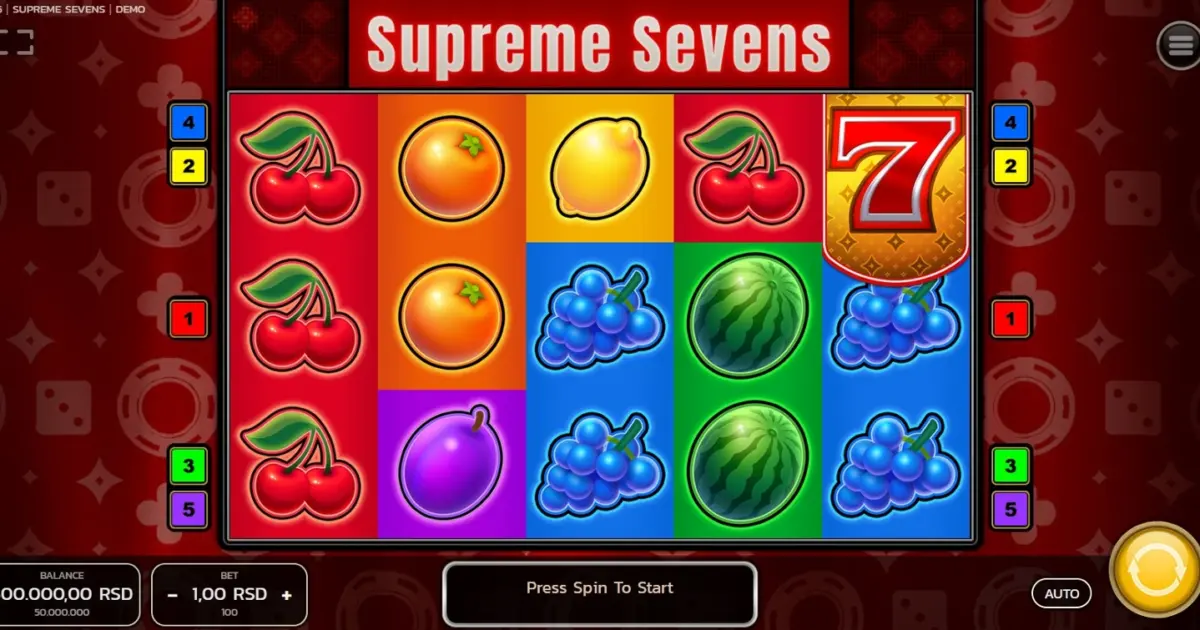
Supreme Sevens is a five-reel fruit-themed release from TipTop with a published return to player of 96%. That sits 0.29 percentage points above the 95.71% average across the games in this database, so on the one number that matters most, the supreme sevens slot is slightly better than the middle of the pack. What TipTop has not published is a volatility rating, a paytable, a payline or ways count, or a maximum win, and no release date is recorded either. That absence shapes the rest of this review.
Who makes Supreme Sevens Slot
TipTop is the studio behind this title, and 65 of its games are catalogued here. That is a mid-sized library. It is large enough that the studio has a house style and a settled approach to maths, but small enough that it is not a name most players will recognise from lobby front pages.
The useful detail is the consistency. Across TipTop’s catalogued titles the average RTP works out at 96.0%, which is exactly what Supreme Sevens returns. In other words, this game is not a deliberately weaker or stronger version of the studio’s standard. It is the standard. That is worth knowing because some studios ship the same game at several RTP settings and leave it to the operator to pick which one you get. When a provider’s catalogue average and an individual game’s figure line up this precisely, there is less reason to suspect a lower-paying variant is circulating.
| Detail | Value |
|---|---|
| Game | Supreme Sevens |
| Provider | TipTop |
| RTP | 96.0% |
| Reels | 5 |
| Themes | Fruits, 5-Reels |
| Type | Slot Machine |
| Popularity rank | 2249 (88.7th percentile) |
| Provider catalogue size | 65 titles |
| Free demo | Available |
Where Supreme Sevens sits in the TipTop catalogue
Flat is the word for it. Compare Supreme Sevens with Fruit Wild Lines, another TipTop title in the same fruit territory, and the RTP is identical at 96.0%. Step across to the studio’s dice-style releases and nothing changes: Da Vinci Dice also returns 96.0%. If you were hoping to trade themes for a better long-run return inside this catalogue, there is no trade to make.
That has a practical consequence. Within TipTop’s library, your choice comes down to format and presentation rather than mathematics, because the return figure is the same wherever you land. A five-reel fruit machine and a dice-mechanic game will feel very different across a session even when they pay back the same proportion over a very large sample. The distribution of those returns, how often small wins land and how large the rare ones are, is where the real difference lives. TipTop has not published that distribution for Supreme Sevens, so comparing its feel to its stablemates is something you can only do by loading both in demo mode and watching what happens.
RTP: 96.0% against a 96.0% house average
A 96.0% RTP means the game is modelled to return £96.00 for every £100 wagered across a sample far larger than any individual session. At a £1 stake over 1,000 spins you wager £1,000, and the theoretical return on that is £960. You will almost never see exactly that. Short runs scatter widely around the long-run figure, and that scatter is the whole reason slots are entertaining and also the whole reason they cost money.
The 4% house edge is the part that does not scatter. It applies to every spin, at every stake, regardless of what happened on the spin before. Each spin is an independent event, so nothing in the results so far changes what the next one is likely to do.
Against the 95.71% corpus average, 96.0% is a marginal edge, worth roughly 29 pence per £100 staked. Real, but small. Against TipTop’s own 96.0% average, it is neutral. The comparison that matters more is the one further down against fruit titles from other studios, where the spread is wider.
Volatility and who it suits
No volatility rating has been published for this game, and that is a genuine gap rather than a formality. Volatility describes the shape of the returns rather than their size. Two games can both hold a 4% edge and behave nothing alike.
A low-volatility slot pays small amounts often. Your balance drifts down gently, sessions last a long time on a modest bankroll, and big results are rare to the point of irrelevance. A high-volatility slot does the opposite: long dry stretches punctuated by occasional larger hits, which means the same bankroll buys far fewer spins before a bad run ends the session. High-volatility play demands a deeper bankroll to survive the variance, not because the game owes you anything afterwards, but simply so you are still playing when a bigger result happens to land.
Without a figure, treat Supreme Sevens as unclassified. The safe approach is to plan as though it could swing hard: keep the stake small relative to your budget, and use the demo to get a rough feel for how frequently anything lands before you commit real money. Anyone quoting a specific volatility rating or max win for this title is quoting something TipTop has not released.
Playing Supreme Sevens for free
A free demo is available, which is the cheapest way to answer the questions the data sheet cannot. In demo mode you can watch how often the reels produce anything at all, how the base game paces itself, and whether the presentation holds your attention for more than five minutes. The Supreme Sevens free demo runs in the browser, so there is nothing to install.
One caveat that matters. Demo play uses play-money credits and cannot pay out real money, and a good or bad run in demo mode tells you nothing about what a real-money session will do. The maths is identical either way, and identical maths still produces wildly different short-run outcomes. Use the demo to judge whether you enjoy the game, not to judge whether it is going to pay.
Slots are paid entertainment, not income. Play only if you are 18 or over, decide before you start what you are willing to spend, and treat that amount as the price of the session rather than a stake you expect back. If the number stops feeling comfortable, stop.
Similar picks
The fruit category here runs to 2,560 titles, so there is no shortage of alternatives, and some of them pay back more. Hot Hot Fruit is the clearest example at 96.84% RTP, which is 0.84 percentage points better than Supreme Sevens. Over £1,000 wagered that difference is about £8.40 in theoretical return, and it costs you nothing to prefer the higher figure.
Going the other way, Trickstar Spins returns 94.0%, a full two points below this game and a clear step down on the one metric you can actually verify before playing. It is a useful reminder that a published RTP in the mid-90s is not a given, and that checking the number is worth the ten seconds it takes.
Supreme Sevens sits at rank 2249, placing it in the 88.7th percentile for popularity. That is upper-tier attention but not front-page fame, which is roughly where a solid, unflashy fruit machine from a mid-sized studio would be expected to land.
Verdict
Supreme Sevens is a fair, unremarkable five-reel fruit machine. The 96.0% RTP is slightly above the corpus average and exactly in line with TipTop’s house figure, so you are neither being short-changed nor handed anything special. The 4% edge is the honest cost of playing.
The reason to hesitate is what is missing. With no volatility rating, no paytable and no published max win, you cannot tell in advance whether this game will grind quietly or swing hard, and that makes bankroll planning guesswork. The free demo closes some of that gap, which is where to start. If you want a higher verified return in the same theme, Hot Hot Fruit is the stronger number on paper.
Frequently Asked Questions
Can I play Supreme Sevens for free?
A free demo of Supreme Sevens is available and runs in the browser with no download required. It uses play-money credits, so nothing you win or lose is real. The demo is the practical way to gauge pacing and hit frequency, since TipTop has not published a volatility rating or paytable for this title.
What is the RTP of Supreme Sevens?
The published RTP is 96.0%, meaning the game is modelled to return £96.00 for every £100 wagered across a very large sample. That leaves a 4% house edge on every spin. It sits 0.29 points above the 95.71% average in this database and exactly matches TipTop's 96.0% catalogue average.
Is Supreme Sevens high or low volatility?
TipTop has not published a volatility rating for Supreme Sevens, so treat it as unclassified and be sceptical of any site quoting a figure. Volatility governs swing size and how long a bankroll lasts, not overall return. Until a rating exists, keep stakes small relative to your budget and test the free demo first.
Who is TipTop and what else do they make?
TipTop is the studio behind Supreme Sevens, with 65 titles catalogued here at an average RTP of 96.0%. Their range spans fruit machines like Fruit Wild Lines and dice-mechanic games including Da Vinci Dice and 5 Hot Strike Dice, all of which return the same 96.0% figure as this release.
How does Supreme Sevens compare to Hot Hot Fruit?
Hot Hot Fruit has the better published return at 96.84% against 96.0% for Supreme Sevens, a gap worth roughly £8.40 in theoretical return per £1,000 wagered. Both sit in the fruit category, which runs to 2,560 titles here. Neither game has a published volatility rating in this data set.