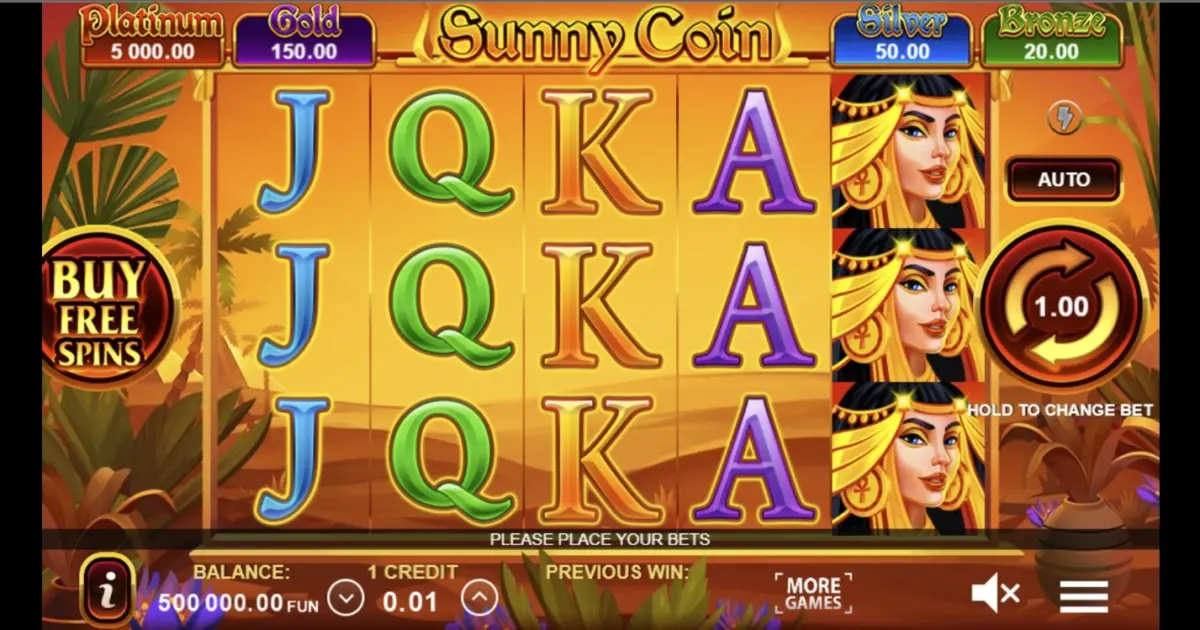
The sunny coin: hold the spin slot gives you three hard numbers to work with: a 96% RTP, five reels, and a build by Gamzix. Almost everything else is unpublished, including the volatility band, the payline count, the stake limits and any maximum win figure. That gap is the main thing to weigh, and it is the reason a free run is worth more here than reading a feature list.
The 5-reel grid explained
Five reels means five vertical columns that stop independently on each spin. Each column shows a small window of symbol positions, and the combination of those positions is what the game reads to decide whether anything has landed. The most common arrangement in this format is three rows deep, giving fifteen visible positions, but Gamzix has not published a row count for this title, so treat any grid diagram you see quoted elsewhere as unverified.
Reel count on its own tells you less than people assume. It sets the outer shape of the game and nothing about how generous it is. A five-reel slot can pay through a handful of fixed lines or through hundreds of symbol combinations, and two games with identical grids can feel completely different across the same hundred spins. What the five-column layout does tell you is that the game follows the standard video-slot convention rather than a three-reel classic format or a cluster grid, so the reading of combinations runs across the reels rather than in blobs.
| Detail | Value |
|---|---|
| Game | Sunny Coin: Hold the Spin |
| Provider | Gamzix |
| RTP | 96.0% |
| Reels | 5 |
| Primary theme | Egypt |
| Game type | Slot Machine |
| Popularity rank | 2,248 (88.7th percentile) |
| Titles in the Gamzix catalogue | 48 |
| Free demo | Available |
Paylines, ways and how Sunny Coin: Hold the Spin pays
There is no payline figure in the published data for this game, so the honest answer is that you will find out when you load it. That is not unusual for smaller studios, and it is worth knowing in advance rather than assuming a number.
In general terms, five-reel slots resolve wins in one of three ways. Fixed paylines run a set number of defined paths across the grid, and you stake the whole set on every spin. All-ways or “pays anywhere” systems drop the line concept and reward matching symbols in any position on consecutive reels. Ways-style counts, the sort quoted as 243 or 1,024 ways, multiply the symbol positions on each reel together. Many slots also layer in wilds that substitute for regular symbols, and scatters that pay from anywhere on the grid instead of along a path.
Those are conventions across the category, not confirmed features of this release. The same applies to free spins, hold-and-respin mechanics and buy features: common in modern slots, unconfirmed here. Check the in-game paytable before you commit real money, because the paytable is the only authoritative description of how a specific title pays.
96.0% RTP put in context
Return to player is a long-run average, not a promise about your session. A 96% RTP returns £96 per £100 wagered across a very large sample, which means a theoretical house edge of 4%. Over 10,000 spins at £0.50 you would stake £5,000 and the model expects £4,800 back. Over a hundred spins the figure tells you almost nothing, because variance dominates at that scale and every spin is independent of the last.
The comparison numbers are more interesting than the raw figure. Gamzix averages 95.87% across its 48 titles, so this sits slightly above the studio’s own norm. Across the whole database the average is 95.71%, putting this game 0.29 percentage points above the corpus average. That is a real but small edge: on £1,000 staked it is worth about £2.90 in expectation.
Within the same studio, Santa Sphere: Hold the Spin is marginally higher at 96.05%, while Coin Win: Hold The Spin returns 94.0%, a two-point gap that costs £20 per £1,000 staked in expectation. If RTP is your deciding factor, that last comparison matters far more than the difference between 96.0% and 96.05%.
Volatility and hit patterns
No volatility rating has been published for this game, and there is no hit frequency figure either. Since volatility shapes your session far more visibly than RTP does, that absence is the biggest unknown here.
The mechanics are worth understanding anyway. Low volatility games pay small amounts often, so your balance drifts rather than lurches and a modest bankroll lasts a long time. High volatility games pay rarely and pay larger when they do, which means long dry stretches punctuated by occasional spikes, and a bankroll that needs to absorb dozens of losing spins in a row without running out. Two games with identical 96% RTPs can deliver completely different experiences on this axis, because RTP describes the total returned while volatility describes how lumpily it arrives.
Without a published figure, the only practical approach is to watch how the balance moves over a few hundred demo spins and judge for yourself. No game is ever “due”, “hot” or “cold” during that process. The random number generator has no memory, a run of blanks does not make a win more likely, and a run of hits does not mean anything is warming up.
Choosing a stake when Gamzix has not published the limits
Minimum and maximum bet values are not in the available data for this title, so you will see the range on the bet selector when the game loads. What you can plan in advance is the size of your session budget and how many spins you want it to cover.
Work backwards from spins, not from stake. Decide the total you are willing to spend, then divide by the number of spins you want. A £40 budget at £0.20 a spin buys 200 spins; the same £40 at £2 a spin buys 20. The expected cost is identical in percentage terms, because the 4% house edge applies to turnover regardless of unit size, but the shorter session gives variance far more room to decide your outcome. Small stakes over many spins bring your result closer to the theoretical average. Large stakes over few spins widen the spread in both directions.
No staking pattern changes the maths. Raising your bet after losses, lowering it after wins, or timing your spins has no effect on expected value, because each spin is resolved independently.
Demo play versus real money
A Sunny Coin: Hold the Spin free demo runs the same maths as the paid version, so it is a genuinely useful way to see the paytable, the pace of the reels and how the balance behaves over a stretch of spins, all without spending anything. It is also the only way to fill in what the published data leaves blank here, particularly the payline structure and the stake range.
What a demo cannot do is forecast your real-money results. Whatever happens in a free session, good or bad, is one sample from a random process and carries no information about the next one. A strong demo run is not a signal.
Slots are 18+ and priced entertainment, not a way to make money. Set a figure you are content to lose before you start, treat it the way you would treat a cinema ticket or a round of drinks, and stop when it is gone rather than topping it up mid-session.
Verdict on Sunny Coin: Hold the Spin slot
The numbers are fine and the documentation is thin. A 96% RTP is above both the Gamzix average of 95.87% and the 95.71% figure across the wider database, which makes this one of the better-returning options in the studio’s 48-game catalogue. It also sits in the 88.7th percentile for popularity at rank 2,248, so it has found an audience.
Against that, no volatility rating, payline count, stake range or maximum win figure has been published, which leaves you buying a game on one statistic. For Egypt-themed play, and there are 908 titles carrying that label, Book of the Sun returns 96.23% and gives you a direct point of comparison at a slightly higher rate.
Worth a demo session if the studio’s hold-and-respin family appeals to you and you want to judge the rhythm yourself. Load the paytable first, decide your spin budget second, and treat the 96% as a long-run statistic rather than a description of tonight.
Frequently Asked Questions
Can you play Sunny Coin: Hold the Spin for free?
Free play is available for this title, so you can spin it without staking anything. The demo runs the same 96% RTP and the same random number generator as the paid version, which makes it a practical way to check the paytable, the payline structure and the bet range before deciding whether to fund a session.
What does the 96% RTP actually mean for my money?
It means the game is modelled to return £96 for every £100 wagered across a very large number of spins, leaving a 4% house edge. That average only holds over tens of thousands of spins. Across a short session, variance decides your result, and every spin is independent of the ones before it.
How volatile is Sunny Coin: Hold the Spin?
Gamzix has not published a volatility rating or hit frequency for this game, so no reliable figure exists. Since volatility determines whether wins arrive in small frequent amounts or rare larger ones, that is a meaningful gap. Watching the balance over a few hundred demo spins is the only practical way to gauge it.
Who is Gamzix and what else do they make?
Gamzix is the studio behind this release and currently has 48 titles in the database, averaging 95.87% RTP. Other Gamzix slots include Santa Sphere: Hold the Spin at 96.05%, Book of Zulu at 96.02% and Coin Win: Hold The Spin at 94.0%, so returns vary noticeably across the catalogue.
How does it compare to Coin Win: Hold The Spin?
The return figures separate them clearly: 96.0% here against 94.0% for Coin Win: Hold The Spin, a two-point gap worth about £20 per £1,000 wagered in expectation. Neither game has a published volatility rating, so the RTP difference is the one hard point of comparison available between the two.