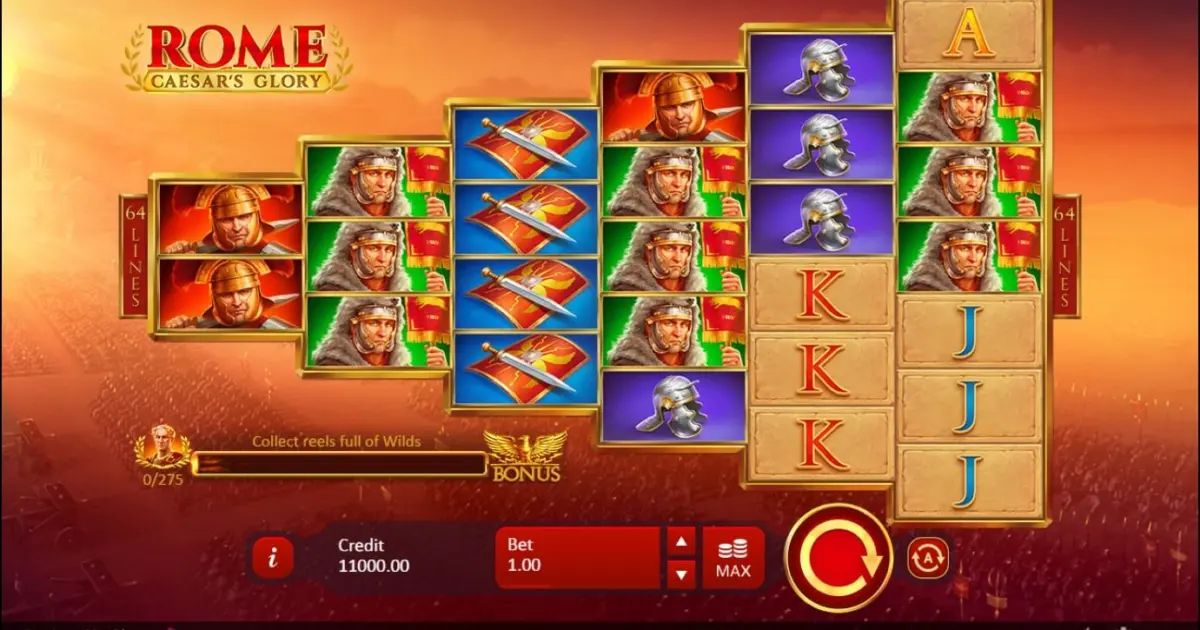
The most decision-relevant fact about the rome ceasar’s glory slot is a gap rather than a figure: no RTP percentage is on record for it. You can still load the free demo and watch the six reels spin, but you will be doing so without the one number that tells you how much a game returns over a long run of play. For some readers that is a dealbreaker. For others, a demo with nothing at stake is exactly the right place to look at a game whose paperwork is incomplete.
What is on record is the reel count, the studio, and how widely the game is played. That is enough to place it, compare it against Playson’s other releases, and decide whether it earns a slot in your session.
Who makes Rome Ceasar’s Glory
Playson developed and published this title. In this catalogue Playson accounts for 112 games, which makes it a substantial studio rather than a one-release outfit. That volume matters for a practical reason: when a single game has patchy published data, the rest of the studio’s output gives you a reference point.
Across those 112 titles, the average return to player sits at 95.61%. The whole corpus tracked here averages 95.71%. The difference between those two figures is a tenth of a percentage point, which is to say Playson builds games that return roughly what the wider market returns. Neither number tells you anything about this specific game, and it would be wrong to assume Rome Ceasar’s Glory matches the house average. Studios release titles above and below their own mean all the time. But if you want a rough sense of what kind of developer you are dealing with, 95.61% across 112 games is the honest answer.
Playson has not published a maximum win figure, a hit frequency, or a stake range for this title in the data available here. If you see any of those quoted elsewhere, treat the source with scepticism until the studio confirms it.
| Provider | Playson |
|---|---|
| Reels | 6 |
| Free demo | Yes |
Where Rome Ceasar’s Glory sits in the Playson catalogue
This game ranks 1,895th by popularity in this catalogue, which places it in the 90.5th percentile — the top tenth of games by how much attention they get. Popularity is not quality and it is certainly not return, but it does tell you the game gets played rather than sitting untouched.
For comparison inside the same studio, three Playson titles are worth knowing about. Super Burning Wins: Classic 5 Lines carries a 99.99% RTP, which is exceptionally high and roughly four and a half percentage points above the Playson average. On a very large sample, that difference is the gap between £99.99 and £95.61 returned per £100 wagered. If published RTP is your primary filter, that is the Playson game to look at first.
Coin Strike: Hold and Win sits at 95.66%, essentially level with the studio average and the corpus average. It is the more typical Playson experience by the numbers. x1000 Golden Penny 2 shares this game’s problem: no published RTP figure. Two unpublished figures in a three-game sample is a reminder that not every release in a large catalogue gets full documentation.
RTP: no published figure against a 95.61% house average
RTP is the long-run statistical average a game returns across an enormous number of spins. A 96% figure means £96 returned per £100 wagered when measured over millions of spins — not over your session, not over a thousand spins, and not in any way you would notice from a single sitting. Short-run results scatter widely around the long-run average, which is why the number is useful for comparing games and useless for predicting an evening.
For this game, that number does not exist in the available data. The practical consequence is that you cannot compare Rome Ceasar’s Glory against the 95.61% Playson average or the 95.71% corpus average on the measure that matters most. You are choosing on theme and reel count alone.
Consider what a one-point RTP gap actually means. Across 10,000 spins at £1 a spin, £10,000 wagered at 96% returns £9,600 on average; at 95% it returns £9,500. A £100 difference in expected cost, spread across a very large sample, with individual sessions swinging far wider in both directions. That is the scale of thing an RTP figure tells you — meaningful over time, invisible on any given night. Without it, you are missing a real piece of information, though a smaller one than marketing copy usually implies.
Volatility and who it suits
No volatility rating is published for this game either. Since volatility shapes session feel more than RTP does, that is a second genuine gap.
Here is what the three broad bands mean in general. Low volatility games pay smaller amounts more often. Balances drift rather than lurch, sessions last longer on a given bankroll, and the experience is steadier. High volatility games do the opposite: long stretches with little return, punctuated by larger and rarer payouts. Two games with identical RTP can feel completely different depending on which side of that line they fall. Medium volatility sits between the two, which is where most modern releases land.
Bankroll follows directly from this. A high-volatility game needs a deeper bankroll relative to stake to survive the dry spells long enough for the maths to express itself — and even then, nothing guarantees it will within your session. A low-volatility game tolerates a shallower bankroll.
Six reels is worth a note. Reel count is not volatility, but wider grids often come with different payout structures than a classic three-reel layout. Playson has not documented how this particular grid pays, so the demo is where you would find out.
Playing Rome Ceasar’s Glory free
A free demo is available, so you can load the game with no deposit, no download and no account and watch the six reels behave. Given the missing RTP and volatility figures, the demo does more work here than it would for a fully documented game. Play a few hundred spins and you will get a rough feel for how often the reels return something and how sharply the balance moves — the practical shape of the game, if not its exact numbers.
One caution that matters: demo play does not predict real-money results. Demo credits and real stakes run the same maths, but a few hundred spins is a tiny sample against the millions that define a long-run average. A good demo run tells you nothing about what follows, and a bad one tells you nothing either. Every spin is independent of the last.
Slots are paid entertainment, not income. Play only if you are 18 or over, decide what the session is worth to you before you start, and treat that figure as spent the moment you begin. If chasing a loss ever feels like the sensible move, that is the moment to close the tab.
Similar picks
This game is filed under a 6-Reels theme label, and no other titles in the catalogue carry that tag — the theme group has zero further games. That means there is no like-for-like list of six-reel siblings to point you at here.
What you can do instead is compare on numbers. The Playson titles above serve that purpose better than a theme match would: a 99.99% published RTP on one, 95.66% on another, and a third with the same documentation gap as this game. If the missing figures here bother you — and they are a reasonable thing to be bothered by — a game with a published RTP is the more informed choice, whatever the theme.
Verdict
Rome Ceasar’s Glory is a popular Playson six-reeler with two important blanks in its record: no published RTP and no published volatility rating. It sits in the top 10% of games here by popularity, so plenty of people play it, and Playson’s 112-game catalogue averages 95.61% RTP — but neither of those facts fills the gaps.
The free demo is the sensible response. It costs nothing, needs no download, and lets you judge the grid on how it actually plays. If you want documented numbers before you stake anything, look at the Playson titles that publish theirs instead.
Frequently Asked Questions
Can I play Rome Ceasar's Glory for free?
A free demo is available for this Playson title, so you can spin the six reels with no deposit, no download and no account. That matters more than usual here, because no RTP or volatility figure is published for the game — the demo is the only way to get a feel for how it behaves.
What is the RTP of Rome Ceasar's Glory?
No RTP figure is published for this game in the available data. For context, Playson's 112 titles average 95.61% and the wider catalogue averages 95.71%, but you cannot assume this game matches either. If you see a specific percentage quoted elsewhere, treat it with caution until Playson confirms it.
Is Rome Ceasar's Glory high or low volatility?
No volatility rating is published for this title. Broadly, low volatility means smaller, more frequent returns and longer sessions on a given bankroll, while high volatility means longer dry stretches and rarer, larger payouts. Without a rating, a few hundred demo spins is your best rough guide to which end it leans towards.
Who is Playson and what else do they make?
Playson is the studio behind this game, with 112 titles in this catalogue and an average RTP of 95.61% across them. Their range includes Super Burning Wins: Classic 5 Lines at 99.99% RTP and Coin Strike: Hold and Win at 95.66%, so the catalogue spans both exceptionally high and market-average returns.
How does Rome Ceasar's Glory compare to Coin Strike: Hold and Win?
Coin Strike: Hold and Win publishes a 95.66% RTP, which is essentially level with Playson's 95.61% house average. Rome Ceasar's Glory publishes no RTP at all. On documentation alone, Coin Strike is the better-informed choice; on reel count they differ, and only the demo will show you which grid you prefer.