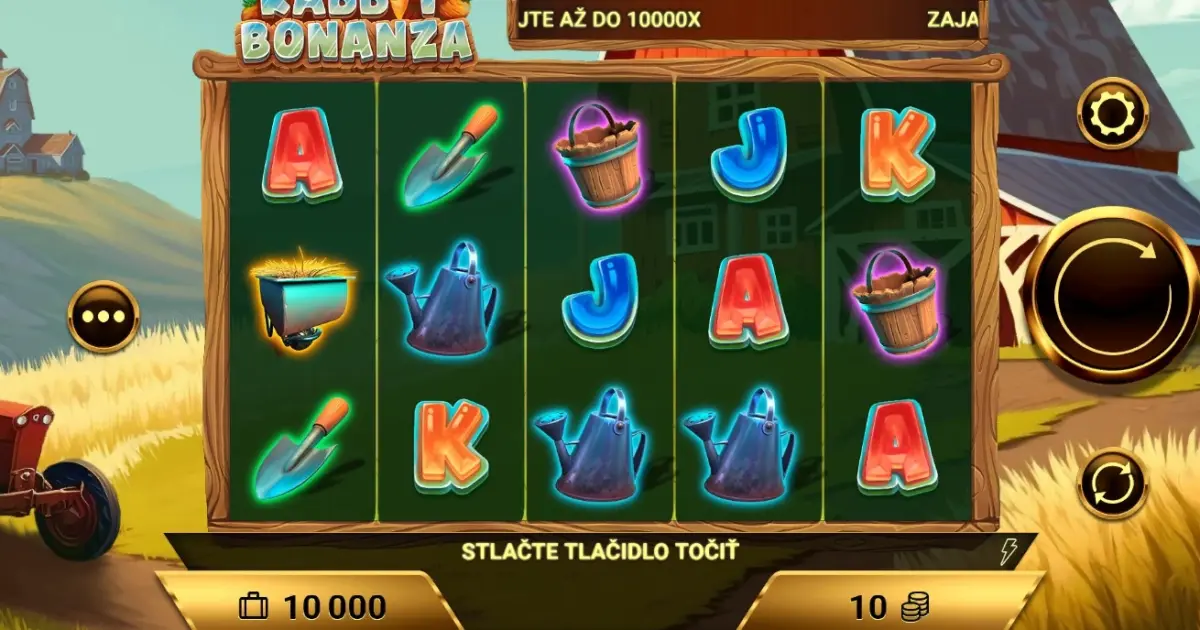
Rabbit Bonanza is a 5-reel slot from Amigo Gaming with a 96.0% RTP and a free demo available, which makes it easy to compare before you risk any balance. It sits at rank 2701 and in the 86.5th percentile for popularity, so it gets steady attention without being at the very top of the lobby. If you want a straightforward reel setup with average-to-slightly-above-average return, the rabbit bonanza slot is worth a short test session to see if the pacing suits you.
First look at Rabbit Bonanza
Rabbit Bonanza comes from Amigo Gaming, a studio with 67 titles in this corpus and an average RTP of 96.02% across its catalogue. That puts this release almost exactly on the provider’s own norm, just 0.02 points below it, rather than being an outlier high or low. The game is listed as a Slot Machine with a 5-Reels theme tag and 5 reels, which tells you the basic grid shape but not the specific line or ways structure.
On this site the game holds rank 2701 and lands in the 86.5th percentile for popularity. In practical terms that means it is more played than the majority of titles here, but it is not in the top few hundred where traffic concentrates. Popularity does not change the maths of any spin, it only tells you how many other players have been opening it to compare.
Because the free demo is available, you can load it with no download and see how quickly the base game cycles, how the paytable is laid out, and whether the presentation suits you. Treat that preview as a way to learn the interface and the pace, not as evidence of how a real-money session will go, since every spin remains independent and random.
What is not published for this title also matters. Amigo Gaming has not supplied a volatility rating, a stake range, a max win figure, a hit frequency or specific feature details in the FACTS available for this review. When those numbers are absent, you should be cautious about any site that quotes them as fact. The honest position is that the only verified figures right now are the provider name, the 5-reel format, the 96.0% RTP and the popularity rank noted above.
How a round plays out
With 5 reels confirmed, Rabbit Bonanza uses the most common slot grid width. In general terms, a 5-reel game spins vertical columns of symbols and then evaluates the visible positions against its paytable. Some 5-reel titles use fixed paylines, others use variable paylines or a “ways” system where any matching symbols on consecutive reels from the left pay. The FACTS for this game do not state which evaluation method it uses, so you should check the in-game rules or paytable screen before you set expectations.
Many slots include concepts such as wild symbols that substitute for other symbols, scatter symbols that pay irrespective of lines, or free-spin triggers tied to a number of scatters. Those are standard industry mechanics, not claims about Rabbit Bonanza specifically. Because the FACTS do not list any particular wild, scatter, free-spins count, multiplier or buy-feature for this title, this review does not assume any of them are present.
What you can reliably do in any demo is watch the rhythm of a round: how long the reels spin, how wins are highlighted, where the balance, bet selector and info button sit, and whether wins occur in small clusters or as occasional larger hits. That rhythm is a function of the game’s design and its undisclosed volatility, so observing 100 to 200 demo spins gives you a feel for pacing without telling you anything about future results.
If you prefer to know exact mechanics before committing, open the game’s help or info pages inside the demo. The presence or absence of payline counts, ways counts, or feature descriptions there is the only safe guide. Anything not written by the provider should be treated as unverified, and this review will not fill the gap with invented detail.
Reading the 96.0% return figure
A 96.0% RTP means that, across a very large number of spins, the game is designed to return £96.00 for every £100 wagered, keeping £4.00 as the house edge on that theoretical sample. It does not mean you will get £96 back from £100 in a single session, or even in a few thousand spins. Short-term outcomes can swing far above or below that average because each spin is independent and random.
To make the figure concrete, consider what it implies at scale. Over 1,000 spins at £1 a stake, total wagers are £1,000 and the 96.0% RTP implies £960 returned on average across an enormous sample, not a promise for your 1,000. Over 10,000 spins at the same stake, the expected return would be £9,600 from £10,000 staked, again as a long-run average. Your actual session will deviate, sometimes materially, from those expectations.
Against the wider corpus average of 95.71%, Rabbit Bonanza sits 0.29 points higher. That is a modest edge in the player’s direction compared with the average title here, though the difference only shows up meaningfully over very large samples. A 0.29-point gap on £1,000 of total wagers equates to £2.90 in theoretical return, which easily disappears inside normal variance over a few hundred spins.
Compared with Amigo Gaming’s own average of 96.02%, this title is essentially on brand, just 0.02 points lower. If you are comparing within the provider’s catalogue, the RTP alone does not make this an odd one out. Use it as a neutral data point alongside the factors you can feel in the demo, such as spin speed and hit regularity, rather than as a predictor of whether the next session will be profitable.
Why volatility changes your bankroll maths
Amigo Gaming has not published a volatility rating for Rabbit Bonanza in the FACTS available here, so this section is about what the absence means and how volatility would matter if it were known. Volatility describes how a slot tends to distribute its returns over time, not how much it returns in total. Two games can share the same 96.0% RTP and feel very different: one may pay smaller amounts more often, another may pay larger amounts less often.
In general, low-volatility play tends to produce steadier, smaller swings, which can stretch a fixed bankroll across more spins and reduce the chance of a quick, deep drawdown. High-volatility play tends to produce longer stretches without a win, punctuated by larger individual hits, which calls for a larger bankroll relative to stake size or a willingness to accept shorter sessions that may end with no significant hit. Medium volatility sits between those poles. These are broad patterns, not guarantees, because randomness still dominates any short sample.
Without a declared level for this title, the practical step is to size your expectations around uncertainty. Do not assume it is low because it is a 5-reel Slot Machine, and do not assume it is high because other titles with similar themes sometimes are. If you move from demo to real balance later, start with stakes that allow at least a few hundred spins on your budget, and watch how often the balance ticks up versus how often it trends down. That observation tells you more than any label borrowed from a different game.
Hit frequency, which is the share of spins that produce any win, is also unpublished here. When hit frequency and volatility are both unknown, avoid any advice that claims a particular bet pattern or timing will smooth the curve or make a bonus “due.” Every spin is independent; the reels have no memory, and no staking pattern changes the 96.0% long-run return you are playing against.
Bet sizing from the minimum stake upwards
The FACTS for Rabbit Bonanza do not include a minimum stake, maximum stake or default stake range, so there is no verified bet ladder to quote. That absence is worth stating clearly, because stake limits define how long a bankroll lasts at a given level and whether the game fits a small or large budget. If you see a min-max quoted elsewhere, cross-check it inside the actual game’s bet selector before relying on it.
You can still plan sensibly around the principle of bankroll in spins. Divide the amount you are willing to spend on entertainment by the stake you intend to use, and you get the number of paid spins that budget buys if every spin were a loss. For example, £50 at £0.20 per spin buys 250 spins; at £0.50 it buys 100 spins; at £1 it buys 50 spins. This is simple division, not a strategy that alters expected value, but it helps you choose a session length you are comfortable with.
Because volatility is also unpublished, keep the first real-money test short and conservative if you decide to play. Use the smallest stake the in-game menu actually offers, play a fixed number of spins, and stop at a loss limit or time limit you set before you started. The demo is useful for finding where the stake controls, autoplay limits and turbo options sit, so you are not adjusting them under pressure.
If stake information later appears from the provider, you will be able to compare it directly with other Amigo Gaming titles and with your usual level. Until then, treat the bet range as unknown and let that uncertainty push you toward smaller, shorter trials rather than larger commitments justified by assumed limits.
Where Rabbit Bonanza sits among 5-Reels slots
The theme tag here is 5-Reels, which describes the reel count rather than a narrative world. That makes this a structural category, shared conceptually with many other titles, not a tight thematic niche where games compete on story elements. Without more specific theme or mechanic data, the fairest comparison is on provider and on verified numbers such as RTP and popularity.
Within Amigo Gaming’s catalogue, Book of Jurassic matches this game’s 96.0% RTP exactly, so on return alone there is no long-run edge between them. If you are deciding between the two, base the choice on which presentation and pacing you prefer in demo rather than on a fractional RTP difference that is not there.
Two other studio mates show how disclosure varies. Samurai Cats and 9 Circles of Hell are both from Amigo Gaming but have no published RTP in the FACTS available here, whereas Rabbit Bonanza does. When you can see a verified 96.0% for one title and nothing for another, the one with the published figure gives you a clearer basis for comparing expected house edge, even though short-term luck still dominates.
On the broader corpus, the 95.71% average puts Rabbit Bonanza 0.29 points ahead of the typical title you will open on this site. That is not a large margin, but it does mean it is not dragging the average down. Combined with a popularity percentile of 86.5, it reads as a solidly visited, normally priced option in its provider’s range, awaiting more detailed disclosure on volatility and stake limits before a deeper classification is possible.
| Item | Detail |
|---|---|
| Game | Rabbit Bonanza |
| Provider | Amigo Gaming (67 games, avg RTP 96.02%) |
| RTP | 96.0% |
| Reels | 5 |
| Theme tag | 5-Reels / Slot Machine |
| Popularity | Rank 2701 — 86.5th percentile |
| Free demo | Available — no download required |
| Volatility / Max win / Bet range | Not published in FACTS |
The honest verdict
Rabbit Bonanza’s case is simple: a 5-reel build, a 96.0% RTP that sits 0.29 points above the corpus average, and a free demo you can try without commitment. It is essentially on the Amigo Gaming house average of 96.02%, so the return is neither a standout high nor a red flag low. Popularity at the 86.5th percentile suggests other players are opening it regularly, which is useful social proof that the interface and load are sound, but it does not change the maths you face on each spin.
The gaps in disclosure limit how strongly you can recommend it for a particular bankroll style. With no verified volatility, hit frequency, max win or stake range, you cannot say whether it will suit a low-stake grinder or a higher-variance hunter. That is not a flaw in the game so much as a limit on what can be judged fairly right now. Use the demo to see if you like the tempo, and wait for provider-published figures before treating any third-party claims about features or limits as fact.
If you do decide to play with real money after the demo, keep it in the entertainment frame. You must be 18+, set a budget and a time limit before you start, and treat any spend as the cost of entertainment rather than a way to make money. Stick to stakes that give you a comfortable number of spins on that budget, use deposit and session tools if you need them, and step away when your limit is reached. Independent, random spins mean no pattern, no system and no session can make the next result more likely.
Frequently Asked Questions
Can I try Rabbit Bonanza for free before I wager?
Free demo play is available for Rabbit Bonanza on this site, so you can load it with no download to check the 5-reel layout and paytable. Demo spins use the same design and 96.0% RTP structure, but they do not predict real-money outcomes because each spin is random and independent.
What is the RTP of Rabbit Bonanza and what does it mean?
Rabbit Bonanza has a 96.0% RTP, which means it is designed to return £96.00 for every £100 wagered across a very large sample. Your short-term session will vary widely from that average. The figure sits 0.29 points above the corpus average of 95.71% and 0.02 points below Amigo Gaming's 96.02% average.
What volatility does Rabbit Bonanza have and how risky is it?
No volatility rating has been published for Rabbit Bonanza in the verified FACTS, so treat any label you see elsewhere with caution. Generally, high volatility brings rarer but larger swings and needs a bigger bankroll for the same stake, while low volatility stretches a budget over more spins. Both share the same long-run RTP.
Who makes Rabbit Bonanza and what else do they offer?
Rabbit Bonanza is made by Amigo Gaming, which has 67 titles in this corpus with an average RTP of 96.02%. Related studio titles include Book of Jurassic at 96.0% RTP, plus Samurai Cats and 9 Circles of Hell, which currently show no published RTP in the available FACTS for comparison.
How does Rabbit Bonanza compare with Book of Jurassic?
On verified return they are identical, both at 96.0% RTP, so neither has a long-run house-edge advantage. Book of Jurassic is the cleaner direct comparison within Amigo Gaming's range for that reason. Choose between them on demo feel, pacing and interface preference rather than on a difference in return.