Quackers slot from ELK Studios runs a 96.0% RTP across 6 reels, placing it modestly above the 95.71% corpus average. Whether that small statistical edge makes up for missing volatility and feature data is the core question of this review.
First look at Quackers slot
The game comes from ELK Studios, a provider that has published 138 titles to date. At the time of cataloguing, Quackers holds a popularity rank of 1039 with a percentile of 94.8, meaning it draws more traffic than the overwhelming majority of entries in this review corpus. That traffic figure reflects curiosity as much as conversion, so treat it as a signal of market noise rather than proof of quality.
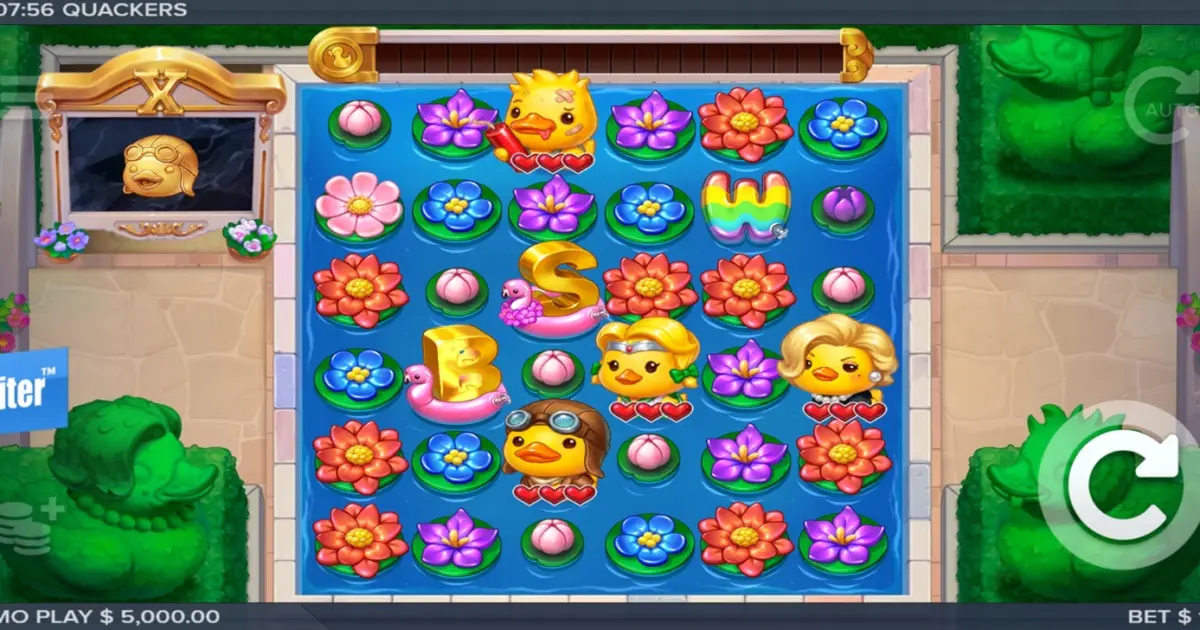
Theme classification is listed as “Relax,” and the layout is fixed at 6 reels. The Relax label in this context suggests a slower, meditative design philosophy rather than an action-driven one, though the provider’s own marketing materials do not elaborate further on what that means in practice for pacing or audio.
Quackers exceeds the ELK Studios average RTP of 94.92% by just over one full percentage point, so the provider has not applied its typical return profile to this release. You can play a Pirots 3 review on this site, which sits at 94.0% and shows a different side of the same developer’s range.
Notably, this page’s dataset carries no release date, no max-win figure, no hit frequency, no bonus-round specification, and no volatility rating. Those gaps matter more than any single number present here.
| Provider | ELK Studios |
|---|---|
| RTP | 96.0% |
| Reels | 6 |
| Theme | Relax |
| Free demo | Yes |
How a round plays out
With 6 reels confirmed and nothing else on features documented, the honest answer is that we can describe a generic slot cycle: you set a stake, trigger a spin, and the reels settle into a visible pattern. Wins form when matching symbols land on adjacent reels along active paylines or ways, but Quackers’ specific paytable geometry is not published in any dataset I can cite.
The “Relax” theme label is the only stylistic hint available. Many Relax-classified slots favour calm colour palettes, soft audio cues and deliberate pacing. I cannot claim Quackers delivers any of those without an official description to support it.
Because no bonus feature, free-spin round, or multiplier mechanic is recorded, you should not assume any exist. Absence of data is not absence of feature, but without a published game sheet from ELK Studios, quoting specifics would mean inventing them. The 6-reel format alone is a modest fact to build around.
Reading the 96.0% return figure
RTP measures the theoretical share of all wagered money a slot returns to players over a very long horizon. At 96.0% RTP, the model assumes that across hundreds of thousands of spins, £96.00 of every £100 wagered eventually comes back as winnings on average. Your individual session has no obligation to match that figure. The sample required to stabilise near the theoretical number is enormous, and the gap between short-session reality and long-run theory can run both ways.
Against the corpus average of 95.71%, Quackers carries a +0.29% edge. That is a small but real margin. Against the provider’s own 94.92% mean, Quackers sits 1.08 percentage points higher, which means ELK Studios applied a more generous configuration than it typically ships. For a useful point of comparison, Big Bass Splash returns 96.71% — nearly a full point above Quackers — and its RTP is documented, unlike Quackers’ volatility rating.
Many players treat a sub-corpus RTP as a warning sign. At 96.0% Quackers clears that bar, so on this axis alone you have no reason to avoid it.
Why volatility matters for your bankroll
No volatility rating appears in Quackers’ published data. That is a real omission, because volatility determines how a fixed RTP actually distributes across your session. A low-volatility slot returns most of that 96.0% through frequent small wins; a high-volatility version of the same maths might return it in a handful of large events separated by long dry spells.
Without the rating, you cannot plan session length accurately. The general framework is: low variance suits a shorter budget over more spins; medium variance needs roughly double the stake-to-bankroll margin to survive the swing; high variance requires a much larger cushion for the same target session length.
Until ELK Studios publishes a volatility classification or a hit-frequency figure, treat Quackers as unknown variance. Check the provider’s own game sheet before real-money play. You cannot size a bankroll responsibly without knowing what kind of distribution you are funding.
Bet sizing with limited data
Neither a minimum stake nor a maximum stake is recorded for Quackers. Without those bounds, I can only describe the relationship between stake range and planning. A narrower top-end stake caps the ceiling for buy-in features or high-value line combinations even when those features exist.
As a rule of thumb, divide your session budget by the number of spins you want and round to the nearest available stake. If your budget is £50 and you want 200 spins, a stake at or below £0.25 keeps you alive for the target duration. If the minimum stake exceeds that line, your effective session shrinks regardless of RTP.
Confirm both bounds on a Quackers free demo before committing money. The demo lets you read the interface without financial risk.
Where Quackers sits among Relax slots
The Relax classification covers 380 entries in this corpus, a substantial sample that makes comparison worthwhile. Big Bass Splash leads this peer set with 96.71% RTP, sitting a full 0.71 points above Quackers and providing both a higher return and a documented volatility tier.
Frutinions and Cleopatra by Arrow’s Edge also appear in the Relax group but carry no published RTP in this dataset, which means Quackers is actually better characterised than two-thirds of its named peers. That is not a compliment — it reflects how frequently basic figures go unrecorded.
The +0.29% above corpus average positions Quackers as a slightly above-median performer in a heavily populated category. Nothing about its numbers suggests a stand-out or a warning; it sits in the middle band of an enormous theme cluster. If you prefer a more documented Relax title, Big Bass Splash delivers more information alongside a higher RTP.
The honest verdict
Quackers is a mathematically decent slot. The 96.0% RTP is respectable, the provider exceeds its own historical average on this title, and the 6-reel format is at least documented. What the game does not offer is enough specification for serious session planning.
No volatility, no max win, no bonus structure, no stake range. You are looking at a single confirmed number and a reel count, dressed in a theme label that means something in the cataloguing taxonomy but nothing you can verify on-screen without playing.
If you decide to try it, treat it as paid entertainment. Set a budget you can afford to lose entirely, and stop when it is gone. No spin carries memory, no system shifts the expectation, and a demo result has zero bearing on what a real-money session produces. Play with that honesty, and the missing data points matter less than they otherwise would.
Frequently Asked Questions
What is the RTP of Quackers slot?
Quackers slot from ELK Studios runs a 96.0% RTP. This is 0.29 percentage points above the corpus average of 95.71% and 1.08 points above the provider's own 94.92% mean, making it a more generous configuration than ELK typically ships.
Is Quackers slot available to play for free?
Yes, a free demo version is available. Demo play lets you read the interface and check stake bounds without financial risk, though demo outcomes carry no predictive value for real-money results.
What is the volatility of Quackers slot?
No volatility rating is published for Quackers in any accessible dataset. Without it, you cannot plan session length or size a bankroll against a target number of spins. Treat the variance as unknown until ELK Studios provides a figure.
Who made Quackers slot and what else do they offer?
ELK Studios is the provider, and they have released 138 titles. The Quackers slot exceeds their average RTP by over one full point, though related titles like Pirots 3 and Pirots 4 sit at 94.0%, below the corpus average.
How does Quackers compare to Big Bass Splash?
Big Bass Splash returns 96.71% RTP versus Quackers' 96.0%, giving it a 0.71-point edge. Both sit in the Relax category, but Big Bass Splash has a documented volatility tier while Quackers does not.