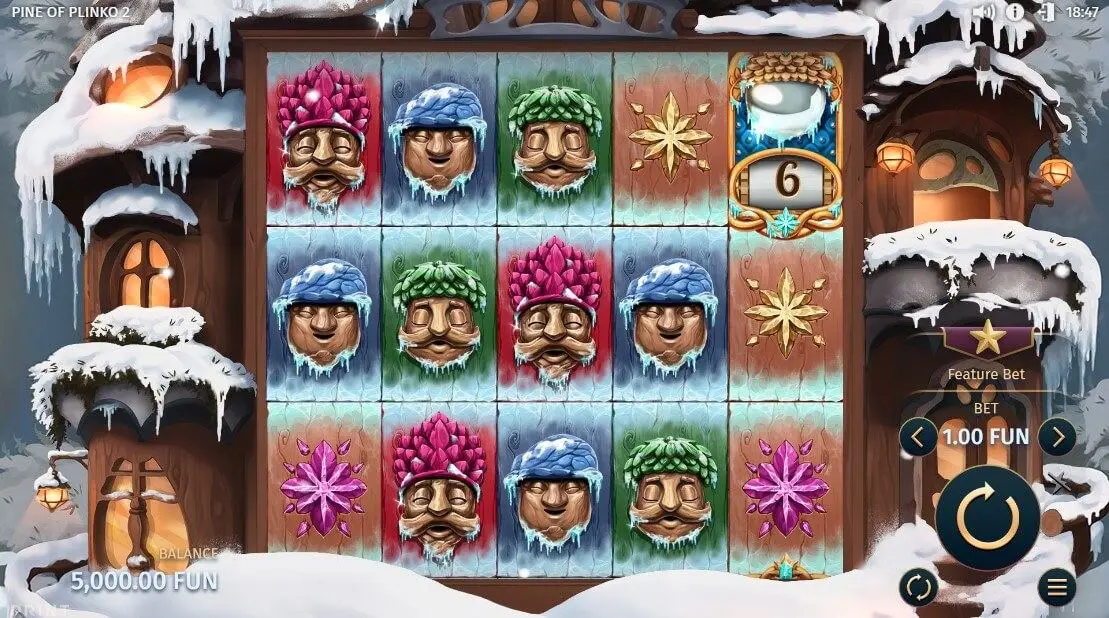
Pine of Plinko 2 slot from Print Studios sits at 96.32% RTP — noticeably above the 95.71% corpus average tracked across hundreds of titles. If you want a mathematically sound winter-themed game with a five-reel layout, the raw numbers clear the threshold most reviewers consider acceptable. The sections below work through what those figures mean for an actual playing session.
Pine of Plinko 2 at a glance
This table gathers every published figure for the game. Where a field is empty, the developer has simply not released a number — and that absence carries weight of its own.
| Attribute | Value |
|---|---|
| Provider | Print Studios |
| RTP | 96.32% |
| Reels | 5 |
| Themes | Winter, Christmas, 5-Reels |
| Popularity rank | 588th overall (top 2.9%) |
| Free demo | Available |
| Volatility | Not published |
| Max win | Not published |
| Stake range | Not published |
Print Studios operates a catalogue of 21 titles, making them a small-to-mid studio rather than a volume producer. Their average RTP across that catalogue is 96.28%, so Pine of Plinko 2 sits a hair above their own house standard. At rank 588 in a corpus running well into the thousands, this title carries the popularity percentile of 97.1% — meaning roughly 3% of reviewed games outrank it on plays. That places it solidly in the upper tier of interest without being the most-hyped launch of the year.
What a 96.32% RTP actually returns
RTP describes the percentage of total wagered money a slot is programmed to return over a statistically meaningful sample — typically millions of spins. It is not a per-session guarantee. Any individual run will land above or below the theoretical figure by a margin you cannot predict in advance.
Work the number through a concrete example. Suppose you play 1,000 spins at a stake of £0.50. Your total wagered is £500. At 96.32% RTP the expected return is £481.60, leaving a theoretical loss of £18.40 across those 1,000 spins. Now apply the corpus average of 95.71% to the same scenario: expected return drops to £478.55, a loss of £21.45. The 0.61-point edge translates into roughly £3 saved per 1,000 spins at that stake — modest in one session, meaningful if you repeat the pattern over hundreds of sessions per year.
Against Print Studios’ own portfolio, the gap is negligible — their average is 96.28%, so this title is within four-hundredths of a point of their house norm. If you want the marginally higher RTP from the same provider, Crystal Golem publishes 96.36%, eight hundredths above Pine of Plinko 2. That is too small a difference to drive a decision on its own, but it confirms both titles sit at the top of the studio’s output.
Volatility and what your session will feel like
Print Studios has not published a volatility rating for Pine of Plinko 2, and no third-party measurement appears in the data available for this review. That absence matters more than readers often realise.
Volatility — sometimes called variance — determines the shape of returns around the long-run average. A low-volatility slot produces frequent, small wins, keeping your balance relatively steady. A high-volatility slot delivers large payouts less often, creating wide swings that can drain a bankroll before the next hit lands. Two games can share an identical RTP of 96.32% and produce completely different session experiences depending on where the volatility sits.
Without a published figure, you cannot pre-plan your bankroll around this game’s swing characteristics. The responsible approach: treat Pine of Plinko 2 as an unknown-variance title. Start at a conservative stake, track how quickly your balance fluctuates over the first 50–100 demo spins, and calibrate from there. If you prefer games with a documented volatility rating, Pond of Plinko from the same provider carries a published 96.1% RTP and may offer clearer session expectations — though you should verify its volatility label independently before drawing conclusions.
The 5-reel layout and how wins are counted
Pine of Plinko 2 uses a five-reel grid, placing it in the dominant structural category across all modern online slots. The theme taglist also includes “5-Reels” as a descriptor, which in this context functions as a layout confirmation rather than a distinct visual category.
What the data does not tell you is the number of paylines, ways, or cluster mechanics that determine how winning combinations form. A five-reel slot can operate on 10 fixed paylines, 243 ways, 1,024 ways, megaways, or a scatter-pay cluster system. Each configuration changes both hit frequency and the distribution of win sizes around the same RTP figure.
Without a published payline or ways count, you cannot estimate how often a winning spin will occur in relative terms. The only way to gauge this is by playing the demo — observing how many spins pass between wins, whether clusters form across adjacent positions or require line alignment, and whether the game uses expanding symbols or fixed patterns. If you have played other winter-themed titles, compare with Mammoth Tundra, which also uses a five-reel format but publishes an RTP of 95.4% — a full 0.92 points lower, meaning more frequent small wins would be needed to reach its theoretical return.
Stake range and sizing a bankroll
Neither Print Studios nor the review data provide a minimum or maximum stake range for Pine of Plinko 2. This is a practical gap, because stake limits directly govern how you size a bankroll for any given session.
As a general framework, if you know your total session budget and your target number of spins, divide the two to find your per-spin stake. A £100 budget over 200 spins calls for £0.50 per spin; the same budget over 500 spins allows £0.20. The wider the gap between minimum and maximum stakes, the more flexibility you have to match a bankroll to a session plan. Narrow ranges — say £0.10 to £1.00 — work for casual sessions; wider ranges that extend into double-digit stakes suit high-budget players who want to maximise per-spin volatility exposure.
Until Print Studios publishes the exact figures, check the stake display in the game lobby before committing real money. If the minimum stake is high relative to your budget, your actual playable spins will be fewer than a theoretical plan might assume. RTP of 96.32% is meaningful over thousands of spins; over 20 spins, the result is almost entirely noise regardless of what the maths predicts.
Playing the Pine of Plinko 2 demo before you commit
A free demo is available for Pine of Plinko 2, and you can play Pine of Plinko 2 free without depositing or downloading any software. The demo runs on the same maths engine as the real-money version — the same 96.32% RTP governs the random number generator regardless of whether you wager credits or cash. What it does not replicate is the psychological pressure of risking money, which changes how players judge risk, abandon session plans, and misread short streaks.
Use the demo to measure what the published data does not: how wins distribute across a session, how quickly balance swings, and whether the interface communicates outcomes clearly. If you want to try Holy Hand Grenade 2 alongside for comparison, note its RTP of 96.01% — a full 0.31 points below Pine of Plinko 2, which compounds into a measurable difference across thousands of spins.
Before you switch to real money, set a firm budget and treat the session as paid entertainment, not a revenue opportunity. No strategy, timing, or stake adjustment changes the house edge. If playing stops being enjoyable, stop. Every player must be 18 or over.
Verdict: who should play Pine of Plinko 2
Pine of Plinko 2 clears the RTP threshold comfortably. At 96.32% it beats the corpus average by 0.61 points and edges past Print Studios’ own house norm of 96.28%. For players who prioritise mathematical fairness above all — who want the long-run cost per wagered pound to be as low as possible — this is a sound choice among Print Studios slots available today.
The caveats are real: no published volatility figure, no stake range, no payline count, no max win. You are accepting structural unknowns in exchange for a verified RTP advantage. Winter-themed players comparing options will find the game sits near the top of its category by raw return, but the absence of variance data means session experience remains a blank until you test it yourself.
Who should try it: anyone who wants above-average RTP, is comfortable discovering volatility through demo play, and likes a five-reel winter aesthetic. Who should look elsewhere: players who need a published max-win figure or volatility rating before committing time, since Print Studios has not supplied either for this title.
Frequently Asked Questions
Is Pine of Plinko 2 free to play?
Yes, a free demo of Pine of Plinko 2 is available without download or deposit. The demo uses the same 96.32% RTP maths engine as the real-money version, so you can observe how wins distribute across a session without risking funds — though demo results do not predict real-money outcomes.
What does the 96.32% RTP mean for my bankroll?
Pine of Plinko 2 returns £96.32 per £100 wagered over a very large sample, which is 0.61 points above the 95.71% corpus average tracked across all reviewed slots. The practical saving over the average game is small per session but accumulates across repeated play, making the RTP a legitimate reason to shortlist this title.
Is Pine of Plinko 2 high or low volatility?
Print Studios has not published a volatility rating for Pine of Plinko 2, and no independent measurement appears in available data. Without this figure you cannot predict whether sessions will produce steady small wins or rare large payouts. Testing the demo and tracking balance swings is the only way to estimate variance yourself.
Who makes Pine of Plinko 2 and what else do they offer?
Print Studios develops Pine of Plinko 2, a small catalogue of 21 titles with an average RTP of 96.28%. Their other releases include Pond of Plinko at 96.1% RTP and Crystal Golem at 96.36%, so Pine of Plinko 2 sits at the upper edge of their published returns.
How does Pine of Plinko 2 compare to other winter slots?
Among the 365 winter-themed games reviewed, Pine of Plinko 2 ranks 588th overall at the 97.1% popularity percentile. Its 96.32% RTP exceeds Mammoth Tundra (95.4%) and Barragan en Laponia (95.0%) in the same theme, making it the strongest winter title by return-to-player among those three.