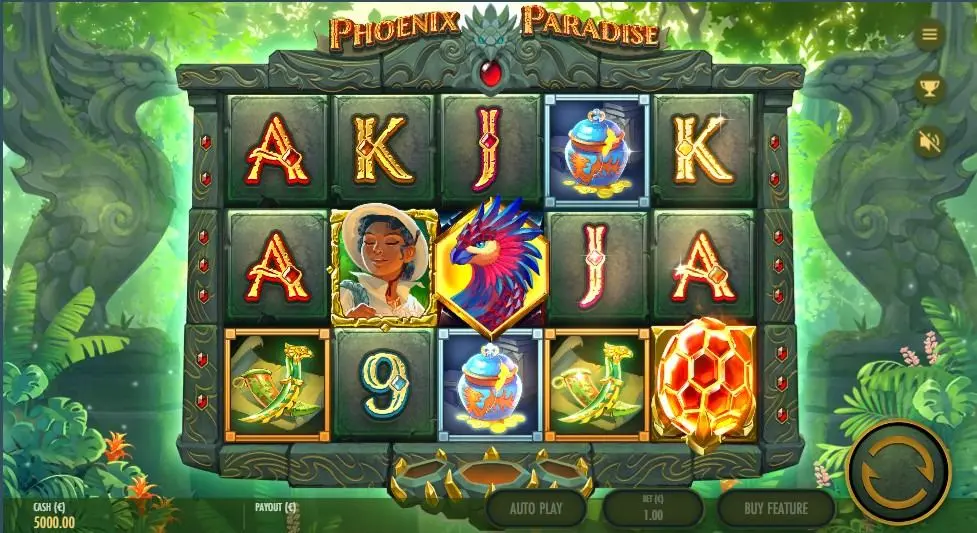
If you want a five-reel Adventure game with a published return figure and a free demo you can load without signing up, this one qualifies. The phoenix paradise slot carries an RTP of 96.13%, which is 0.42 percentage points above the 95.71% average across the games catalogued here and a shade above Thunderkick’s own 95.78% house average across 93 titles.
What follows is what the published numbers actually mean for a session, and an honest note about the specifications Thunderkick has not released. Several figures players usually want — volatility band, payline count, stake limits, maximum win — are not available for this title, and that absence shapes how much you can plan in advance.
| Specification | Detail |
|---|---|
| Game name | Phoenix Paradise |
| Provider | Thunderkick |
| RTP | 96.13% |
| Reels | 5 |
| Primary theme | Adventure |
| Secondary theme | 5-Reels |
| Category | Slot Machine |
| Popularity rank | 2,698 (86.5th percentile) |
| Provider average RTP | 95.78% across 93 games |
| Corpus average RTP | 95.71% |
| Free demo | Available |
The 5-reel grid explained
Five reels is the default shape of the modern online slot, and it is the one structural fact confirmed here. A five-reel layout gives a designer more room than a three-reel cabinet: more positions on screen means more possible symbol combinations, which in turn allows a wider spread between the smallest and largest outcomes without breaking the maths.
What Thunderkick has not published is the row count, so the total number of visible positions is unknown. That matters more than it sounds. A five-by-three grid and a five-by-four grid behave differently in practice, because the extra row changes how often symbols cluster and how much a single reel can swing a spin. Without that figure you cannot estimate the size of the symbol pool or how crowded the screen will feel.
The practical answer is to load the demo and count the rows yourself before you form an opinion. One spin tells you more than any amount of inference. Thunderkick builds 93 games in total, and the studio has never settled on a single house grid, so guessing from their catalogue is not reliable either.
Paylines, ways and how the Phoenix Paradise slot pays
No payline or ways figure has been published for this title, so the following is general slot mechanics rather than a description of this game. Treat it as background for reading the in-game paytable.
Most five-reel games settle into one of three payment models. Fixed paylines award a prize when matching symbols land on a defined path, usually left to right, and the line count is constant every spin. Ways games — often marked as 243, 1,024 or similar — pay whenever matching symbols appear anywhere on consecutive reels, regardless of row. Cluster and scatter-pays games ignore adjacency and simply count matching symbols anywhere on the grid.
Each model produces a different rhythm from the same RTP. Higher line or ways counts generally mean more frequent small returns, many of them smaller than your stake, because the cost of covering all those paths is folded into the bet. Lower line counts tend to pay less often but larger when they do.
Because the model here is unconfirmed, the paytable in the demo is your only reliable reference. Read it before you judge whether the pace suits you.
96.13% RTP put in context
Return to player is a long-run statistical average, not a session promise. A 96.13% figure means that across a very large number of spins — millions, not hundreds — the game is designed to return £96.13 for every £100 wagered. The remaining £3.87 is the house edge. Over 500 spins at £1, the mathematically expected cost of play is around £19.35, but the actual result of any 500-spin stretch can land a long way either side of that. Short samples are dominated by variance, not by RTP.
The comparison points are useful. At 96.13% this sits 0.42 points above the 95.71% corpus average and 0.35 above Thunderkick’s 95.78% average, so it is one of the studio’s better-returning games rather than an outlier. Within their own catalogue, Tiger Rush edges ahead at 96.30%, while Esqueleto Explosivo 2 matches it exactly at 96.13%. Looking wider across Adventure games, Rich Wilde and the Tome of Madness returns 96.59%.
A half-point difference is small per spin but real over thousands of them. It is worth noting without treating it as decisive.
Volatility and hit patterns
Thunderkick has not published a volatility rating for this game, and no hit frequency figure is available either. That is a genuine gap, because volatility affects a session far more visibly than RTP does.
Two games can both return 96.13% and feel nothing alike. A low-volatility game pays small amounts often, so your balance drifts down slowly with frequent small recoveries and a longer session from the same budget. A high-volatility game pays rarely but larger, which means long dry stretches punctuated by occasional bigger returns, and it needs a deeper bankroll to survive the gaps. Medium sits between the two.
Without a published rating, the demo is the only way to gauge the swing size, and even then a few hundred spins is a small sample. Watch how often a spin returns anything at all, and how large the biggest returns are relative to your stake. Those two observations tell you most of what a volatility label would have.
Every spin is independent, so a quiet stretch does not make the next spin more likely to pay. Results do not owe you anything.
Choosing a stake when no bet range is published
No minimum or maximum bet has been published for this title, so you will only see the range once the game loads. Most online slots start somewhere around ten or twenty pence and run up to between fifty and one hundred pounds a spin, but that is an industry pattern, not a confirmed figure here.
Work backwards from your budget instead of from the stake selector. Decide what you are willing to spend for the session, then divide by the number of spins you want it to last. A £50 budget stretched across 250 spins puts you at 20p a spin; the same £50 across 50 spins puts you at £1. The maths of the game does not change with stake size — the 96.13% return applies at every level — so the only thing you are choosing is how fast you move through your budget.
Do not scale stakes up after losses or down after wins expecting it to help. Expected value per pound wagered is identical regardless of the pattern.
Demo play versus real money
A free demo is available, which means you can try the game with virtual credits, no download and no deposit. That is the sensible first step given how many specifications are unpublished: the demo answers the grid layout, payline model, stake range and feature set questions directly.
What the demo cannot tell you is what real-money play will return. It runs on the same mathematics, but a demo session is a small sample, and a good or bad run in play money carries no information about what happens next with your own funds. Anyone treating a lucky demo streak as a signal is reading noise.
Play only if you are 18 or over. Set a budget before you open the game, treat that money as the price of entertainment rather than an investment you expect back, and stop when the budget is gone rather than topping it up. If it stops being fun, close the tab.
Verdict on Phoenix Paradise
The case for this game rests on one solid number and a lot of blanks. 96.13% is above both the Thunderkick average and the wider catalogue average, which puts it on the better side of the middle for long-run return. It sits in the 86.5th percentile for popularity at rank 2,698, so it has found an audience without being a headline release.
Against that, the unpublished volatility, grid detail, payline model and stake range mean you cannot judge the session experience from the specifications alone. If you want a game you can evaluate on paper before playing, Midas Golden Touch is another Thunderkick title at 96.10% worth lining up alongside it.
The reasonable approach is the free demo first. Fifteen minutes there tells you the row count, the pay model and the swing size, at which point you can decide whether the return figure is enough to hold your interest. Adventure slots are a crowded field with 326 titles tracked, so there is no shortage of alternatives if it does not land.
Frequently Asked Questions
Can you play Phoenix Paradise for free?
A free demo is available for this Thunderkick title, running on virtual credits with no deposit and no download required. That is worth using here, because the volatility rating, payline count and stake range have not been published, so loading the demo is the fastest way to see how the five-reel game actually behaves.
What is the RTP of Phoenix Paradise?
The published RTP is 96.13%, meaning the game is designed to return £96.13 per £100 wagered across a very large sample of spins. That leaves a 3.87% house edge. It sits 0.42 points above the 95.71% average across the games tracked here and above Thunderkick's own 95.78% catalogue average.
Is Phoenix Paradise high or low volatility?
Thunderkick has not published a volatility rating for this game, and no hit frequency figure is available either, so treat any number quoted elsewhere with caution. Low volatility means frequent small returns and longer sessions; high means rarer, larger ones and a deeper bankroll requirement. The demo is your only practical gauge.
Who is Thunderkick and what else do they make?
Thunderkick is the studio behind this game and 93 titles in total, averaging 95.78% RTP across the catalogue. Their better-known releases include Esqueleto Explosivo 2 at 96.13%, Tiger Rush at 96.30% and Midas Golden Touch at 96.10%, so this title sits comfortably in the upper half of their range for published return.
How does it compare to Rich Wilde and the Tome of Madness?
Rich Wilde and the Tome of Madness returns 96.59%, roughly half a percentage point more than this game's 96.13%, so it has the edge on long-run return. Both fall under the Adventure theme, one of 326 titles in that category here. Volatility for this title is unpublished, so a like-for-like risk comparison is not possible.