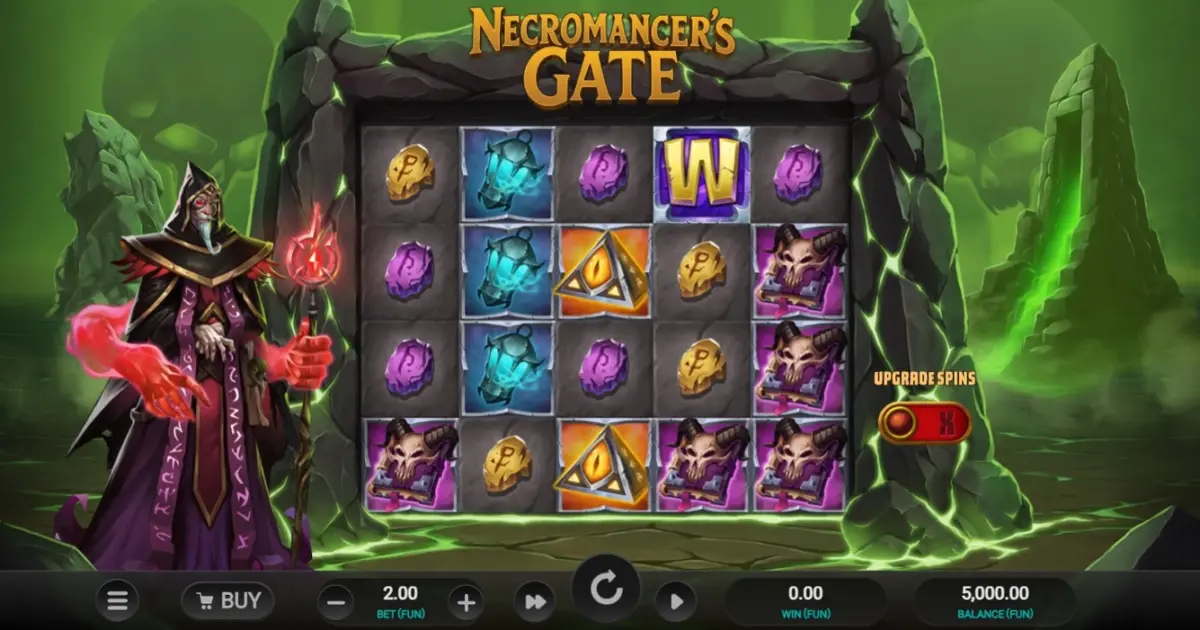
If you want the short answer: this is a five-reel Relax Gaming release with a published return of 96.1%, which puts it slightly above both the studio’s own 95.77% average and the 95.71% average across the slots we track. It sits in the top 8% of titles by popularity here, so plenty of people have already looked at it. A free demo is available, which means you can see how it behaves without spending anything.
First look at Necromancer’s Gate
The necromancer’s gate slot comes from Relax Gaming, a studio with 170 games in our database. The theme is labelled Magic, and it runs across five reels. That is the extent of what has been published about its structure, so treat any detailed description you read elsewhere — symbol names, animation set pieces, soundtrack claims — as someone’s embellishment rather than confirmed fact.
What is confirmed is more useful than atmosphere anyway. A 96.1% return figure, a five-reel layout, and a popularity rank of 1537 out of the full catalogue, which places it in the 92nd percentile. Games that rank that highly usually get there through word of mouth rather than marketing spend alone.
Payline count, ways count, bonus structure and maximum win are not in the published data for this title. That absence matters. Without a max win figure you cannot judge the shape of the payout distribution, and without a hit frequency you cannot estimate how often a spin returns anything at all. The demo is the practical way to fill those gaps yourself.
| Provider | Relax Gaming |
|---|---|
| RTP | 96.1% |
| Reels | 5 |
| Theme | Magic |
| Free demo | Yes |
How a round plays out
A five-reel spin works the same way across almost every modern video slot: the reels resolve independently of the last spin, a random number generator decides the outcome before the animation finishes, and any winning combination pays according to the paytable. Nothing carries over between spins unless the game explicitly says it does.
Many slots in this bracket layer extra mechanics on top — wilds that substitute for other symbols, scatters that trigger free spins, cascading or multiplier features. Whether this particular title uses any of them is not something the published data tells us, so it would be dishonest to describe features it may not have. Open the demo and the paytable will answer it in thirty seconds.
One thing worth internalising before you spin: every round is independent. A long stretch without a win does not make the next spin more likely to pay, and a run of wins does not mean the game has switched into a generous mode. There is no such mode. The maths is identical on spin one and spin ten thousand.
Reading the 96.1% return figure
RTP is a long-run average, not a promise about your session. 96.1% means £96.10 returned per £100 wagered across a very large sample of spins — hundreds of thousands, not hundreds. The house edge is the other 3.9%. Over 500 spins at £1, you have wagered £500 and the theoretical return is £480.50, but real 500-spin results scatter widely around that number in both directions.
Compared against the field, 96.1% is a modest advantage. It beats the 95.71% corpus average by 0.39 percentage points and the Relax Gaming average of 95.77% by a similar margin. In practical money, 0.39 points is about £3.90 per £1,000 wagered — real, but small enough that it should not be your deciding factor.
Some studio releases publish higher figures. Money Train 2 is listed at 96.4% and Money Train 3 at 96.25%, both above this title. At the other end, Outlaw Territory sits at 94.0%, which costs you £21 more per £1,000 wagered than 96.1% does.
Why unpublished volatility changes your bankroll maths
No volatility rating has been published for this game, which is a genuine gap rather than a detail to skip past. Volatility describes how returns are distributed, and it affects your session far more directly than RTP does. Two games can both return 96.1% while feeling completely different to play.
Low volatility means frequent small wins and a bankroll that drains slowly and predictably. High volatility means long dry stretches punctuated by larger payouts, which requires a deeper bankroll to survive without busting early. Same average return, very different experience.
Since the figure is not available, judge it yourself in the demo. Run a couple of hundred spins at a fixed stake and watch the shape of the balance line. Frequent small bumps suggest lower variance. Long flat stretches with occasional spikes suggest the opposite. That observation will tell you more about whether the game suits your budget than any published label would.
Bet sizing from the unpublished minimum upwards
Stake limits have not been published for this title either, so the demo is where you confirm the range. What you can plan for regardless is the relationship between stake and session length, which is pure arithmetic.
Divide your budget by your stake to get your maximum spin count, then discount it for the house edge. A £50 budget at £0.20 a spin gives you 250 spins before returns are counted; at £2 a spin it gives you 25. The RTP does not change with stake size, so a bigger bet does not buy you better odds — it just moves you through your budget faster.
Set the stake so a losing session is comfortably affordable, not so a winning one is exciting. And ignore any suggestion that varying your bet size in a pattern improves your position. Because each spin is independent, no progression, timing or stake sequence alters expected value. It only changes how quickly you reach the end of your money.
Where Necromancer’s Gate sits among Magic slots
Magic is a well-populated category with 361 titles in our database, so this one competes on numbers rather than novelty. Its 96.1% return holds up reasonably within that field, though it is not the strongest figure available.
Madame Destiny Megaways publishes 96.56%, the highest of the Magic titles listed here, which is worth a look if return percentage is your primary filter. Queens of Avalon and Alchemy Elements have no published RTP at all, and that lack of disclosure is a fair reason to prefer a game that does publish one.
Among Relax Gaming’s 170 releases, the studio is best known for the Money Train series, so if you like how this one plays, that line is the obvious next stop. Sitting in the 92nd percentile for popularity, this title has clearly found an audience of its own.
The honest verdict
A slightly above-average return from an established studio, with meaningful gaps in the published data. The 96.1% figure is solid and verifiable. The absence of volatility, stake range, max win and feature details means you are buying partly blind, and the free demo is the sensible correction for that.
Worth playing if you want a five-reel magic title with a documented RTP and you are happy to establish the rest yourself. Less compelling if you specifically need a known volatility profile or a stated maximum win before committing.
Slots are 18+ paid entertainment, not a way to make money. Decide what you can afford to lose before you open the game, treat that figure as the price of the session, and stop when it is gone. Demo play costs nothing and tells you nothing about future real-money results — the outcomes are random either way.
More from Relax Gaming
- Money Train 4 — 96.1% RTP
- Money Train 3 — 96.25% RTP
- Outlaw Territory — 94.0% RTP
- Money Train — 96.2% RTP
- Wild Chapo 2 — 96.1% RTP
- Titan Strike — 96.09% RTP
- Purrrminator — 96.1% RTP
- Temple Tumble Megaways — 96.25% RTP
Frequently Asked Questions
Can I play Necromancer’s Gate for free?
A Necromancer’s Gate free demo is available, so you can spin it with virtual credits before wagering anything. The demo runs on the same random number generator as the paid version, which makes it a reliable way to check the paytable, feature set and stake range — details Relax Gaming has not published for this title.
What is the RTP of Necromancer’s Gate and is that good?
The published return is 96.1%, meaning £96.10 back per £100 wagered across a very large sample. That beats the 95.71% average across the slots we track and Relax Gaming’s own 95.77% average, but only by about 0.39 percentage points — roughly £3.90 per £1,000 wagered.
How volatile is Necromancer’s Gate?
Relax Gaming has not published a volatility rating for this game, so treat any figure quoted elsewhere with caution. Run 200 or so demo spins at a fixed stake and watch the balance: frequent small wins point to lower variance, while long flat stretches broken by spikes point to higher variance and a deeper bankroll requirement.
Who makes Necromancer’s Gate and what else do they produce?
Relax Gaming developed it, and the studio has 170 titles in our database with an average published RTP of 95.77%. Their best-known line is the Money Train series — Money Train 2 lists 96.4% and Money Train 3 lists 96.25%, both slightly above this game's 96.1% return.
How does it compare to Madame Destiny Megaways?
Madame Destiny Megaways publishes a higher return at 96.56% against 96.1% here, a gap worth about £4.60 per £1,000 wagered. Both sit in the Magic category, which contains 361 titles in our database. Neither figure guarantees anything over a short session, since RTP only holds across very large samples.