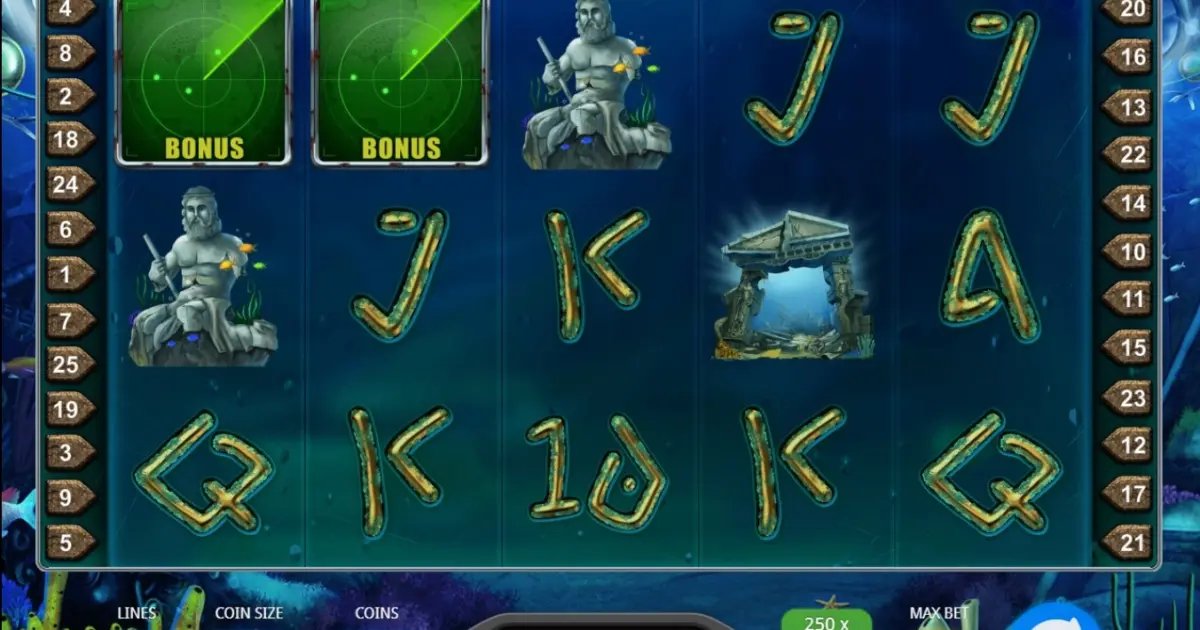
If you are deciding whether to load the Mission Atlantis slot for a session, the short answer is that its 96.5% RTP sits comfortably above the industry average and above its own provider’s typical output, but the absence of published volatility data makes it harder to predict what a session will feel like. That gap is not a footnote — RTP tells you the long-run return, while volatility tells you the shape of the swings between spins.
Oryx Gaming ranks this title at position 189 by player activity, placing it in the 99.1st percentile of the review corpus. Five reels and an ocean theme give you the structural skeleton. Before weighing whether those strengths offset the missing risk data, it helps to see every figure Oryx has confirmed in one place.
| Attribute | Value |
|---|---|
| Provider | Oryx Gaming |
| RTP | 96.5% |
| Reels | 5 |
| Volatility | Not published |
| Theme | Ocean and sea |
| Popularity rank | 189 (99.1st percentile) |
| Provider average RTP | 95.5% |
| Corpus average RTP | 95.71% |
| Free demo available | Yes |
What 96.5% RTP means over 1,000 spins
RTP is a long-run statistical average calculated across millions or billions of simulated spins, not a prediction for your next ten. At 96.5%, the expected return is 96.50 units back for every 100 units wagered over that enormous sample. You can apply that ratio to any session size to get a theoretical number, but the result will almost never match what you walk away with.
Suppose you play 1,000 spins at a stake of £1 per spin. Total wagered comes to £1,000. The theoretical return at 96.5% RTP is £965, implying a loss of £35 over those thousand spins. Double your stake to £2 and the expected loss scales to £70. The math is linear; your actual result will be one of a wide distribution of outcomes, and £35 is simply the centre of that distribution.
The more useful comparison is relative. Oryx Gaming’s average RTP across its 24 catalogued titles is 95.5%, which means Mission Atlantis returns a full 1.0 percentage point above its own provider’s norm. Against the broader corpus average of 95.71%, it edges ahead by 0.79 points. Neither margin changes the house edge, but a higher RTP does reduce the rate at which your balance erodes per unit of play compared to a 95% game. Over 1,000 spins at £1, that difference is £15 — small in isolation, meaningful across many sessions.
What RTP does not tell you: when the returns arrive, whether they cluster around frequent small wins or rare large ones, or how long a losing stretch might last. That information lives in the volatility and hit-frequency data, which brings you to the next section’s problem.
How volatile is Mission Atlantis?
Oryx Gaming has not published a volatility rating for this title. You will not find “low,” “medium,” or “high” confirmed by the provider in any field available here, and no secondary source in the dataset overrides that silence. If you encounter a volatility classification quoted on another review site, treat it as unverified speculation rather than a fact you can plan a bankroll around.
This absence matters because volatility is the other half of the risk equation. Low-volatility slots pay small wins frequently, producing a gradual downward drift in your balance with shallow dips and modest spikes. High-volatility slots pay less often but larger when they do, creating long stretches of small losses punctuated by swings that can either rescue a session or accelerate a bust. Medium volatility sits between those two extremes.
Without knowing which category Mission Atlantis occupies, you cannot set a realistic expectation for session length at a given bankroll. A £50 budget might last 300 spins on a low-volatility game and expire after 80 spins on a high-volatility game at the same stake. The RTP figure remains the same in both cases — it is the variance of outcomes that changes, and that is the number you are missing here.
The practical consequence: start at the lower end of whatever stake range the casino offers you and extend your session before committing a larger budget. You are gathering personal variance data that Oryx has not provided.
What the Ocean and sea theme brings to the game
Theme in a slot review is not decoration — it shapes the visual grammar, the symbol set, and the expectations you bring to the reel window. Mission Atlantis draws on an ocean and sea setting, which places it in a crowded genre of 527 other titles covering similar territory. A five-reel layout is the industry standard for modern video slots, giving you more horizontal space for paylines or ways than the three-reel classics.
The “Atlantis” naming evokes a lost civilisation beneath the sea, which is a specific mythological premise. Oryx has not published a feature list, bonus description, or symbol breakdown that would let you evaluate how that premise translates into actual gameplay mechanics. You know the reels spin in an ocean-themed environment, and that the title references the sunken-city concept. Beyond those two points, any description of characters, animations, or narrative progression would be invented.
What you can say about 5-reel ocean themes generally: they typically support a wider range of payline configurations than 3-reel games, which increases the number of simultaneous ways a spin can resolve. More paylines or ways do not change RTP — they redistribute it across more potential outcomes per spin, which interacts with volatility to determine how a session feels. Without knowing this game’s specific payline or ways count, you cannot quantify that effect.
The theme label is a starting point, not a feature specification. It tells you the aesthetic direction; it does not tell you what happens when symbols land.
Stakes, session length and bankroll
No minimum or maximum stake range is published in the data available for Mission Atlantis. You will need to check the specific casino hosting the game to find the actual limits, because providers often allow operators some flexibility in configuring the stake menu.
Stake range determines your session architecture. Divide your planned budget by the per-spin cost to estimate the number of spins you can buy before the money runs out, assuming a worst-case scenario of zero returns. A £50 budget at £0.10 per spin gives you 500 spins of raw reel time. At £5 per spin, it gives you 10. The RTP percentage is identical in both cases — the difference is how quickly variance reveals itself and how many spins you get to ride it out.
Without a published volatility rating, you are planning blind on the most important variable. A conservative approach: treat the £50 at £0.10 example as your starting point, because 500 spins provides enough observations to begin forming a personal read on the game’s swing pattern. If the balance drops fast and rarely recovers, you have likely encountered higher variance than you expected. If it drifts slowly with regular small hits, you are probably in lower-variance territory.
Oryx has confirmed a free demo version is available. Use it to observe how quickly a notional balance depletes across 100–200 spins before wagering real money. Demo play cannot predict real-money outcomes, but it can show you the rhythm of wins and losses without financial cost.
Alternatives if Mission Atlantis is not for you
If the missing volatility data is a dealbreaker, Oryx Gaming’s own catalogue offers nearby options with published specifications. Golden Dunes carries an identical 96.5% RTP, so you get the same theoretical return without necessarily getting the same risk experience — check its volatility rating if it is published. Beer Boost sits slightly lower at 96.32% RTP but is a more recent release where Oryx has typically been more forthcoming with metadata.
For comparison beyond the provider, Big Bass Bonanza by Pragmatic Play runs at 96.71% RTP in the same ocean and sea category, giving you a third of a percentage point of theoretical edge plus a well-documented volatility profile and a mature feature set that you can evaluate before committing.
The broader theme corpus contains 527 slots covering water-adjacent settings, so genre is not a constraint. What matters is whether the available data — RTP confirmed, volatility absent — is sufficient for your decision-making. If you need both halves of the risk picture before you spin, the alternatives above let you make that comparison.
Final take
Mission Atlantis clears the RTP threshold that most rational players use as a screening tool: 96.5% is above average, it beats Oryx’s own norm, and it outperforms the corpus benchmark. The theme is familiar without being restrictive, and the popularity percentile confirms that players are choosing it at scale.
The unresolved question is variance. A confirmed high RTP does not tell you whether your balance will hold steady for hundreds of spins or plunge before a single meaningful return arrives. Oryx has not published that data, and the absence is the main reason a cautious player might pass this game over for an alternative with a documented volatility rating.
If you do spin it, set a budget before you open the game and treat the session as a fixed-cost entertainment purchase, the same way you would budget for a film or a meal out. Never chase losses back through the reels — each spin is an independent event, and no amount of play changes the underlying house edge. You must be 18 or over to play. Play within your means.
Frequently Asked Questions
Is Mission Atlantis free to play in demo mode?
Yes. Oryx Gaming has confirmed a free demo version of Mission Atlantis is available. Demo play lets you observe the game's rhythm across many spins without staking money, though results in demo mode are generated by the same random number generator and carry no financial consequence either way.
What is the RTP of Mission Atlantis and how does it compare?
Mission Atlantis runs at 96.5% RTP, which is 1.0 percentage point above Oryx Gaming's provider average of 95.5% and 0.79 points above the 95.71% corpus average. This means a slower theoretical rate of balance erosion per unit wagered compared to games at the provider's typical RTP level.
Does Oryx Gaming publish a volatility rating for Mission Atlantis?
No published volatility rating exists in the available data for this title. That means you cannot determine in advance whether the game will produce frequent small wins or rare large swings. Starting at a low stake to observe your own pattern over 100 or more spins is the practical workaround for this gap.
What other slots has Oryx Gaming made besides Mission Atlantis?
Oryx Gaming has 24 catalogued titles in the review corpus. Golden Dunes matches Mission Atlantis exactly at 96.5% RTP, while Beer Boost runs at 96.32% and Fairytale Forest Quik at 96.08%. The provider average across all 24 games is 95.5% RTP, making Mission Atlantis the strongest performer in their line-up by return-to-player metric.
Can I win real money playing Mission Atlantis in demo mode?
No. Demo play uses a simulated balance with no cash deposit and produces no real-money payouts. The game requires a funded real-money session at a licensed operator to generate withdrawable winnings, and the available data does not indicate any specific casino hosting this title.




