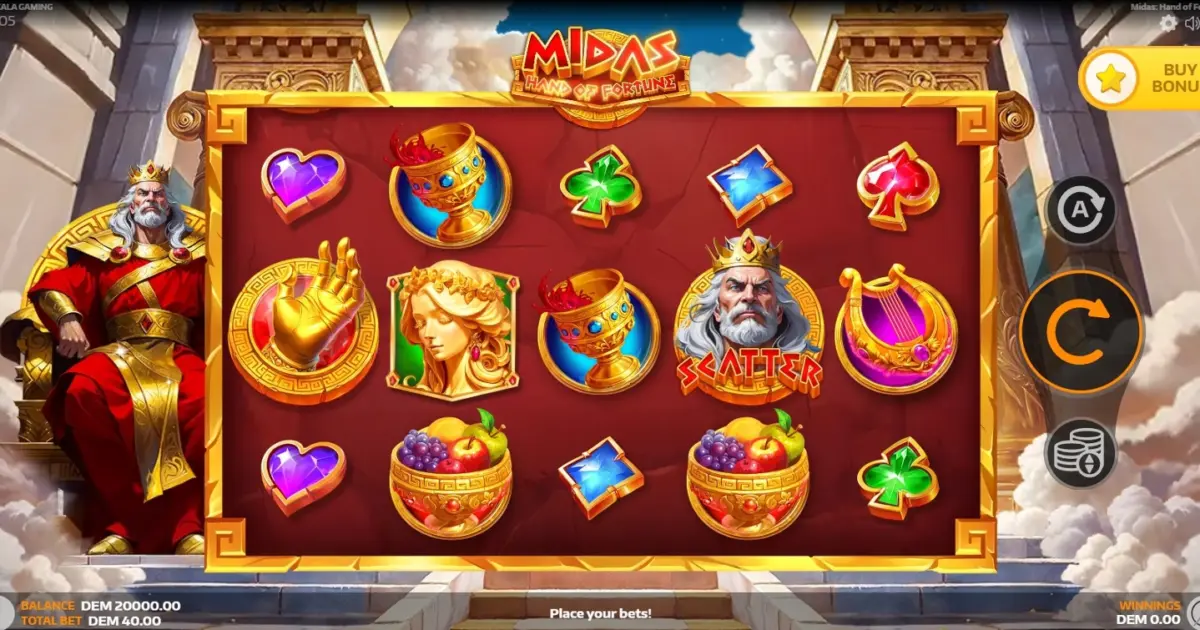
The short answer: the midas: hand of fortune slot returns 95% RTP, which is 0.71 percentage points under the 95.71% average across the games catalogued here. It is a five-reel Mancala Gaming release built on a mythology theme, and it is free to try with no money staked. What you will not find is a published volatility rating, payline count or max win figure, which means the maths below is where your decision has to come from.
That gap in the data matters more than it might sound. Two games can share an identical 95% return and feel nothing alike over a hundred spins, because RTP says how much comes back on average and says nothing about the shape of the ride.
Who makes Midas: Hand of Fortune
Mancala Gaming is the studio behind this title, and it has 90 games listed in this catalogue. That is a mid-sized library by industry standards: large enough that the studio has a settled house style, small enough that individual releases are not lost in a back catalogue of thousands.
The more telling number is the studio’s average RTP across those 90 titles: 95.01%. This game sits at 95.0%, which is effectively dead on the house line. When a provider’s average and an individual game’s figure match this closely, it usually points to a deliberate configuration standard rather than a per-game decision. For you as a reader, that means the RTP here is not a one-off outlier to be avoided or sought out; it is simply what this studio ships.
Nothing in the published data covers release date, licensing, or which markets the studio is certified in. If those things matter to you, check the operator’s own game information panel rather than trusting a figure quoted on a review page, including this one.
| Provider | Mancala Gaming |
|---|---|
| RTP | 95.0% |
| Reels | 5 |
| Theme | Mythology |
| Free demo | Yes |
| Site-wide average RTP | 95.71% |
Where Midas: Hand of Fortune sits in the Mancala Gaming catalogue
Right in the middle, on return at least. Compare it with Mustang Rush at 95.0% and Book of Wealth III at 95.0% and you get the same figure three times over. Across Mancala Gaming slots, the pattern holds: the studio average of 95.01% tells you that picking between these titles on RTP alone is picking between identical numbers.
So the choice becomes theme, mechanics and how the game feels at your stake level. That is genuinely useful information, because it removes a variable. You are not sacrificing long-run return by choosing the mythology theme over the western one.
On popularity, this game ranks 2339 overall, placing it in the 88.3rd percentile of the catalogue. Popularity is a measure of attention, not quality and certainly not of payouts. A widely played game is not more generous than an obscure one; the return figure is fixed in the game’s configuration regardless of how many people are spinning it.
RTP: 95.0% against a 95.01% house average
A 95% RTP means that across a very large sample of spins, the game is configured to return £95 for every £100 wagered, with £5 retained. The word “average” is carrying all the weight in that sentence. Over 100 spins at £1, the distribution of outcomes is wide enough that £95 is one of the least interesting things that might happen. Over several million spins, the actual return converges on 95%.
Against the catalogue average of 95.71%, this game gives up 0.71 percentage points. In practical terms, wagering £1,000 at 95.71% has a theoretical cost of £42.90; at 95.0% it is £50.00. A difference of around £7 per £1,000 staked. Small per session, meaningful over a year of regular play.
One thing worth stating plainly: every spin is independent. The game holds no memory of what came before, so a long run without a win does not increase the chance of the next spin landing, and a good run does not borrow from the future. No stake pattern, timing choice or progression changes the 95% figure.
Volatility and who it suits
No volatility rating has been published for this game, so treat any confident claim you see about it elsewhere with suspicion. That absence is worth understanding rather than skipping past.
Volatility describes swing size. A low-volatility game pays smaller amounts more often, so bankrolls deplete slowly and sessions run long and fairly flat. A high-volatility game pays rarely but larger, so the same bankroll can vanish in a short run of dead spins, and the wins that do land are the ones carrying the entire 95% return. Both configurations can share the identical RTP and produce completely different session experiences.
Because the figure is not published here, the only reliable way to gauge it is to play the demo and watch what happens: how often something lands, how large the returns are relative to your stake, how long a given balance lasts. That is observation, not measurement, and a short demo run will not give you a statistically meaningful answer. It will, though, tell you whether the pace suits you.
Hit frequency is also unpublished. Many slots disclose it; this one does not.
Playing Midas: Hand of Fortune Slot for free
A Midas: Hand of Fortune free demo is available, which is the sensible first step given how much of the spec sheet is blank. Demo mode runs the same game configuration with play-money credits, so you can see the reel behaviour, the pace and the interface without committing anything.
Be clear about what the demo does not do. It cannot pay out real money, and a good or bad run in demo mode has no predictive value for what happens with real stakes. The random number generator does not know or care which mode you are in, and results from a few hundred spins are noise either way.
Stake range is not published in the available data, so you will need to open the game’s bet panel to see the minimum and maximum. That matters for bankroll planning: a £0.10 minimum and a £1 minimum produce very different session lengths from the same starting balance.
This is 18+ entertainment. Decide what the session is worth to you before you start, treat that figure as the price of the entertainment rather than an investment, and stop when it is spent. If it stops being fun, that is the signal to close the tab.
Similar picks
Mythology is a crowded category, with 801 titles carrying the theme in this catalogue, so there is no shortage of alternatives at different return levels. Gates of Olympus is the obvious comparison at 96.5% RTP, a full 1.5 points higher, which on £1,000 wagered is a theoretical cost of £35 against £50 here. If return is your deciding factor, that is the stronger number.
Going the other way, 9 Arrows of Odysseus sits at 94.0%, a point below this game. Same theme, weaker long-run return.
None of this tells you which game you will enjoy more, and a higher RTP does not guarantee a better session. It shifts the long-run maths in your favour, nothing more. Over a single evening, the difference between 95% and 96.5% is swamped by variance.
Verdict
A middling return and a thin data sheet. The 95% RTP is standard for Mancala Gaming and slightly below the wider catalogue average, and the absence of volatility, payline and max win figures means you are buying with less information than a comparable release would give you.
That is not a reason to write it off. It is a reason to use the free demo properly before deciding anything, and to be honest with yourself about the 0.71-point RTP gap if you play regularly. If you want the mythology theme with a better long-run figure, the alternatives above are a point or more ahead. If this particular game appeals, it is playable at no cost, and that is the right place to test it.
Frequently Asked Questions
Can you play Midas: Hand of Fortune for free?
A free demo is available, running the same configuration with play-money credits rather than cash. It lets you see the pace, the interface and the reel behaviour before deciding whether to stake anything. Because the volatility rating is unpublished, the demo is the only practical way to get a feel for swing size.
What is the RTP of Midas: Hand of Fortune?
The RTP is 95.0%, meaning the game is configured to return £95 per £100 wagered across a very large sample of spins. That sits 0.71 points below the 95.71% catalogue average, a theoretical cost of £50 rather than £42.90 per £1,000 staked. Short sessions will vary widely from that figure.
Is Midas: Hand of Fortune high or low volatility?
No volatility rating has been published for this title, so any confident claim about it is guesswork. Volatility determines swing size rather than return: high-volatility games pay rarely and larger, low-volatility games pay small and often. Both can share the same 95% RTP while producing very different session lengths.
Who is Mancala Gaming and what else do they make?
Mancala Gaming is the studio behind this release, with 90 titles in this catalogue and an average RTP of 95.01% across them. Mustang Rush and Book of Wealth III both sit at 95.0%, the same figure as this game, so the studio appears to apply a consistent return standard across its library.
How does it compare to Gates of Olympus?
Gates of Olympus carries a 96.5% RTP against 95.0% here, a 1.5-point advantage that works out to roughly £15 less theoretical cost per £1,000 wagered. Both draw on mythology. Over a single session, though, variance will overwhelm that gap entirely, so the edge only shows up across sustained play.