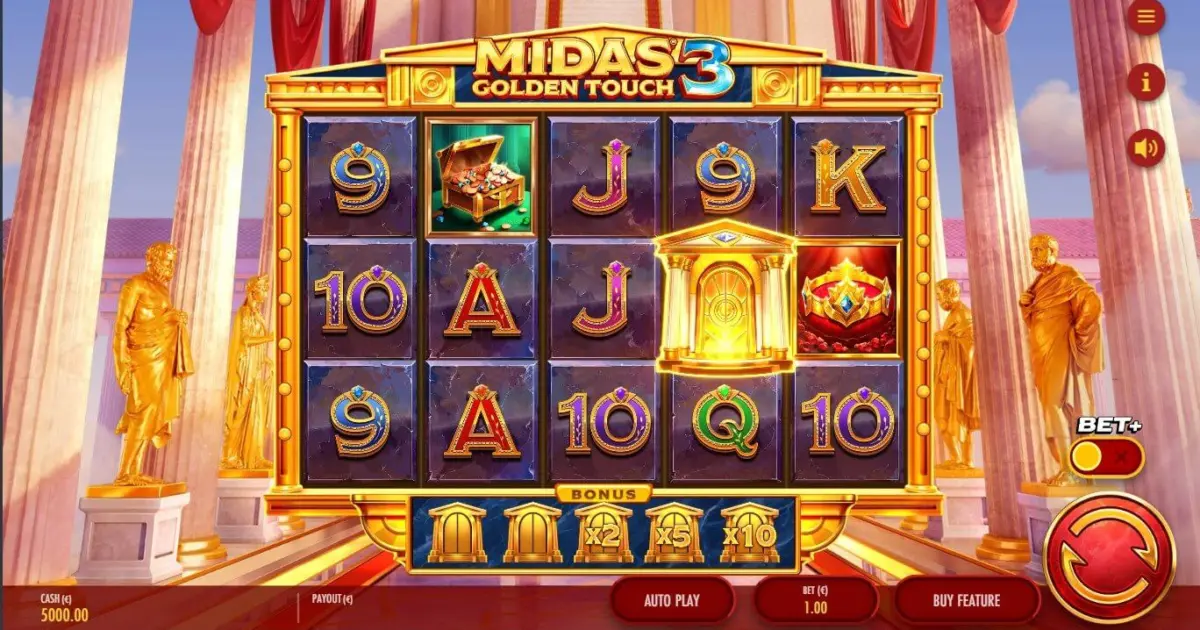
The headline figure on this game is 94.16%, and it is the first thing worth knowing. That is below the average for both Thunderkick’s own catalogue and the wider set of games listed on this site, which means the long-run cost of playing is higher than the typical alternative. The midas golden touch 3 slot is a five-reel release from Thunderkick, built on a mythology theme, and a free demo is available if you want to see it move before deciding.
Midas Golden Touch 3 at a glance
Here are the confirmed numbers, and only the confirmed numbers. Anything not listed below has not been published in the data available for this title.
| Detail | Value |
|---|---|
| Provider | Thunderkick |
| RTP | 94.16% |
| Reels | 5 |
| Theme | Mythology |
| Category | Slot Machine |
| Thunderkick catalogue size | 93 games |
| Thunderkick average RTP | 95.78% |
| Site-wide average RTP | 95.71% |
| Popularity rank | 1530 (92.3rd percentile) |
| Free demo | Available |
Notice what is absent. There is no published paylines or ways count, no volatility rating, no stake range, no maximum win multiplier, and no hit frequency figure. That absence matters. If you see a specific max win number quoted for this game elsewhere, treat it with caution until Thunderkick publishes one, and check the paytable inside the game itself rather than a third-party summary. This game suits someone who already likes Thunderkick’s mythology series and wants the newest instalment. It suits a value-hunter considerably less well.
What a 94.16% RTP actually returns
Return to player is a long-run statistical average, not a promise about your session. At 94.16%, the maths says £94.16 is returned per £100 wagered across a very large sample of spins. The remaining £5.84 per £100 is the house edge. Individual sessions scatter widely around that figure in both directions, and no sequence of spins is owed to you.
Work it through. Suppose you place 1,000 spins at £0.20 each. That is £200 staked. At a 94.16% return, the expected value returned is £188.32, an expected cost of £11.68 for the session. Run the same 1,000 spins on a 95.71% game — the average across the games catalogued here — and expected return rises to £191.42, a cost of £8.58. The gap is £3.10 per £200 wagered, or 1.55 percentage points.
Small per session, cumulative over time. Across 10,000 spins at the same stake, that difference is roughly £31. Thunderkick’s own catalogue average of 95.78% across 93 games tells you this title sits at the low end of what the studio usually ships, not at its typical level. If RTP is your deciding criterion, Tiger Rush from the same studio returns 96.30% — a 2.14-point improvement on identical stakes.
Unrated volatility and what your session will feel like
No volatility rating has been published for this game, so anyone telling you it is high or low is guessing. What you can do is understand the two ends of the scale and work out which one you are looking at from the demo.
Low-volatility slots pay smaller amounts more often. Balances drift down gradually rather than dropping in steps, sessions last longer on the same bankroll, and the biggest results are modest. High-volatility slots invert all of that: long stretches with little or no return, punctuated by rarer and larger hits. Two games can share an identical RTP and feel completely different to sit with, because volatility describes the shape of the distribution while RTP describes only its centre.
The practical implication is bankroll size. A high-volatility game needs a deeper balance relative to your stake to survive the dry runs long enough for the maths to have any chance of expressing itself. A low-volatility game is more forgiving of a thin bankroll but will rarely produce a memorable result. Since this game gives you no rating to plan around, the demo is where you find out. Watch 200 or 300 spins and note how often anything lands at all. If you want a rated comparison point in the same theme, Gates of Olympus is the reference many players use, and it carries a 96.50% RTP.
The 5-reel layout and how wins are counted
Five reels is the standard modern configuration, and it tells you the shape of the grid without telling you how wins are awarded. That second part is where slots differ, and it is not documented here.
Broadly, five-reel games settle into three win-counting models. Fixed paylines run a set number of defined paths across the grid — 10, 20, 25 and so on — and a combination pays only if it lands along one of those paths. All-ways or “ways” systems drop the paths entirely and pay any matching symbols on adjacent reels from the left, which is why you see counts like 243 or 3,125 ways quoted. Cluster and scatter-pays models ignore adjacency rules and pay for a minimum count of symbols anywhere on the grid. Some games use cascading or tumbling reels, where winning symbols are removed and replaced so a single paid spin can resolve several times.
Which of these this game uses is a paytable question. Open the information screen in the demo and check the win rule before you place a real stake, because it determines how a given stake is divided and how you should read the paytable values. Thunderkick’s earlier Midas Golden Touch returns 96.10%, and comparing the two paytables side by side is the fastest way to see what changed in this sequel.
Stake range and sizing a bankroll
No minimum or maximum stake has been published for this title, so treat the numbers below as method rather than specifics — check the actual limits in the game before committing.
The useful ratio is spins per bankroll, not stake in isolation. Divide your session budget by your chosen stake and you get the number of spins you can place before the money is gone, assuming nothing returns at all. A £50 budget at £0.20 per spin buys 250 spins; the same budget at £1.00 buys 50. On a game with no published volatility rating, 50 spins is not enough to tell you anything, and it is a very short session.
Every spin is independent. The result of the last one has no bearing on the next, so no staking pattern, timing choice or bet progression changes the 94.16% expected return. Raising your stake after losses does not recover anything; it only increases the amount at risk per spin. Pick a stake that gives you the number of spins you want from the budget you have already decided to spend, then leave it alone.
Playing the Midas Golden Touch 3 demo before you commit
A Midas Golden Touch 3 free demo is available, and given how much information is missing from the published data, it is genuinely the most efficient way to answer your own questions. In demo mode you can read the full paytable, confirm the win-counting method, see the real stake range, and get a rough feel for how often anything lands. All of that is unavailable from a spec sheet.
One limit on what the demo tells you: it runs the same maths but with play credits, so results there predict nothing about a real-money session. A generous demo run and a flat one are both ordinary samples from the same distribution.
Play is for adults 18 and over. Decide what the session is worth to you before you open the game, treat that figure as the price of entertainment rather than an investment, and stop when it is spent. If it stops being fun, close the tab.
Verdict: who should play Midas Golden Touch 3
The case for it is series loyalty and popularity. This game sits in the 92.3rd percentile for popularity, so plenty of people are playing it, and if you enjoyed the earlier Midas titles the sequel is the obvious next stop.
The case against is the return figure. 94.16% is 1.55 points under the site-wide average and 1.62 under Thunderkick’s own, and the studio has 92 other games, several of which return more. Combined with unpublished volatility, paylines and stake range, you are being asked to accept a worse long-run return in exchange for less information than usual.
Play the demo first. If the mechanics land for you and the theme is what you want, the RTP gap costs a few pounds per couple of hundred wagered — real, but not ruinous. If you are choosing purely on numbers, Esqueleto Explosivo 2 at 96.13% is the better arithmetic from the same studio.
Frequently Asked Questions
Can I play Midas Golden Touch 3 for free without downloading anything?
A free demo of Midas Golden Touch 3 is available, so you can spin it with play credits rather than real money. Thunderkick slots run in the browser, which means no download is needed. The demo uses the same 94.16% RTP and the same maths as the real-money version, so it is a fair way to see the paytable and mechanics first.
What is the RTP of Midas Golden Touch 3 and is it good?
The RTP is 94.16%, which returns £94.16 per £100 wagered across a very large sample of spins. That is below average: the games catalogued here average 95.71%, and Thunderkick's own 93 titles average 95.78%. So this sits roughly 1.55 percentage points under par, making it a weaker return than most alternatives on identical stakes.
Is Midas Golden Touch 3 high or low volatility?
Thunderkick has not published a volatility rating for this title, so any confident claim you see about it is guesswork. Volatility determines swing size and how long a bankroll lasts, independent of RTP. The practical workaround is the demo: place 200 to 300 spins, note how often anything returns, and size your real-money stake from what you observe.
Who makes Midas Golden Touch 3 and what else do they produce?
Thunderkick, a studio with 93 games in this catalogue and an average RTP of 95.78% across them. Their range includes Tiger Rush at 96.30% and Esqueleto Explosivo 2 at 96.13%, both returning more than this title. The original Midas Golden Touch returns 96.10%, which makes the sequel's 94.16% a notable step down within the same series.
How does Midas Golden Touch 3 compare to Gates of Olympus?
Gates of Olympus returns 96.50% against 94.16% here, a gap of 2.34 percentage points on the same wager. Both draw on mythology, one of 801 themed games listed on this site. On £200 wagered, that difference is roughly £4.68 in expected cost. If return is your main criterion, the Olympus figure is clearly stronger.