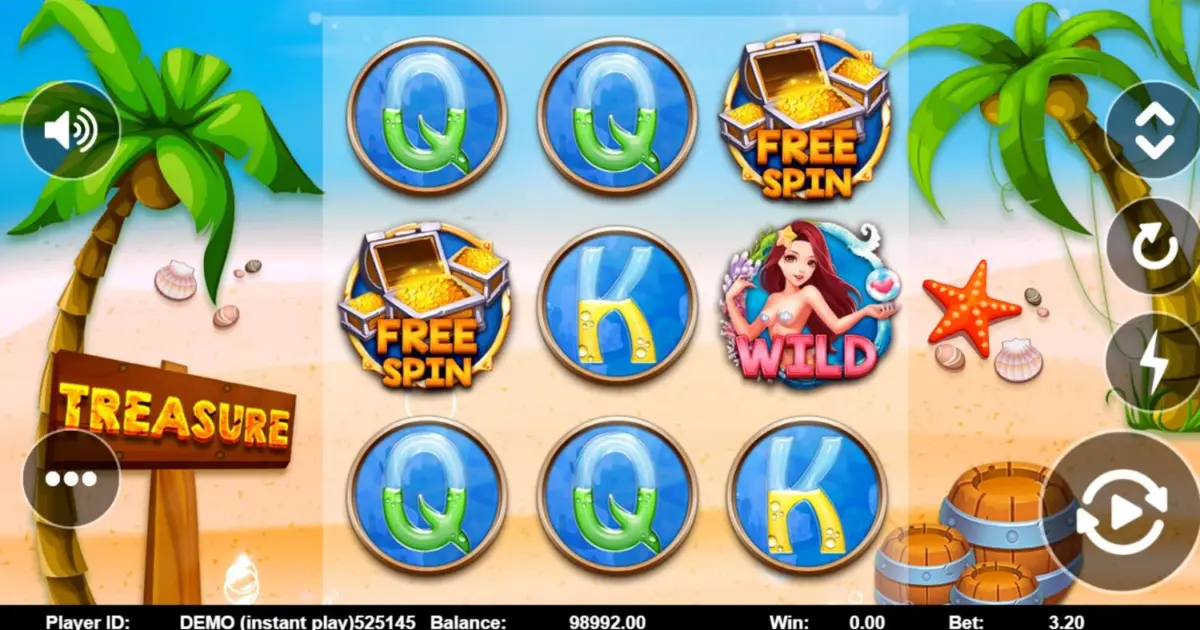
The single most important thing to know about this game is what is missing. Triple Profits Games has not published a return-to-player percentage, a volatility rating, a stake range or a maximum win figure for it, which means the usual numbers you would use to decide whether a game suits your bankroll simply are not on the table. What you do get is a free demo, three reels, and a popularity rank that says plenty of people have already tried it.
That combination makes the mermaid treasure slot a game you can sensibly try but cannot sensibly budget for in advance. Below is everything the available data supports, plus the maths you can apply yourself once you see the paytable in front of you.
Is Mermaid Treasure worth playing?
It is worth ten minutes in demo mode, and not much more than that until the numbers are published. Free play costs nothing and answers questions no review can answer for you: how often the reels land something, how the paytable is structured, whether a three-reel format holds your attention.
The supporting evidence is thin but not negative. The game ranks 2337 in the catalogue, placing it in the 88.3rd percentile for popularity — higher than roughly seven in eight titles. Popularity is a measure of traffic, not of generosity or design quality, and it tells you nothing about the return percentage. It does suggest the game is easy to find and that other players have not immediately bounced off it.
| Feature | Detail |
|---|---|
| Provider | Triple Profits Games (TPG) |
| Reels | 3 |
| Themes | Holiday, 3-Reels |
| Type | Slot Machine |
| Popularity rank | 2337 (88.3rd percentile) |
| Free demo | Available |
| Published RTP | Not disclosed |
| Corpus average RTP for comparison | 95.71% |
What an undisclosed RTP means over 1,000 spins
RTP is the share of all money wagered that a game is mathematically expected to pay back across an enormous number of spins. It is a long-run average, not a schedule, and it says nothing about what happens on any individual session.
Work through a worked example at the catalogue average of 95.71%. At £0.20 a spin, 1,000 spins puts £200 through the game. A 95.71% return implies roughly £191.42 back in theory, an expected cost of about £8.58. Move to a 96.51% game and the same £200 implies about £193.02 back, a cost near £6.98. That gap of roughly £1.60 per 1,000 spins is small in one session and meaningful across a year of play.
Here is the problem: none of that arithmetic applies to this title, because the figure is unpublished. Any RTP number you see quoted for Mermaid Treasure on another site is not traceable to the provider and should be treated as unverified. The practical workaround is to check the in-game information panel or help screen when you load it, since many operators display the configured return there. If no figure appears, you are playing a game whose expected cost you cannot calculate.
How volatile is the Mermaid Treasure slot?
No volatility rating has been published, so this has to be reasoned about rather than reported. Volatility describes the size and spacing of wins rather than their total. A low-volatility game pays small amounts frequently, and a bankroll of 100 spins tends to survive; a high-volatility game pays rarely and larger, and the same bankroll can vanish without a single meaningful hit. Both can share an identical RTP.
Three-reel formats as a class usually carry fewer paying combinations than five-reel grids, which historically meant simpler, flatter maths — but modern three-reel releases vary widely, and the reel count alone is not proof of anything. Treat the format as a hint, not a rating.
The demo is the best instrument available. Spin 200 times at a fixed stake and note how many spins return anything at all, and how the largest single win compares to your stake. That gives you a rough feel for hit frequency and swing size. It is a small sample and will not predict real-money sessions, but it is far better than assuming.
What the Holiday theme brings to the game
The theme label is Holiday, with a secondary 3-Reels tag. That tells you the presentation leans on festive or seasonal imagery, and nothing more specific than that — no character, soundtrack or animation detail is documented, so treat any confident description of the visuals elsewhere as invention.
Holiday is a crowded category, with 329 titles carrying the tag. That matters for one practical reason: you have a lot of directly comparable alternatives, several of which do publish their return figures. A theme has no effect on mathematics. It changes nothing about hit frequency, volatility or expected return, and a festive skin over a three-reel engine pays exactly what the paytable says it pays.
Where the theme genuinely counts is engagement. Seasonal games tend to be played in short bursts around the time of year they evoke, and a format you find visually pleasant is one you will play at a considered pace rather than clicking through impatiently. That is a real benefit, just not a financial one.
Stakes, session length and bankroll
The minimum and maximum stake are not published either, so the sizing exercise has to start from your side of the table rather than the game’s. Decide the total you are prepared to spend first, then work backwards.
A usable rule is to divide your session budget by the number of spins you want the session to last. A £40 budget across 400 spins means £0.10 a spin. A £40 budget at £1.00 a spin buys 40 spins, which on any game with meaningful volatility is not enough spins for the long-run average to assert itself at all. Short sessions are dominated by variance, which is why two players on the same game and the same stake can walk away with wildly different results.
Every spin is independent. The reels have no memory of what came before, so no staking pattern, no timing and no progression changes the expected value of what follows. Increasing your stake after losses only increases the money at risk per spin.
Alternatives if Mermaid Treasure is not for you
If the absence of a published return figure bothers you — and it reasonably might — the Holiday category offers titles with documented numbers. Sweet Bonanza Xmas publishes a 96.51% RTP, the highest of the comparable festive titles here and roughly 0.8 percentage points above the 95.71% catalogue average. Lucky Santa Bonanza sits at 96.12%, and Santa Sphere: Hold the Spin at 96.05%, both also above that average.
If you specifically want more Triple Profits Games (TPG) slots, the studio has 85 titles in the catalogue, including Lucky 7 — though note that it, too, carries no published RTP, so the same information gap applies.
Final take
A free demo with no disclosed return percentage, no volatility rating and no stated stake range is worth trying and hard to recommend as a real-money regular. Try the Mermaid Treasure free demo, check whether the in-game help screen reveals a return figure, and let that decide the rest.
Slots are paid entertainment, not a way to make money. Play only if you are 18 or over, set a budget before you start and treat it as spent the moment you do, and stop when it is gone rather than topping it up. Demo results have no bearing on real-money outcomes.
Frequently Asked Questions
Can you play Mermaid Treasure for free?
A free demo is available, which lets you spin the three reels with play credits and no deposit. That matters more than usual here, because the provider has not published an RTP, volatility rating or stake range, so the demo is the only way to see the paytable and get a feel for how often the reels return anything.
What is the RTP of Mermaid Treasure?
Triple Profits Games has not published an RTP figure for this title, so any percentage quoted elsewhere is unverified. For context, the average across the catalogue is 95.71%. Check the in-game information panel when you load it, since operators often display the configured return there. Without a figure, you cannot calculate the expected cost of a session.
Is Mermaid Treasure high or low volatility?
No volatility rating has been published, so the risk profile is genuinely unknown. Volatility governs how large and how spaced-out wins are, not the total returned. Three-reel games historically carried fewer paying combinations than five-reel grids, but that is a hint rather than proof. Spinning 200 demo rounds gives you a rough sense of hit frequency.
Who is Triple Profits Games and what else do they make?
Triple Profits Games (TPG) is the studio behind this release, with 85 titles in the catalogue. Others include Gemstone Legend, Fortune Tiger and Lucky 7. None of those three publish an RTP figure either, so the same information gap applies across the range if disclosed return percentages are important to you.
How does Mermaid Treasure compare to Sweet Bonanza Xmas?
Sweet Bonanza Xmas publishes a 96.51% RTP, roughly 0.8 percentage points above the 95.71% catalogue average, while Mermaid Treasure publishes no figure at all. On that basis alone the comparison favours the documented game. Both sit in the Holiday category, which contains 329 titles, so there is no shortage of alternatives with stated numbers.