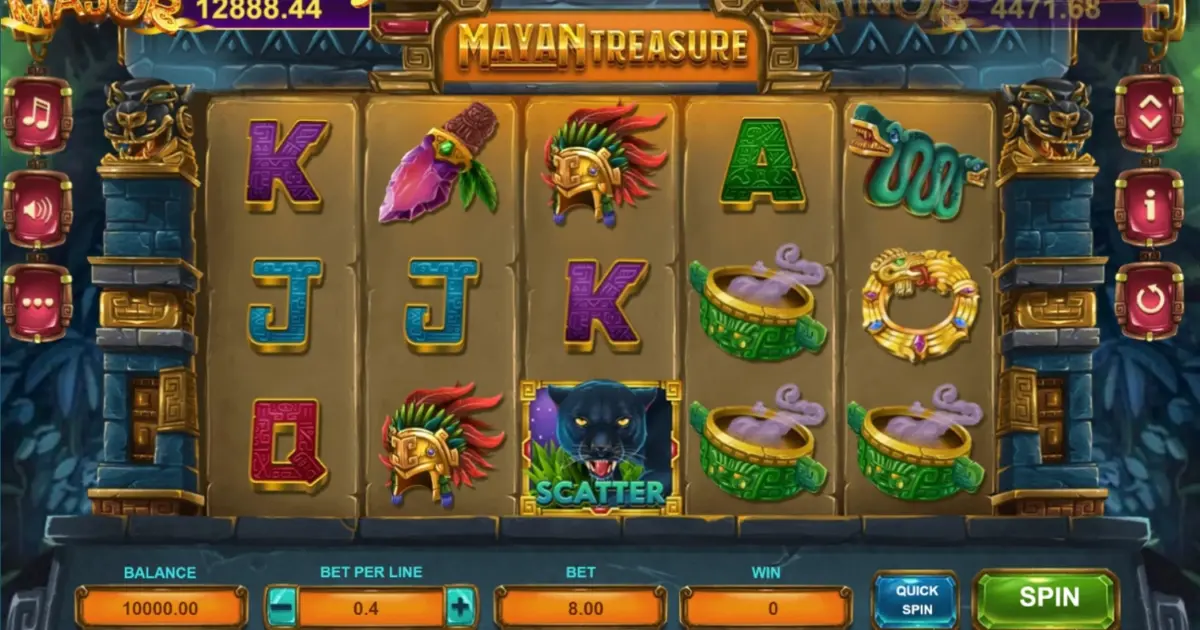
Mayan Treasure is a 5-reel slot from Triple Profits Games (TPG) that is available to try as a free demo, which is useful because key figures like RTP, volatility and stake limits have not been published. If you compare games on numbers before you commit, the missing data is the headline here. The mayan treasure slot is therefore best approached as a look-first title you test for feel rather than one you can model on paper.
Mayan Treasure at a glance
This is a 5-reel entry in the TPG catalogue, which spans 85 games. It is listed as a Slot Machine in the 5-Reels theme group, so you can expect a conventional reel-based structure rather than an experimental mechanic, though the FACTS block does not detail paylines, ways or features.
Rank and discovery matter if you are browsing a large lobby. Mayan Treasure sits at rank 2874 with a popularity percentile of 85.6, which puts it outside the most-played tier. That does not reflect quality on its own, it simply means fewer players are choosing it compared with higher-ranked titles, so independent information is thinner and you will lean more on a hands-on demo.
What is confirmed versus what is not is the clearest way to frame this game:
| Detail | What is known |
|---|---|
| Provider | Triple Profits Games (TPG) — 85 games in catalogue |
| Reels | 5 |
| Themes / Subcategory | 5-Reels / Slot Machine |
| Popularity | Rank 2874, 85.6th percentile |
| Free demo | Available |
| RTP | Not published |
| Volatility | Not published |
| Stake range / Max win | Not published |
If you like to shortlist by numbers, treat Mayan Treasure as incomplete on paper and use the demo to fill the gaps that published specs normally cover. For context against the wider market, the corpus average RTP across tracked slots is 95.71%, but without a figure for this game you cannot place it above or below that line.
What RTP means when no figure is published
Return to Player is a long-run statistical average, not a promise for a single session. A 96% RTP, for example, means that for every £100 wagered the game is designed to return £96 across a very large number of spins — millions, not hundreds — with the remaining 4% as the house edge. Every spin remains independent and random.
Because Triple Profits Games has not published an RTP for Mayan Treasure, you cannot do the usual maths that helps you plan. With a known figure you could estimate the theoretical return for a sample — for instance, 1,000 spins at £0.20 is £200 staked, which at 95.71% (the corpus average) would average £191.42 returned and £8.58 retained by the house over that huge sample, while at 96.5% it would average £193 returned. Those examples illustrate the concept only; they are not the expectation for this title.
The comparison that is possible is this: tracked slots average 95.71%. When a game’s own RTP is missing you have no way to know if it sits near, above or below that benchmark, or whether different versions with different RTPs exist at different sites — many providers do publish ranges. Until TPG publishes a figure, treat any RTP you see quoted elsewhere for Mayan Treasure with caution and rely on the demo for a qualitative sense of hit rate rather than a quantitative one.
The absence also means you cannot estimate session cost from theoretical loss per spin. That matters if you budget by expected value; here you are budgeting blind to the house edge, so conservative stakes and a firm stop-loss are more important than usual.
Undisclosed volatility and what your session will feel like
Volatility describes how returns are distributed, not how much is returned overall. Low volatility typically means more frequent but smaller wins and a smoother bankroll line, while high volatility tends toward longer dry spells punctuated by larger swings. Medium volatility sits between. This is true across all slots as a general principle.
Mayan Treasure has no published volatility rating in the FACTS supplied, so no such profile can be attributed to it here. That leaves you without the two numbers that together shape expectations: RTP for long-run average and volatility for short-run texture. Without them, you cannot know whether to expect the bankroll to erode gradually or to swing sharply.
What does that mean in practice? If you usually pick low-volatility games to stretch a small budget across a longer session, you have no confirmation this title will behave that way. If you prefer high-volatility games for the chance of larger peaks, you similarly have no confirmation. Many slots do publish these ratings precisely so you can match the game to your tolerance for variance; when they are absent, the only honest approach is to note the gap.
You can still learn something from a demo by observing, without assigning labels, how often wins occur and how large they feel relative to stake across a few hundred spins, remembering that short samples are noisy. Keep stakes flat, do not infer that a cold streak makes a win more likely, and avoid systems that claim to beat variance.
The 5-reel layout and how wins are counted
The one structural fact supplied is reel count: 5. A 5-reel layout is the most common configuration in modern video slots and usually presents symbols on a grid where wins are evaluated on paylines or ways. Without a payline or ways count in FACTS, you cannot state how Mayan Treasure evaluates winners.
In general terms, paylines are defined lines across the reels that must be covered by matching symbols from left to right, with the number of lines influencing hit frequency and stake multiplication. Ways-based games, such as 243 ways, award wins for matching symbols on consecutive reels regardless of exact position. Both are just counting methods; the provider chooses one and publishes it. Here that choice is not published, so do not assume either.
Reel count alone tells you the game will scroll vertically and evaluate across five columns, but it does not tell you symbol count per reel, row count, or whether special symbols exist. Many slots include wilds that substitute for other symbols and scatters that trigger features, yet those are concepts, not confirmed features of this game. Until paytable information is provided by TPG, treat any description of wilds, scatters, free spins or multipliers for Mayan Treasure as unverified.
For comparison while you wait for full specs, you could look at other TPG titles that do have pages on the site, such as Gemstone Legend, and note how their layouts are documented. That helps you see what a complete paytable looks like, but it does not tell you that Mayan Treasure works the same way.
Stake range and sizing a bankroll
Stake range frames everything about session planning: minimum stake sets the cheapest cost per spin, maximum stake caps exposure, and the distance between them shows how flexibly you can adjust. Without a published minimum, maximum or default denomination for Mayan Treasure, you cannot calculate spins per budget.
In a typical planning exercise you would divide bankroll by stake to get spin count — £40 at £0.20 is 200 spins, at £1 it is 40 spins — and then consider RTP and volatility to gauge how long that might last in practice. Here you can only do half the exercise. You can decide a total budget and a loss limit, but you cannot translate that into an accurate spin count until the stake limits are known.
The safest proxy is to set your budget first and keep stakes consistent once you see the actual limits in the demo lobby. Do not chase losses by raising stakes to recover, because stake progression does not change expected value and each spin is independent. If you are comparing, Fortune Tiger is another TPG title on the site where you can see how stake information is normally presented, which shows the kind of detail to look for when it becomes available for Mayan Treasure.
You should also check that the stake display in the demo matches the real-money version at the casino you might later use, as providers sometimes expose different denominations by market. If the FACTS remain silent on limits, verify them directly in the game client before staking.
Playing the Mayan Treasure slot demo before you commit
The FACTS confirm that a free demo is available, which for this title is more than a convenience — it is the primary way to evaluate a game with missing specs. You can load the Mayan Treasure free demo with no download and see reel behaviour, paytable layout and stake options as implemented, without wagering. That lets you judge pace and clarity before deciding if it fits your preferences.
Use the demo to answer practical questions: does the paytable list paylines or ways clearly, does it state RTP, and does help text describe any features in plain language. If that information is absent even inside the client, you remain in the same position as the FACTS suggest, which itself is useful to know.
Demo play does not predict real-money results. It uses the same random system but short samples tell you little about long-run averages, and the feeling of a few hundred spins is not a forecast. Keep any conclusions provisional.
If you choose to play with real money after the demo, do so with care. You must be 18 or over, set a budget you can afford to lose and treat the game as paid entertainment, not a way to make money. Use deposit limits and time-outs where available, and step away if you are no longer enjoying it. Every spin is random; no pattern makes a win more likely.
For another point of reference in the same provider catalogue while you compare, Lucky 7 (Triple Profits Games) is listed alongside Mayan Treasure and can show how TPG presents other slot pages when complete data is available.
Verdict: who should play Mayan Treasure
Mayan Treasure suits a player who is comfortable evaluating a slot hands-on and does not need published RTP or volatility to decide. The confirmed positives are straightforward: it is a 5-reel game from an established provider with a free demo, so you can inspect it without cost.
The downside is equally plain. Triple Profits Games has not published RTP, volatility, stake range or max win for this title, so you cannot model expected return, estimate session length or compare it on numbers to alternatives. That will put off anyone who filters by 96%+ RTP or by known low or high volatility.
If you do try it, set a strict budget, keep stakes level and view any early impressions from the demo as tentative. Should TPG later publish the missing figures, revisit the comparison against the 95.71% corpus average and your preferred risk profile; until then, treat Mayan Treasure as a demo-first curiosity rather than a numbers-led pick. If you want a game with the same provider but are seeking a fully documented page to benchmark presentation, the related titles above will help you calibrate what complete information looks like.
Frequently Asked Questions
Can I play Mayan Treasure for free without downloading?
Free demo access is confirmed as available for Mayan Treasure in the FACTS provided, which typically means you can load it in your browser with no download. The demo lets you view the paytable and stake options without wagering, but it cannot pay real money and short demo samples do not predict real-money outcomes.
What is the RTP of Mayan Treasure and what does it mean?
No RTP has been published for Mayan Treasure in the FACTS, so no figure can be reported here. RTP is a long-run average — for example 96% implies £96 returned per £100 wagered over millions of spins — not a short-session guarantee. Until TPG publishes a number, you cannot compare this game to the 95.71% corpus average or estimate theoretical loss.
What volatility does Mayan Treasure have and how will that affect my session?
Volatility is not published for Mayan Treasure, so no low, medium or high rating can be assigned. Volatility normally shapes whether wins are frequent and small or rare and larger, and therefore how quickly a bankroll swings. Without a rating, set a conservative budget, keep stakes flat and remember each spin is independent.
Who makes Mayan Treasure and what else do they offer?
Mayan Treasure is by Triple Profits Games (TPG), a provider with 85 games in its catalogue. The FACTS list related TPG titles like Gemstone Legend, Fortune Tiger and Lucky 7 (Triple Profits Games). Exploring those pages shows how TPG titles are normally presented, though features and figures vary by game and are not interchangeable.
What stake levels can I use on Mayan Treasure and how should I budget?
Minimum and maximum stakes are not published for Mayan Treasure, so you cannot calculate precise spins per bankroll in advance. A common approach is to decide a total loss limit first, then check the actual limits inside the demo client and divide budget by stake — for example £40 at £0.20 is 200 spins — keeping stakes consistent.