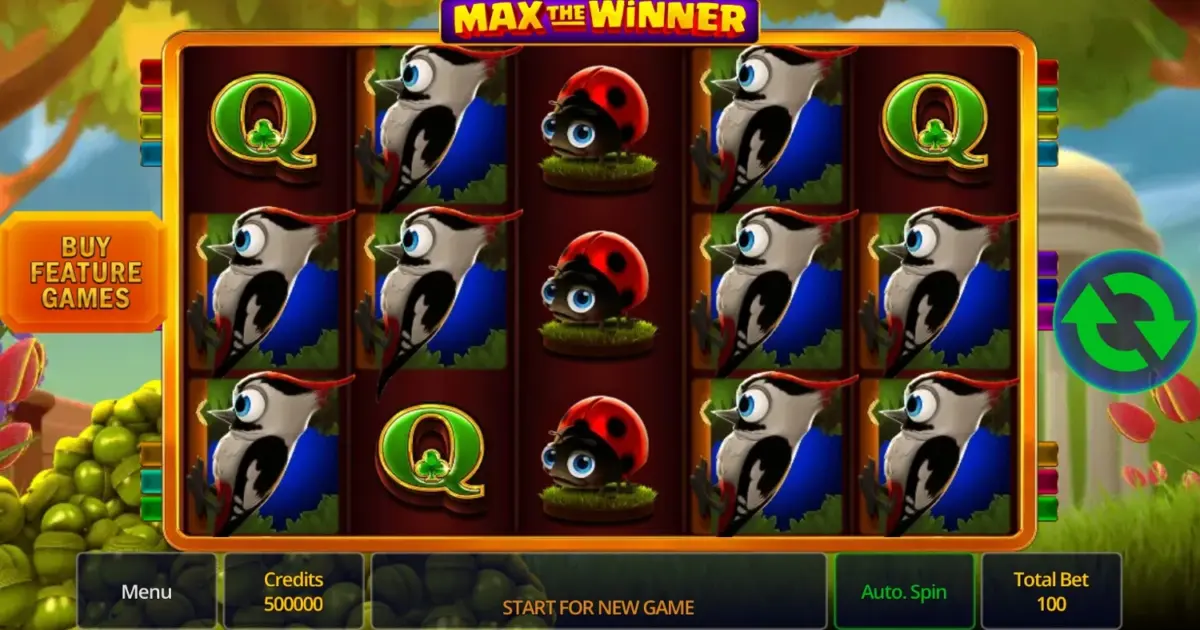
Swintt’s Max The Winner slot carries a published return of 95.55%, which is 0.16 percentage points under the average of the games in our database and nearly a full point above Swintt’s own house average of 94.67%. It runs on five reels, takes an animal theme, and can be played as a free demo with no money staked. What Swintt has not published is a volatility rating, a payline count or a maximum win figure, and that gap matters more than any single number here.
So the short answer: the maths is mid-table for the wider market and above par for this studio, but you are buying into a game whose risk profile is undocumented. That is a reason to start small rather than a reason to skip it.
First look at Max The Winner
Here is everything Swintt has actually confirmed about the game, with nothing filled in by guesswork.
| Figure | Value |
|---|---|
| Provider | Swintt |
| RTP | 95.55% |
| Reels | 5 |
| Type | Slot Machine |
| Themes | Animals, Nature, 5-Reels |
| Free demo | Available |
| Popularity rank | 2233 (88.8th percentile) |
| Swintt average RTP | 94.67% across 173 games |
| Database average RTP | 95.71% |
Note what is not in that table. No volatility band, no hit frequency, no payline or ways count, no max win multiplier, no release date. If you see a specific max win quoted for this title elsewhere, treat it sceptically — Swintt has not put a number on record, and an unsourced figure is worth nothing when you are planning a session. The rank of 2233 puts it in the upper reaches of the games we track by attention, so it is not obscure, just thinly documented.
How a round plays out
A round here is a five-reel spin at whatever stake you select. Beyond that, the specifics of how wins are formed in this particular game are not in the public data, so anything said about its symbols, special features or bonus triggers would be invention.
What can be said generally is how five-reel games tend to work. Symbols land across the reels and are assessed against fixed paylines, adjacent-reel clusters, or a ways-style system where every matching symbol on consecutive reels contributes. Which of those applies changes how often small returns land but not the long-run figure, which is already fixed at 95.55%. Many modern slots layer on wilds that substitute for regular symbols, scatters that trigger free spins, and sometimes a paid feature entry. Whether any of those appear in this game is not documented.
One thing is certain regardless of mechanics: each spin is resolved independently by a random number generator, so the outcome of your last twenty spins carries no information about the next one. The free demo is the practical way to find out how the round actually behaves.
Reading the 95.55% return figure
RTP is an average across an enormous number of spins, not a promise about your session. At 95.55%, the game is modelled to return £95.55 for every £100 staked across a sample far larger than any individual will ever play — millions of spins, not thousands. The complement, 4.45%, is the house edge.
Scale it to something realistic. Stake £0.50 a spin for 500 spins and you have wagered £250; the modelled return on that is roughly £238.88, an expected cost of about £11 for the session. Actual results will scatter widely around that, and the scatter is wider than most people expect at short sample sizes. Over 50 spins the expected loss is around a pound, which is small enough that variance completely dominates it.
Context helps. Against the database average of 95.71% this is a fractional shortfall, essentially indistinguishable in practice. Against Swintt’s own 94.67% across 173 titles it is comfortably above average, making it one of the better-returning options in the studio’s catalogue. For comparison, the studio’s Big Max Diamonds and Wilds is published at 95.05%, half a point lower over the same long horizon.
Why undisclosed volatility changes your bankroll maths
Volatility describes the shape of the outcomes rather than their average, and Swintt has not rated this game. That absence is worth planning around.
In a low-volatility design, returns arrive frequently in small amounts. Your balance drifts down slowly, sessions last a long time on a modest bankroll, and the biggest single results are unremarkable. High volatility inverts this: long stretches with nothing back, punctuated by occasional larger returns that account for most of the 95.55%. Two games with identical RTP can feel like completely different products because of this.
The practical consequence is that you cannot size a bankroll confidently without knowing which shape you are in. The conservative move is to assume the more demanding case. If you budget for high volatility and the game turns out to be gentle, you simply play longer than planned. Budget for low volatility on a high-variance game and you can burn through your money in a few dozen spins. Run the free demo for a couple of hundred spins and watch how the balance line moves: steady erosion with regular small returns, or flat stretches broken by spikes. That observation tells you more than any label would.
Bet sizing from an unpublished minimum upwards
Swintt has not published the stake range for this title, so the minimum and maximum will depend on the operator’s build and are visible only once the game loads. Check them before your first real spin rather than assuming they match another game you have played.
The method does not change. Decide the total you are willing to spend first, then work backwards to a stake. If you want 300 spins from £30, you need a £0.10 spin. If the minimum available is higher than the stake your budget implies, the honest conclusion is that the game is too expensive for that budget, not that you should shorten the session and hope.
Two things worth stating plainly. Raising or lowering your stake does not change the 95.55% return or the house edge — it only changes how much money each percentage point represents. And no sequence of stake changes, no doubling after a loss, no pausing and returning, alters the expected value of the next spin. Every spin is independent, so staking systems only redistribute the same edge into a different pattern of swings.
Where the Max The Winner slot sits among Animals slots
Animal-themed games are one of the largest groups we track, with 1,788 titles carrying the label, so the theme alone is not a differentiator. The RTP is where you can separate options, and on that measure this game sits below several well-known alternatives in the same category.
Strength of Hercules publishes 96.31%, three-quarters of a point higher, which over £250 of wagering is roughly £19 of modelled return versus about £239 here. Hercules Power Wild at 96.20% and Apex Strike Megaways at 96.13% land in similar territory, and the Megaways title gives you a documented mechanic to reason about rather than an undisclosed one. If the return figure is your main filter, those three are the stronger picks.
What keeps this game in the conversation is its standing within Swintt’s own range. At 95.55% it beats the studio average by almost a point, and its popularity percentile of 88.8 suggests plenty of players are finding it. A Max The Winner free demo also costs nothing to sample, which is the cheapest possible way to test whether the presentation and pacing suit you before committing anything.
The honest verdict
A reasonable but not outstanding choice. 95.55% is a fair return by this studio’s standards and roughly market-average overall, and the five-reel format is familiar enough that nothing about the structure should surprise you. The problem is the documentation: with no volatility rating, no stake range, no payline count and no max win on record, you are committing money to a product whose risk profile you have to discover by playing it. That is a real drawback compared with better-documented rivals at 96% and above.
The sensible order of operations is demo first, small stakes second. Use the free version to see how the swings behave over a few hundred spins, then decide whether the shape suits your budget.
One practical note before you play. Slots are paid entertainment, not income — the 4.45% house edge applies whatever you do, so decide what the session is worth to you and stop there. Play only if you are 18 or over, set the budget before you open the game rather than during it, and never stake money you need for something else.
Frequently Asked Questions
Can you play Max The Winner for free?
A free demo version is available, so you can spin the game with virtual credits and no deposit. This is the practical way to test a title whose volatility rating Swintt has not published, since you can watch how the balance behaves over a few hundred spins before deciding whether to stake real money on it.
What is the RTP of Max The Winner?
The published return to player is 95.55%, meaning a modelled return of £95.55 per £100 wagered across a very large sample of spins. That leaves a house edge of 4.45%. It sits 0.16 points below the 95.71% average of the games we track, but nearly a point above Swintt's own 94.67% average.
Is Max The Winner high or low volatility?
Swintt has not published a volatility rating for this title, so treat any figure quoted elsewhere with caution. The safe approach is to plan your bankroll as though the game were high variance, which means smaller stakes and more spins, then adjust after watching how the demo actually behaves across a couple of hundred rounds.
Who is Swintt and what other slots do they make?
Swintt is the studio behind this game, with 173 titles in our database and an average published RTP of 94.67% across them. Other releases include Sweet Bonbonella at 94.51%, Wild Pharaoh at 94.63% and Big Max Diamonds and Wilds at 95.05%, all of which return slightly less over the long run than this one.
How does Max The Winner compare to Strength of Hercules?
Strength of Hercules publishes a higher return at 96.31% against 95.55% here, a gap of 0.76 percentage points. On £250 of total wagering that difference is roughly £19 of modelled return. Both carry animal-category labels, so if the RTP figure is your deciding factor, the Hercules title has the stronger number.