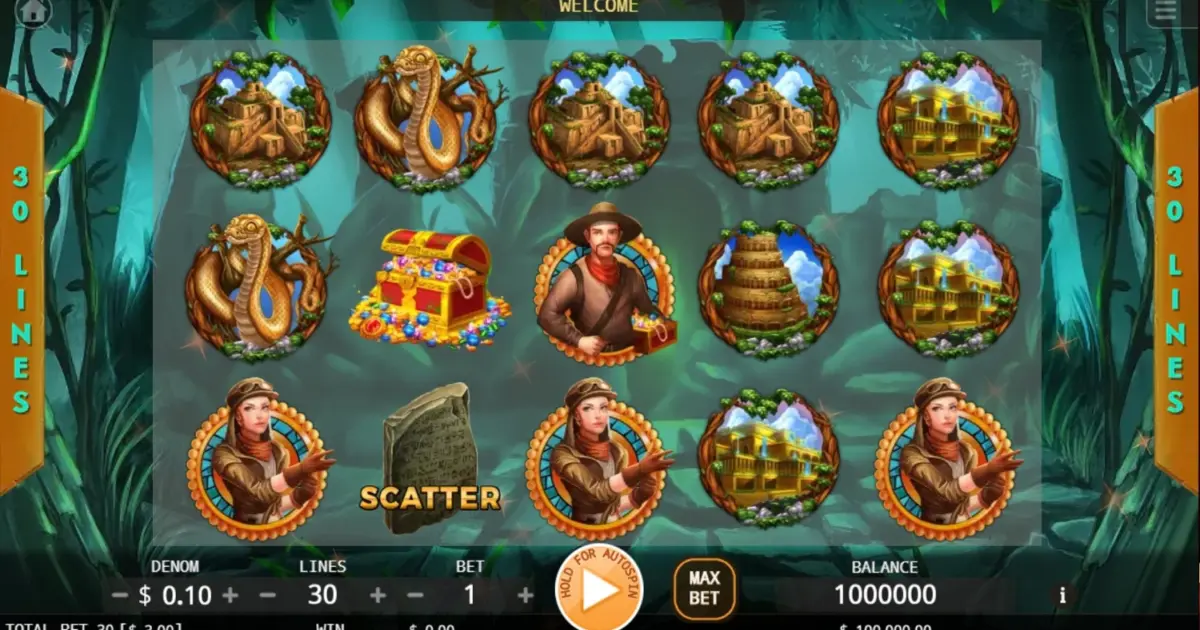
Lost Realm is a five-reel slot from Ka Gaming that has no published RTP, no disclosed volatility rating and no stated stake range. You can play it free on this page, but before you switch to real money, you need to understand exactly which numbers are missing and what that absence means for your bankroll planning.
First look at Lost Realm
Ka Gaming lists Lost Realm as a five-reel slot machine, placing it in the format that dominates the online catalogue. The provider’s portfolio stretches to 602 titles, which means Lost Realm is one game among many rather than a marquee release with detailed documentation attached.
What makes this entry unusual is not its format but its silence. Where most providers publish at least a return-to-player percentage on the in-game information screen, Ka Gaming has not attached an RTP figure to Lost Realm’s record. There is no volatility classification, no minimum or maximum stake, no hit frequency and no max win cap. The popularity percentile sits at 94.6, meaning the game ranks in roughly the top 5% by engagement across the entire corpus, yet the technical data a player needs to evaluate expected returns simply is not there.
| Detail | Value |
|---|---|
| Provider | Ka Gaming |
| Reels | 5 |
| Category | Slot Machine |
| RTP | Not published |
| Volatility | Not published |
| Stake range | Not published |
| Free demo | Available |
| Popularity percentile | 94.6 |
| Rank (of corpus) | 1075 |
A high rank tells you people play the game. It does not tell you whether the game pays back a fair share. Those are different claims, and only the first one is supported by the data on file.
How a round plays out
With five reels confirmed and nothing else published, here is what you can reasonably expect from a single spin. Five reels means five vertical strips of symbols that stop independently. Many slots in this format carry a fixed set of horizontal or diagonal paylines — commonly between 10 and 50 — while others use a “ways” mechanic where matching symbols on adjacent reels pay regardless of row. Ka Gaming has not specified which structure Lost Realm uses, so treat any specific line count you encounter in third-party descriptions as unverified.
Across 602 Ka Gaming slots in the catalogue, the provider’s average return sits at 94.47%. That figure is a portfolio-wide number, not a guarantee for any single title, but it gives you a rough anchor: most Ka Gaming games land somewhere near or below that line, which is noticeably under the 95.71% corpus average across all providers we track.
The information screen inside the game itself is the authoritative source for paylines, symbol values and any bonus triggers. Before wagering real money, open that screen and screenshot the RTP percentage if one is displayed. If the screen shows nothing, that absence is itself a data point: it means the math model behind Lost Realm has not been externally verified or disclosed.
The missing RTP figure and what it means
Return-to-player is expressed as a percentage: an RTP of 96% means that across millions of spins, the game returns 96 currency units for every 100 wagered. It is a long-run statistical average, not a session guarantee. Over 100 spins at 50 pence each, you wager £50; an RTP of 96% implies an expected loss of £2 over that sample — but variance means your actual result could be anywhere from a small win to a loss several times that amount.
For Lost Realm, Ka Gaming has not published a specific RTP. The provider’s 602-game average is 94.47%, which is roughly 1.2 percentage points below the 95.71% corpus-wide figure. A one-point RTP difference sounds trivial, but over a long session it compounds: at 94% versus 96%, you lose twice as fast per unit wagered. If Lost Realm sits at the provider average, you are giving up value relative to higher-RTP competitors before volatility even enters the picture.
Without a confirmed figure, you cannot build a session plan around a specific expected loss rate. That is the practical consequence of the missing data: you are gambling on the math model, not just on the symbols.
Why the absent volatility rating changes your bankroll maths
Volatility describes how spread out a slot’s payouts are around its average return. A low-volatility game pays small amounts frequently, keeping your balance relatively stable and your session long. A high-volatility game pays rarely but in larger clusters, producing deep losing stretches punctuated by occasional hits that can swing your balance sharply upward. Medium volatility sits between those extremes.
Ka Gaming has not classified Lost Realm’s volatility. Without that classification, you cannot size your stake appropriately. As a rule of thumb, high-volatility games require at least 200 to 400 spin units of bankroll to survive a typical dry stretch, while low-volatility titles may need only 60 to 100. Choosing a stake on a game with an unknown volatility profile means you are guessing at the swing size you can tolerate.
If you do play Lost Realm with real money, start at the lowest available stake and track your results over at least 100 spins. If you go 80 or 90 spins without a meaningful hit, the game is behaving like a high-volatility title regardless of what any label might say. That self-collected data is more useful to your next session than any unverified third-party classification.
Bet sizing when the range is unpublished
The FACTS record for Lost Realm contains no minimum or maximum stake. That gap means you cannot pre-calculate how long a fixed bankroll will last. If the minimum stake is, say, 10 pence, a £20 budget buys you 200 spins before any winnings are reinvested. If the minimum is £1, the same budget yields only 20 spins and almost certainly leaves you unable to observe the game’s true payout pattern.
Before funding a real-money session, check the stake selector in the live game. Note the floor and ceiling, then decide your budget as a multiple of the floor. A sensible starting point for an unknown-volatility game is at least 150 spin units: if the minimum is 20 pence, bring £30 or more. If your total entertainment budget is smaller than that, the free demo version is the correct tool, not a consolation prize.
The demo at Miss Tiger lets you observe Ka Gaming’s stake-range conventions on a title where you can at least compare against other games from the same provider before committing funds.
Where Lost Realm Slot sits among 5-reel games
The theme database classifies Lost Realm under “5-Reels,” but that grouping contains zero other titles — meaning no comparable games share that exact label in the corpus. Without a peer group, you cannot rank Lost Realm against same-format competitors by RTP or volatility.
The nearest meaningful comparisons come from within Ka Gaming’s own catalogue. The Primeval Rainforest shares the provider but likewise has no published RTP in the database, so no apples-to-apples return comparison is possible. Monkey Heist sits in the same situation. The honest conclusion is that Ka Gaming’s documentation practices make cross-game comparison unreliable across its entire portfolio, not just for Lost Realm.
Compared to the corpus average RTP of 95.71%, even if Lost Realm matched the provider’s 94.47% benchmark it would trail the market by more than a full percentage point. Games with published RTPs above 96% exist in abundance and offer transparent maths you can actually plan around.
The honest verdict
Lost Realm has the right format — five reels, from an established provider — and it clearly attracts players, ranking at the 94.6th percentile. But it fails on the one dimension that should matter most to someone comparing games before spending money: transparency. No RTP, no volatility, no stake range, no max win figure. You are being asked to commit to a math model you cannot inspect.
The free demo lets you experience the mechanics without financial risk, and that is genuinely useful for judging whether the pacing and presentation hold your attention. For real-money play, the missing data means you cannot verify value, and you should treat this game as higher-risk than a fully documented competitor with the same reel count.
You must be 18 or over to play. Set a fixed entertainment budget before you start and treat any loss as the price of the session, not an investment with an expected return. No spin is due, no pattern changes the odds, and no demo result predicts what the real-money version will do next.
Frequently Asked Questions
Can I play Lost Realm for free without downloading anything?
Yes. Ka Gaming's Lost Realm is available as a free demo directly in this browser, with no download or registration required. The demo uses play credits, so the reels spin identically to the real-money version but no cash is ever wagered or won. It is the safest way to assess whether the game's pacing suits you before deciding anything about funded play.
What is the RTP of Lost Realm?
Ka Gaming has not published a specific RTP figure for Lost Realm. The provider's portfolio-wide average across 602 titles is 94.47%, which sits below the 95.71% corpus average for all tracked slots. Because no game-specific number exists, you cannot calculate a reliable expected loss rate for Lost Realm before playing it with real money.
Is Lost Realm a high-volatility or low-volatility slot?
No volatility classification has been published for Lost Realm by Ka Gaming. Without that rating you cannot determine the typical swing size or the bankroll depth needed to survive a dry stretch. Track your own results over 100-plus spins at the lowest available stake to build a personal volatility profile before committing meaningful funds.
What other games does Ka Gaming make that are similar to Lost Realm?
Ka Gaming produces 602 titles in total, including Monkey Heist, Miss Tiger and The Primeval Rainforest, all of which share the five-reel slot format. Notably, none of these three games have a published RTP in the database either, reflecting a broader documentation pattern across the provider's catalogue rather than an isolated omission.
Can I win real money from the Lost Realm demo version?
No. The free demo operates on virtual credits with no cash in or cash out. It exists to let you experience the mechanics and presentation without financial risk. Switching to a funded session requires logging into a licensed casino operator, and the maths behind your real-money play may or may not be the same configuration as the demo, since RTP is sometimes set at multiple tiers by the operator.




