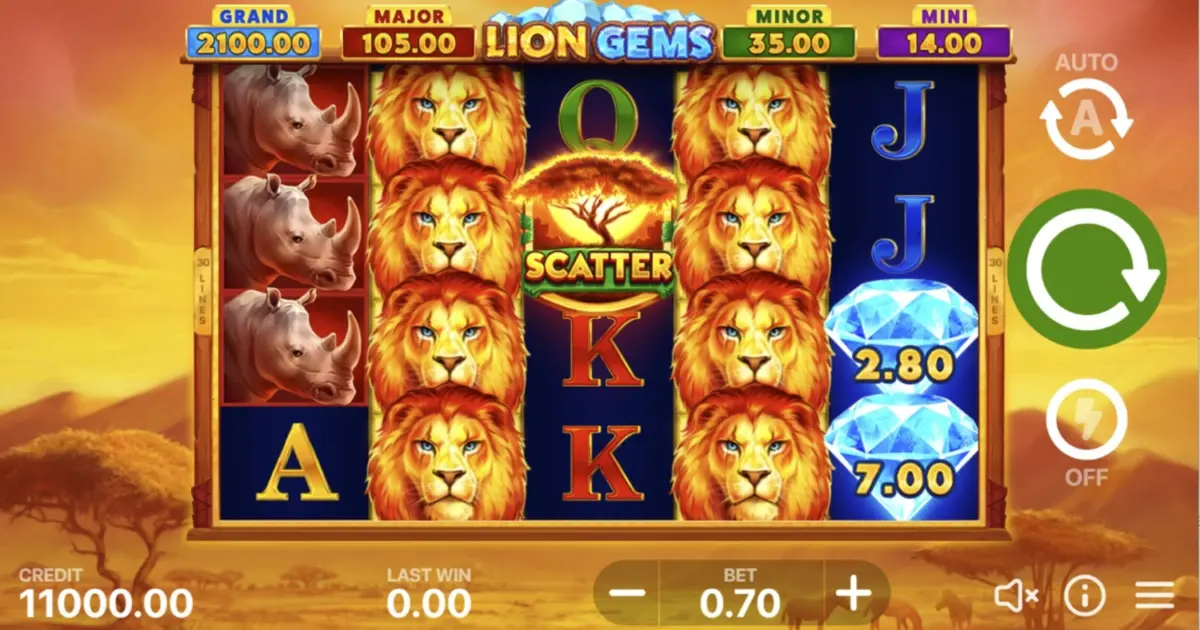
The lion gems: hold and win slot is a five-reel Playson release with an Animals theme, a 95.55% return figure, and a free demo you can open without an account. It runs a fraction below both the site-wide and provider averages, so this is an ordinary-return pick driven by theme and reach rather than headline rates. Decide whether that trade-off suits you before you load it up.
First look at Lion Gems: Hold and Win
Playson’s tracked catalogue holds 112 titles, and this one is a five-reel Animals slot that also carries a Nature tag. The primary theme is Animals, which supports a lion at the centre of the action; how the game actually looks in motion is something you judge in the demo, not something the published data verifies.
| Figure | Value |
|---|---|
| Provider | Playson |
| RTP | 95.55% |
| Reels | 5 |
| Primary theme | Animals |
| Free demo | Available |
| Popularity percentile | 86.1 |
What the numbers do confirm is reach. The game sits at popularity percentile 86.1 with a rank of 2773 across the tracked corpus, so it draws notably more attention than the median title. That gap between strong popularity and ordinary return is worth noticing before you decide why you are here.
Two gaps in the public record deserve an honest mention. Playson has not published a max win figure for this title, so treat any number you see quoted elsewhere with caution. Hit frequency is also absent. Neither omission makes the game unplayable, but both limit how precisely you can forecast what a session hands back.
How a round plays out
Five reels is the only mechanical detail the published data gives us; the number of paylines or ways is not stated. That forces a general description. Across the genre, five-reel slots typically pay when matching symbols land on connected reels starting from the left, and special symbols such as wilds, which stand in for others, and scatters, which commonly trigger a bonus feature, appear widely. None of that is confirmed as present here.
The reliable way to learn what this specific game actually does is the demo. It costs nothing, needs no download, and lets you watch the reels settle as often as you like before you commit stakes. That is the honest answer to how it plays: verify the mechanics yourself rather than trust a summary.
What the demo cannot give you is the long-run economics, because demo results do not predict real-money outcomes. Use it to judge mechanics and pacing, not expected value.
Reading the 95.55% return figure
RTP, or return to player, is a long-run statistical average, not a promise for any single visit. At 95.55%, the game mathematically returns £95.55 for every £100 wagered across a very large sample of spins, keeping the difference as the house margin. Over a typical session of a few hundred spins, results wander well above or below that figure; only over hundreds of thousands of spins does the average settle near it.
Context sharpens the reading. The platform average across all tracked slots is 95.71%, and Playson’s own average across 112 titles is 95.61%. This game runs 0.16 points under the corpus figure and roughly in line with its provider’s norm. It is not a low-return trap, but it is not a standout either. The gap is small enough that it should not, on its own, change your decision; differences of a few tenths matter most across very large volumes of play.
Registered Playson peers show the range. Super Burning Wins: Classic 5 Lines returns 99.99%, about as high as slots go, while Coin Strike: Hold and Win sits at 95.66%, close to this title’s level. If pure published return is your priority, the first of those pulls the maths further in your favour.
Why volatility matters when Playson hasn’t published one
No volatility figure has been published for this title, so the honest position is that its risk profile is unconfirmed. Here is why that matters. Volatility describes how wins are distributed. A low-volatility game pays out modest amounts often, producing long sessions with gentle bankroll swings. A high-volatility game pays rarely but larger, so a bankroll can drain fast before one meaningful hit lands. Medium volatility sits in between.
Without a published figure you cannot predict swing size or how long a given bankroll will last, which makes bankroll planning fuzzier than it needs to be. Every spin is independent of the last, so nothing about the run of results signals what comes next.
The practical route is the demo. Play enough spins to feel how often wins land and how large they run, then judge whether that rhythm suits your bankroll. That is a judgement about feel, not a prediction of real-money returns.
Bet sizing when the minimum stake isn’t published
The minimum and maximum stakes for this game are not in the published data, so treat any specific figure you see elsewhere as unverified. What is general is how stakes interact with session planning. A smaller stake stretches the same bankroll across more spins, which matters more when volatility is unknown, as it is here. A larger stake exposes the same budget faster. For a title with no volatility data, smaller stakes are the more forgiving way to start while you learn its behaviour.
Nothing about stake choice changes expected value. Every spin is independent, and no progression, timing or pattern alters the 95.55% long-run figure. The only thing a stake moves is how quickly a fixed bankroll is exposed to the variance you felt in the demo.
Because you can try it at zero cost first, testing pacing before you commit money removes most of the guesswork from that decision.
Where the Lion Gems: Hold and Win slot sits among Animals slots
The Animals category holds 1788 tracked titles, so this five-reel release competes in a crowded field, and on published return it sits on the lower side of its themed peers. Strength of Hercules runs at 96.31% and Hercules Power Wild at 96.20%, while Apex Strike Megaways comes in at 96.13% — each above the 95.55% on offer here. If a higher published return matters more to you than the animal theme, those are the comparisons to open first.
Return is only half the story. A popularity percentile of 86.1 shows this title draws more interest than most of the field despite the lower number, which suggests players respond to the theme or the feel of the reels in ways the RTP alone does not capture. Whether that is enough for you is a judgement the demo makes easier — it is the cheapest way to test whether the lower return buys you a theme you actually enjoy.
The honest verdict
The honest verdict is mixed. This is an ordinary-return five-reel slot from a well-known provider, with strong popularity, a working demo, and no published figures for volatility, bet range, hit frequency or max win. What you can say with confidence: the 95.55% RTP sits marginally below both site and provider averages, and the theme-led interest is real, according to the data.
18+. Set a budget before you start and treat the session as paid entertainment, not an income source. The demo is useful for testing mechanics at no cost, but nothing about demo play predicts what real money will do; every real-money spin is independent. If the numbers you want are missing, shop around — the same provider’s catalogue holds higher-return options.
The bottom line: if you like the theme and want to try it risk-free, the demo makes that easy. If you prioritise the highest published return, you can do better elsewhere.
Frequently Asked Questions
Can I play Lion Gems: Hold and Win for free and without a download?
A free demo is available here, and it needs no download or account, so you can spin the five reels as often as you like. The demo exists to judge mechanics and pacing; it does not pay out and does not predict real-money results, which are independent spin by spin.
What does the 95.55% RTP figure actually mean?
RTP is a long-run average. At 95.55%, the game mathematically returns £95.55 per £100 wagered over a very large sample of spins. It runs 0.16 points below the 95.71% platform average, so in a short session your own results can easily sit well above or below that figure.
Is Lion Gems: Hold and Win high or low volatility?
No volatility figure has been published, so its risk profile is unconfirmed. Volatility controls swing size and how long a bankroll lasts — low-volatility games pay often but small, high-volatility games pay rarely but large. Without the data, the demo is the practical way to feel how wins land before you stake.
Who developed Lion Gems: Hold and Win, and what else do they make?
Playson developed it, and 112 of its titles are tracked here. Coin Strike: Hold and Win returns 95.66%, nearly identical to this game, while Super Burning Wins: Classic 5 Lines runs at 99.99% — a much higher-return option from the same provider for readers who prioritise return.
Can demo play on Lion Gems: Hold and Win pay real money?
No. Demo play never pays out real money, and its results do not predict what real-money play will do. To win real money you would play the game with stakes at a licensed casino, where every spin is independent and carries the 95.55% long-run return.