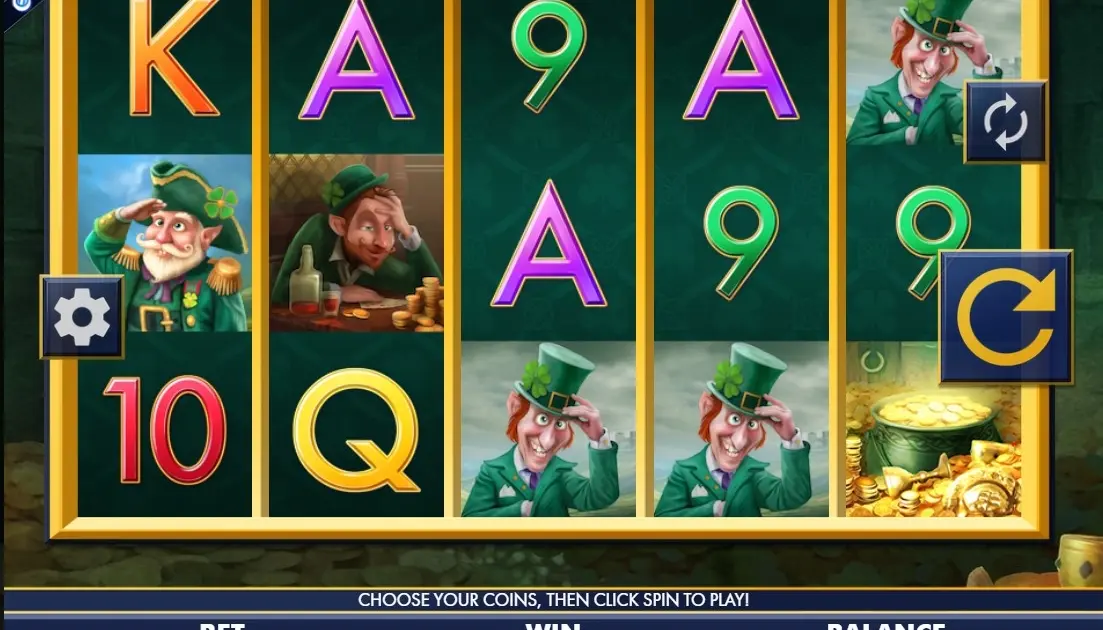
Leprechaun Tales Slot is worth a look mainly for one number: its 97.32% RTP puts it noticeably above both its provider average and the wider market. Beyond that headline figure, Genesis Gaming has not published core structural details, so your decision comes down to whether that strong statistical return is enough to try the free demo and see if the session feel suits you.
| Detail | Value |
|---|---|
| Game name | Leprechaun Tales |
| Provider | Genesis Gaming (100 games) |
| RTP | 97.32% |
| Provider average RTP | 96.88% |
| Corpus average RTP | 95.71% |
| RTP vs corpus | +1.61 percentage points above average |
| Popularity rank | 2632 (86.8th percentile) |
| Free demo | Available |
The reel grid explained
Genesis Gaming has not published a reel count, row count, or layout description for Leprechaun Tales in the FACTS available for this review, so there is no verified grid to describe here. That absence matters because the grid defines how many symbols land per spin and how combinations are evaluated, and without it you cannot confirm from this page whether the game uses a classic 5×3 layout, a 6-reel structure, or something else.
What you can take from that gap is practical: treat any reel description you see quoted elsewhere with caution until you can verify it in the game’s own help screen or paytable. Many slots do use a 5-reel, 3-row grid because it balances readability and combination frequency, while other titles expand to 6 reels or add extra rows to increase ways to win. Those general approaches change the number of symbols in view and therefore how often two or three matching symbols appear on screen, but they do not change the principle that every spin is independent and determined by a random number generator.
For Leprechaun Tales specifically, the most reliable way to confirm the grid is to open the free demo and check the info or paytable page, which should list reels, rows, and how symbols are evaluated. Until Genesis Gaming publishes that specification more widely, missing data is itself useful information — it tells you not to base stake or session plans on assumed reel maths. Focus instead on the figures that are verified, particularly the 97.32% RTP, and use demo play to judge whether the visual layout and spin pace suit your preferences without risking funds.
Paylines, ways and how Leprechaun Tales pays
The FACTS for this title do not include a payline count, a “ways to win” figure, or a description of how winning combinations are formed, so no specific pay mechanic can be confirmed here. That means this section can only outline what those terms mean in general, so you can interpret the paytable correctly when you see it in-game.
In general slot terminology, a payline is a defined path across the reels that is checked for matching symbols, usually from left to right. Many slots still use fixed paylines — for example 10, 20, or 25 lines — where you cover all lines on every spin and a win is paid when matching symbols land on a single active line. Other games use “ways to win” instead, where any matching symbols on consecutive reels create a win regardless of their exact row position; a 5×3 game with 243 ways is a common example of that approach, while larger grids can offer 1,024 ways or more. Both systems pay according to the paytable, which lists how much each combination returns for a given stake.
Because Leprechaun Tales does not have that mechanic disclosed in the available data, you should verify in the demo whether it uses lines or ways, whether wins pay left-to-right only or both ways, and whether any special symbols affect evaluation. Wilds in many slots substitute for other symbols on a line or way, and scatters in many slots pay regardless of position, but those are concepts, not confirmed features of this game. The key point is that lines or ways do not alter RTP by themselves — they change hit distribution and presentation, while the long-run return remains governed by the game’s maths model and the 97.32% figure published for this title.
97.32% RTP put in context for leprechaun tales slot
97.32% RTP means that, over a very large number of spins, the game is designed to return £97.32 for every £100 wagered, leaving a house edge of 2.68%. That is a long-run statistical average, not a prediction for any single session; across 100 spins at £1 a spin, the expected return is £97.32 on £100 wagered, but actual results will vary widely due to randomness. Across 10,000 spins at £1, the expected total wager is £10,000 and the expected return is £9,732, yet individual players will see results above or below that average, sometimes by a large margin.
Context helps. Genesis Gaming’s average across its 100 games in this corpus is 96.88%, so Leprechaun Tales sits 0.44 percentage points above its own provider’s typical return. Against the broader corpus average of 95.71%, it is 1.61 percentage points above the market average, which is a meaningful difference when you compare games side by side. Small differences compound over volume: over 5,000 spins at £0.50, total wager is £2,500; at 97.32% the expected return is £2,433, versus £2,392.75 at 95.71% — a £40.25 gap in expected value for the same stake and spin count.
For comparison within Genesis Gaming, Tres Huevos is listed at 97.10% and Galapagos Islands at 97.07%, both slightly below Leprechaun Tales, while The Boom Squad is at 97.06%. Those figures show Leprechaun Tales is at the higher end of the provider’s range, but RTP alone does not tell you about swing size or how often wins occur — that is governed by volatility and hit frequency, which are not published for this title. Use RTP as a filter for long-run value, then judge fit by session length and bankroll comfort in demo play, remembering each spin remains independent.
Volatility and hit patterns
No volatility rating, variance label, or hit frequency figure has been published for Leprechaun Tales in the FACTS, so its risk profile cannot be confirmed here. That missing label matters because two games with identical RTP can feel very different in practice: one may pay frequent small wins that keep the balance ticking over, while another may pay rarely with larger gaps between wins.
In general terms, low volatility tends to mean more frequent but smaller wins, which can extend session time on a given bankroll but rarely produces large balance swings. High volatility tends to mean fewer wins, longer dry spells, and larger potential swings when wins land, which usually requires a larger bankroll or a lower stake to sustain the same number of spins. Medium volatility sits between those extremes, balancing hit rate and swing size. Hit frequency, where published, would quantify how often any win occurs — for example a 25% hit frequency implies a win on roughly one spin in four on average — but without that figure you cannot assume a hit rate for Leprechaun Tales.
Because volatility is unpublished, the best practical approach is to treat Leprechaun Tales as unknown variance and plan conservatively until you have observed its behaviour in the free demo. Start with a stake that allows at least 200 to 300 spins on your demo balance and note how often wins occur and how far the balance dips between them. That observation does not predict real-money results — the random number generator does not adapt to your session — but it gives you a feel for swing size. If you prefer steadier sessions, you would normally look for a confirmed low-volatility title; if you prefer larger swings, you would look for confirmed high volatility. Here, the absence of a label is a prompt to rely on the one verified strength, the 97.32% RTP, and to size your stake for uncertainty rather than assuming a gentle or aggressive profile.
Choosing a stake between [BET_MIN] and [BET_MAX]
Genesis Gaming has not published a minimum or maximum stake, a coin denomination range, or a max win figure for Leprechaun Tales in the available FACTS, so there are no verified bet limits to quote. That absence means you should confirm the stake range directly in the game’s controls or paytable before planning a session, as limits can vary by casino and by currency.
In general, stake choice interacts with bankroll and intended session length in a straightforward mathematical way. If your total budget for a session is £50 and you stake £0.25 per spin, that budget covers 200 spins before accounting for any returns; at £0.50 it covers 100 spins, and at £1 it covers 50 spins. Because RTP is a long-run average, actual balance after those spins will differ from the expected return due to variance, but the spin count your stake buys is certain at the start. A smaller stake relative to bankroll extends the number of decisions you get to make, which many players prefer when trying a new game, while a larger stake shortens the session and increases both the size of wins and losses per spin.
Without a published max win or volatility label, there is no verified ceiling to anchor expectations for Leprechaun Tales. Treat any max win number you see elsewhere with caution until it appears in the official paytable. When you verify the stake limits in the demo, test the lowest and highest options to see how the interface handles stake steps, whether the game enforces a minimum number of lines or ways that affects total bet, and how quickly balance changes at each level. That hands-on check, combined with the known 97.32% RTP, lets you choose a stake that fits your budget for entertainment rather than chasing an assumed payout size that has not been confirmed.
Demo play versus real money
Free demo play for Leprechaun Tales is available, which lets you inspect the layout, paytable, and spin pace without wagering. Demo uses the same random number generator logic as real-money play for spin outcomes, but the credits have no cash value — you cannot withdraw demo winnings, and demo losses do not cost you. That makes demo useful for learning how the game evaluates wins and how quickly the balance moves at different stakes, not for predicting what would happen with real funds.
Real-money play adds financial risk and the need for session controls. Decide beforehand how much you are willing to spend for entertainment, how long you intend to play, and when you will stop regardless of the result. Every spin is independent; the game does not become more or less likely to pay after a run of wins or losses, and no staking pattern changes the 97.32% long-run return. If you switch from demo to real money, keep the same stake sizing you were comfortable with in demo and remember that variance means short-term results can deviate sharply from the average.
Play responsibly and treat slots as paid entertainment, not a way to make money. You must be 18+ to gamble. Set a budget you can afford to lose, use deposit or time limits where available, and take breaks. If gambling stops feeling enjoyable or you are spending more than intended, seek support and consider self-exclusion tools. Free demo is a safer place to satisfy curiosity about mechanics without financial pressure.
Verdict on Leprechaun Tales
Leprechaun Tales earns attention for its maths rather than its marketing: at 97.32% it is well above the 95.71% corpus average and ahead of many Genesis Gaming peers, which is a concrete advantage if you value long-run return as a filter. The trade-off is transparency — with no verified reel count, payline or ways figure, volatility label, stake range, or max win disclosed in the FACTS, you are asked to judge the experience largely from the demo rather than from published specifications.
That makes the free demo more than a novelty here; it is the only reliable way to confirm how the grid is structured, how wins are evaluated, and what stake options your chosen site actually offers. Use it to check the paytable directly, count visible rows and reels, and test a comfortable stake for at least a few hundred spins to gauge swing size before committing funds. If you prefer fully documented games where every mechanic is spelled out in advance, the missing details may be a drawback. If you are comfortable verifying mechanics in-game and you prioritise RTP, the 97.32% figure is the strongest argument the game has on paper. In either case, keep sessions budgeted and stake-limited, and treat the strong RTP as a long-run average, not a promise for the next spin.
Frequently Asked Questions
Can I play Leprechaun Tales for free without wagering real money?
Yes, free demo play is available for Leprechaun Tales. Demo uses play credits with no cash value, so you can explore the paytable and pace without risk. It does not predict real-money outcomes because every spin is independent and random, and you cannot withdraw demo winnings.
What is the RTP of Leprechaun Tales and what does it mean for my session?
Leprechaun Tales has a 97.32% RTP, meaning it is designed to return £97.32 per £100 wagered over a very large sample, leaving a 2.68% house edge. Over 1,000 spins at £1, expected return is £973.20, but short-term results vary widely and are never guaranteed.
What is the volatility of Leprechaun Tales?
Genesis Gaming has not published a volatility rating or hit frequency for Leprechaun Tales in the available FACTS, so its risk profile is unconfirmed. In general, low volatility brings frequent small wins and longer sessions, while high volatility brings rarer wins and larger swings. Check the paytable and demo feel instead of assuming.
Who makes Leprechaun Tales and what else do they offer?
Leprechaun Tales is by Genesis Gaming, which has 100 games in this corpus with an average RTP of 96.88%. Other Genesis Gaming titles in the same high-RTP group include Tres Huevos at 97.10% and Galapagos Islands at 97.07%, both slightly below Leprechaun Tales' 97.32%.
What stake should I choose for Leprechaun Tales?
No minimum or maximum stake is published for Leprechaun Tales, so verify limits in the game's controls where you play. As a general guide, divide your session budget by your stake to see spin count — £40 at £0.20 buys 200 spins — and pick a level that lets you play comfortably without chasing results.