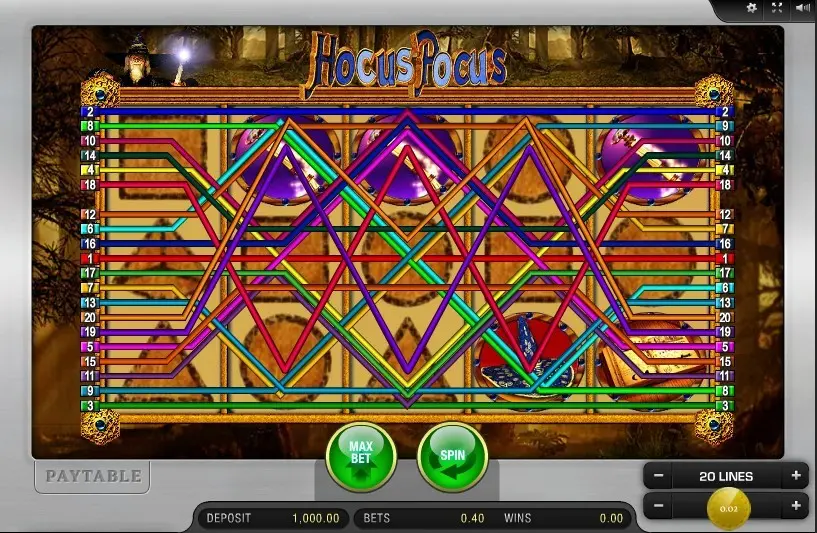
Before you spend time reading further: the Hocus Pocus slot from Merkur Gaming is a mid-tier return title. At 95.53%, it sits below its provider’s own average of 96.04% and marginally below the broader corpus benchmark. That does not make it unplayable, but it does mean the maths work slightly against you compared to several alternatives within the same catalogue. If you want the full picture before committing a session, keep reading.
Is the Hocus Pocus slot worth playing?
The short answer is: it depends on what you are optimising for. At 95.53% RTP, this game returns less over a large number of spins than the average slot in our dataset. Over 10,000 spins at a £1 stake, you would theoretically retain £9,553 of your £10,000 wagered, versus £9,571 for the corpus average and £9,604 for Merkur’s own portfolio mean. The gap between Hocus Pocus and its provider’s average — 0.51 percentage points — compounds meaningfully over thousands of spins. That said, this title ranks at position 471 with a popularity percentile of 97.6, which means it is played more than 97% of the games in the catalogue. Demand does not equal value, but it tells you enough people find something in it worth returning to. If RTP is your primary filter, skip this one and look at Merkur’s Lucky Pharaoh instead. If you are drawn to the concept and want a free demo before staking real money, the maths below should help you decide whether the entertainment justifies the statistical cost.
What 95.53% RTP means over 1,000 spins
RTP is a long-run statistical average calculated across millions of spins by the game’s developers. It does not describe any individual session, and no player should expect a specific return from any particular number of spins. That caveat aside, working through the arithmetic gives you a sense of the theoretical expectation and how this number compares to alternatives.
| Metric | Value |
|---|---|
| Game RTP | 95.53% |
| Provider average RTP | 96.04% |
| Corpus average RTP | 95.71% |
| Difference vs corpus | −0.18 pts |
| Difference vs provider | −0.51 pts |
Over 1,000 spins at £1 per spin, the theoretical return is £955.30 against £1,000 wagered — a theoretical net loss of £44.70. At the corpus average of 95.71%, the same 1,000-spin session would yield a theoretical return of £957.10. The gap is £1.80 over that sample, which sounds trivial. Scale it to 10,000 spins and it becomes £18.00. Scale to 100,000 spins — a realistic lifetime for a regular player — and the difference between this game and a 95.71% title becomes £180 in theoretical terms. None of this predicts your actual result in any session. Every individual spin is independent of the last. But it does quantify the house edge you are accepting, which is the only number you can rely on before the reels stop spinning.
How volatile is Hocus Pocus?
Merkur Gaming has not published a volatility rating for this title, and no hit frequency figure is available in our dataset. This absence matters more than most readers realise. Volatility tells you how your theoretical return is distributed across a session — whether you can expect frequent small wins or rare large payouts that carry long stretches of dead spins between them. Without knowing the variance profile, you cannot plan a realistic bankroll or predict what a typical session will feel like.
What you can say with confidence: the game exists within Merkur’s catalogue of 182 titles, and the provider’s average RTP sits at 96.04%. A title below that average could be paired with either high volatility (large, infrequent payouts that make the below-average RTP less visible in short sessions) or low volatility (steady small wins that make the RTP deficit compound faster because you play more spins at lower swings). There is no way to determine which without published data. If you require certainty about session shape before you play, check whether Merkur’s official game documentation has been updated since our data was captured, or choose a title with a published volatility rating instead.
What the theme brings to the game
The title “Hocus Pocus” evokes magic and the supernatural. The phrase itself is a theatrical incantation associated with stage conjuring and, more recently, with Halloween pop culture. That is all the context the name provides. No theme classification is assigned to this game in our dataset — the theme game count is zero, meaning no other title in the catalogue is grouped with it by subject matter.
This leaves you without useful information. You cannot know from available data whether this is a cartoon-adjacent magical romp, a darker occult-themed game, or something closer to a classic fruit machine with a decorative name. The visual and audio design, symbol set, animation style, and any narrative layer are all undocumented here. If the theme is a major factor in your game selection — and for many players it is the difference between engagement and boredom within twenty minutes — this slot gives you nothing to work with before you open the demo. That is a genuine gap, not a neutral absence, because theme is the primary emotional hook that keeps players in a session after the maths stop being novel.
Stakes, session length and bankroll
No stake range is published for Hocus Pocus in our data. This is the second critical gap after volatility. Without knowing minimum and maximum bets, you cannot model session length from a fixed bankroll, and you cannot determine whether this game suits your budget without opening it first.
Here is what you can do: treat the free demo as your information-gathering tool before staking a penny. Play through at the highest and lowest stakes the interface allows. Note how long the balance lasts at minimum bet, and whether the paytable is visible and readable. Those observations replace the missing data with empirical evidence from a single session — imperfect, but better than guessing.
As a general principle for any game without published volatility or stake information: if you do decide to play for real money, allocate a bankroll you can afford to lose entirely, and set a spin limit before you start. A 500-spin ceiling at a low stake gives you enough sample size to see the game’s character without a significant financial commitment. Without a published hit frequency or max win figure, you cannot calculate an expected session duration — but you can impose one from outside.
Alternatives if Hocus Pocus is not for you
Merkur Gaming has not published a max win figure for this title, so treat any number you see quoted elsewhere with caution. Given that gap alongside the below-average RTP, it is worth comparing this game against other entries from the same provider that do carry stronger return numbers.
Lucky Pharaoh delivers a 96.25% RTP — nearly three-quarters of a percentage point above Hocus Pocus. Over 10,000 spins at £1, that difference represents £72 in theoretical return. If you enjoy Merkur’s mechanics and want a better mathematical position, this is the obvious upgrade within the same catalogue.
Centurio sits at 96.08%, just above the provider’s portfolio average. It is a less dramatic improvement than Lucky Pharaoh but still places you on the right side of Merkur’s typical range rather than below it.
Hide and Seek rounds out the comparison at 96.07%, statistically indistinguishable from Centurio. All three alternatives beat Hocus Pocus’s 95.53% by a meaningful margin in the RTP context. The question becomes: is the entertainment value of Hocus Pocus worth paying 0.51 percentage points per spin to access it? For most players comparing numbers before a session, the answer will lean toward the alternatives.
Final take
Hocus Pocus is a well-known name in Merkur Gaming’s catalogue with genuine player demand, but it is not a strong mathematical proposition. The 95.53% RTP is below both the corpus and provider averages, and the absence of published volatility, stake range, and max win data means you cannot properly assess risk before playing. The free demo is available with no download required, which lets you inspect what the game actually offers — but a demo cannot tell you what the long-run maths will do to your balance in a real session.
If you do play, treat it as paid entertainment with a fixed budget you have already decided to part with. Set a spending limit and a time limit before your first spin. Never chase losses, and never adjust your stake mid-session based on what you think the game “owes” you — every spin is an independent event with the same fixed return. Hocus Pocus is 18+ content, and if gambling stops feeling like entertainment, the UK National Gambling Helpline is available at 0808 8020 133.
Frequently Asked Questions
What is the RTP of the Hocus Pocus slot?
The Hocus Pocus slot has an RTP of 95.53%. This sits 0.51 percentage points below Merkur Gaming's portfolio average of 96.04% and 0.18 points below the broader site-wide average of 95.71%, placing it in the lower tier of return figures among the provider's 182 published titles.
Can you play Hocus Pocus for free?
Yes, a free demo version of Hocus Pocus is available to play without downloading any software or registering an account. Demo play uses simulated credits and does not pay out real money, but it lets you assess the game's layout, stake range, and overall feel before deciding whether to wager actual funds.
Is Hocus Pocus a high or low volatility slot?
Merkur Gaming has not published a volatility rating for Hocus Pocus, and no hit frequency data is available. Without this information, you cannot determine whether the game pays out frequently in small amounts or delivers rare large wins with long dead stretches between them. This is a genuine data gap rather than a neutral omission.
How does Hocus Pocus compare to other Merkur Gaming slots?
At 95.53% RTP, Hocus Pocus sits below Merkur's portfolio average of 96.04%. Three related titles from the same provider — Lucky Pharaoh at 96.25%, Centurio at 96.08%, and Hide and Seek at 96.07% — all offer measurably higher theoretical returns than Hocus Pocus does.
Does Hocus Pocus have a maximum win or bonus feature?
No maximum win figure or bonus feature list has been published for Hocus Pocus in the available data. Treat any specific numbers you encounter on third-party sites with caution, as they may be inaccurate or speculative. The free demo lets you check the in-game paytable directly before playing.




