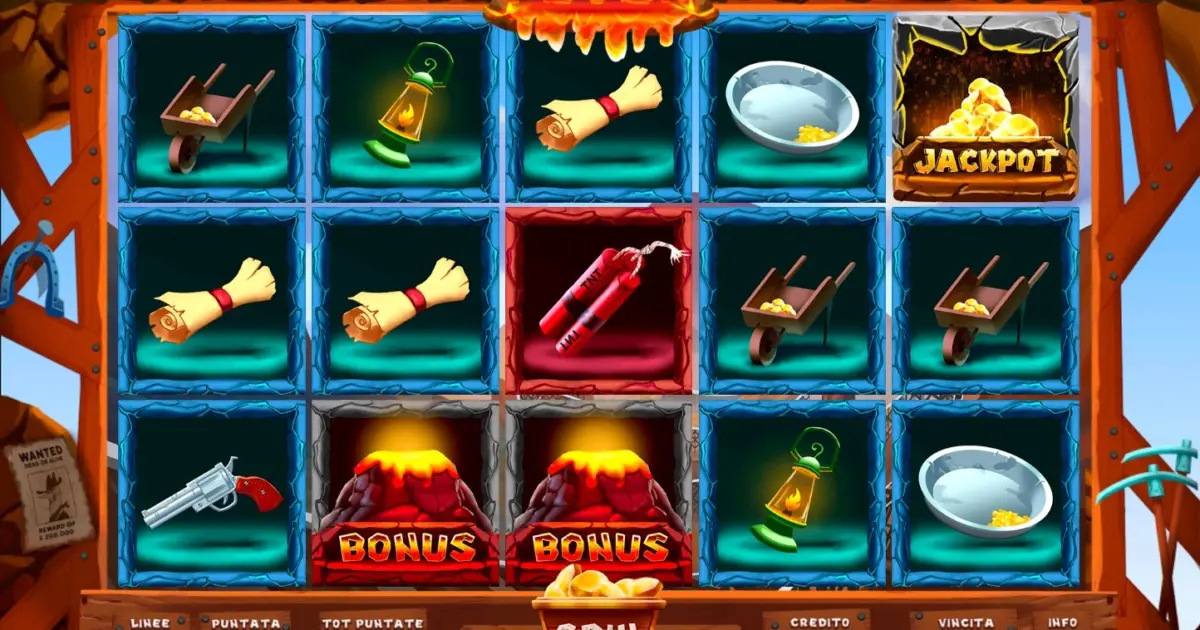
Gold Fever is a 5-reel Mining slot from Giacaonline with a 94.61% RTP, which puts it just below both its studio average and the wider market average. The gold fever slot is therefore one to compare on the numbers first, then decide if the theme and structure are worth your session budget — the free demo lets you do that without risk.
| Detail | Figure |
|---|---|
| Game name | Gold Fever |
| Provider | Giocaonline |
| RTP | 94.61% |
| Reels | 5 |
| Primary theme | Mining |
| Subcategory | Slot Machine |
| Popularity rank | #2144 (89.3rd percentile) |
| Provider average RTP | 94.71% |
| Corpus average RTP | 95.71% |
| RTP vs corpus | -1.10% |
| Free demo available | Yes |
Gold Fever Slot versus the average slot
Gold Fever sits 1.1 percentage points below the corpus average RTP of 95.71%. That figure is the mean return across a large sample of slots in the database used for this review, so the gap is not trivia — over a very large number of spins, a 94.61% game is mathematically expected to return £94.61 per £100 wagered, while a 95.71% game would return £95.71 per £100 wagered. The difference is £1.10 per £100 wagered in expected value, which compounds as volume increases.
To make that concrete: over 1,000 spins at £1 a spin (£1,000 staked), the expected return on Gold Fever is about £946.10, versus £957.10 on an average-RTP slot. Over 10,000 spins at the same stake (£10,000 staked), the expected gap grows to £110. That does not mean you will see those numbers in a single session — variance ensures short-term results swing widely around the average — but it does mean the house edge is larger here at 5.39% versus 4.29% on the corpus average.
Popularity context helps too. Gold Fever is ranked #2144, which places it in the 89.3rd percentile for play. In other words, it is not among the most-played handful of titles that dominate lobbies, but it sits well above the long tail of rarely-tried games. Players comparing it will often be choosing between a familiar high-traffic Mining title and a less ubiquitous option like this one, where the lower RTP is the main trade-off to weigh.
RTP breakdown: 94.61% in context
94.61% RTP is a long-run statistical average, not a promise for your session. Every spin is independent, and the random number generator does not adjust to compensate for earlier results. You could be ahead after 50 spins or well behind; both outcomes are normal in a small sample because volatility and chance dominate the short term.
What 94.61% does tell you is the theoretical price of play if you spun indefinitely. At that level, the expected cost is £5.39 per £100 wagered over a very large sample. Compare that to the corpus average of 95.71% (£4.29 per £100) and to the provider’s own average of 94.71% (£5.29 per £100). Gold Fever is 0.10 points below Giocaonline’s house average, so it is almost exactly typical for this studio, but a touch below market median.
For session planning, translate the percentage into stakes. If you plan 500 spins at £0.40 (£200 staked), the theoretical average return is about £189.22, for a theoretical loss of £10.78. At £1 a spin for 500 spins (£500 staked), the theoretical average return is about £473.05. Again, actual sessions will deviate — sometimes sharply — but the maths is a useful anchor for budgeting. Because no hit frequency, max win figure or feature breakdown has been published for this title in FACTS, you cannot estimate how often wins arrive or how large the swings might be; you can only price the long-run edge accurately from the RTP.
Volatility profile
Giocaonline has not published a volatility rating for Gold Fever in the data available for this review, and FACTS contains no measured swing profile, hit frequency or max win figure. That absence matters, because volatility is the other half of the risk picture alongside RTP. RTP tells you the long-run price; volatility tells you how bumpy the ride is likely to be between now and the long run.
In general terms, low volatility slots tend to produce more frequent but smaller wins, which can stretch a fixed bankroll over more spins and reduce the chance of a rapid bust-out. High volatility slots tend to produce rarer, larger wins, which means longer dry spells are more common and a larger bankroll or lower stake relative to budget is usually needed to survive the swings. Medium volatility sits between the two, mixing modest base-game returns with occasional bigger hits. Many slots also use mechanics such as wilds, scatters or free spins to shape volatility, but without specific feature data you should not assume Gold Fever uses any particular one.
Because the volatility is unstated here, the practical approach is to treat the session length as unpredictable and size stakes conservatively in the demo first. Run a sample of spins at the smallest comfortable stake, note how quickly the balance moves, and decide whether that tempo fits your budget. If you prefer a known risk profile, filtering by published volatility elsewhere will be more useful than guessing from the Mining theme alone, since theme does not determine maths.
Giocaonline as a studio
Giocaonline has 31 games in the database for this review, with an average RTP of 94.71% across that catalogue. Gold Fever at 94.61% sits 0.10 points under that studio mean, so it is representative rather than an outlier — you are not getting a notably higher or lower theoretical return than the provider’s typical offering.
That catalogue average is itself about a point below the wider corpus average of 95.71%, which tells you where Giocaonline generally positions its maths: slightly higher house edge on average than the market mean. That is not a judgement on entertainment value, but it is a fact to carry into comparisons if RTP is your primary filter.
If you want to stay within the same studio for a side-by-side check, Divina Commedia – Purgatorio at 94.66% is five basis points higher than Gold Fever, while Cook & Spin at 94.47% is fourteen basis points lower — both differences are small in expected value per £100 but useful if you are choosing between Giocaonline titles on RTP alone. For a like-for-like session test, try each in demo with identical stakes and spin counts and compare how the balance behaves, rather than relying on theme or rank.
Three Mining alternatives worth comparing
The Mining theme is well-populated, with 168 games carrying that label in the corpus. That gives you plenty of direct comparisons where the theme is held constant and the maths is the variable. Since Gold Fever is 5 reels and labelled Mining and 5-Reels, the cleanest comps are other Mining slots with published RTPs that let you see the price gap immediately.
Fire in the Hole at 96.06% is 1.45 points above Gold Fever. Over 1,000 spins at £1 a spin that is an expected difference of £14.50 per £1,000 staked in favour of the alternative, before volatility effects. Gold Collector: Diamond Edition at 96.40% is 1.79 points above Gold Fever, which widens the expected gap to £17.90 per £1,000 staked. Both are closer to or above the corpus average, so if minimising theoretical cost is your priority, either is mathematically cheaper over volume than Gold Fever.
For a nearer comparator, Magic Stones at 95.08% sits only 0.47 points above Gold Fever and is still below the market mean. That smaller gap may be less decisive if you prefer to stay with a particular presentation, but it is still measurable across a long session. When comparing, keep reels and theme constant and focus on RTP and, where published, volatility. A Mining label tells you the subject matter draws on mining; it does not tell you how the game pays, how often it pays, or what features it includes, so avoid inferring visuals, characters or soundtracks from the label alone.
Getting the most out of the free demo
FACTS confirms a free demo is available for Gold Fever, which is the most useful way to assess fit before staking real money. Use the demo to answer practical questions that numbers alone cannot: what stake levels are offered in your jurisdiction, how quickly a set bankroll is consumed at your preferred bet, and whether the pacing holds your attention. Because no payline count, ways count, stake range, hit frequency or max win figure is listed in FACTS, the demo is also the only way to see the actual reel layout and paytable details that the database does not currently record.
Treat demo spins strictly as a learning tool, not a forecast. The random number generator behaves the same in demo and real-money modes in terms of independence of spins, but demo play cannot predict real-money results, and past demo outcomes do not change the odds of future spins. Play for free with the same discipline you would use with real funds: set a time limit, note starting and ending demo balances, and run the same number of spins at the same stake across the games you are comparing so the contrast is fair.
Keep it as entertainment with limits. You must be 18+ to gamble where it is legal. Decide a budget before you play and treat any money wagered as the cost of entertainment — not a way to make money. If you need to stay in control, use deposit limits, time-outs and self-exclusion tools where available, and seek support if gambling stops being fun. A short break and a preset spend cap do more for session enjoyment than any betting system, because no pattern or progression can change the underlying expected value.
Should you play Gold Fever?
Play Gold Fever for the Mining and 5-reel format if that combination appeals, not for a market-leading RTP. At 94.61% it is priced a point below the corpus average and in line with its provider’s norm, so over volume it is expected to cost slightly more per £100 wagered than an average slot. The 89.3rd percentile popularity rank suggests a solid niche audience rather than mass-market dominance, which may or may not matter to you.
The main information gaps are volatility, hit frequency and max win, none of which are published in FACTS for this title. Without them you cannot properly judge bankroll requirements or swing size from the data sheet alone. That makes the free demo essential rather than optional: test a fixed number of spins at a fixed stake, compare directly to a higher-RTP Mining alternative, and see which tempo you prefer. If RTP is your deciding factor, the alternatives named above offer a lower theoretical cost; if theme and studio familiarity matter more, Gold Fever remains a representative Giocaonline entry at essentially the studio’s standard price.
Frequently Asked Questions
Can I play Gold Fever for free without risking real money?
Yes, a free demo is listed as available for Gold Fever, so you can try it with play credits. Use the demo to check the 5-reel layout, paytable and pace at your preferred stake. Remember demo outcomes are independent spins and do not predict real-money results, even though the underlying randomness works the same way.
What is the RTP of Gold Fever and what does 94.61% mean in practice?
Gold Fever has a 94.61% RTP, which is the long-run theoretical return per £100 wagered. Over a very large sample it implies £94.61 returned for every £100 staked, leaving a 5.39% house edge. Short sessions vary widely because each spin is independent, but over volume a 94.61% game costs more than the 95.71% corpus average.
What volatility is Gold Fever and how risky is it for my bankroll?
No volatility rating, hit frequency or max win figure is published for Gold Fever in the available data, so its risk profile cannot be stated from FACTS. In general, low volatility stretches bankrolls with smaller, more frequent wins, while high volatility brings longer dry spells and bigger swings, but you should test Gold Fever in the free demo to gauge its actual tempo.
Who makes Gold Fever and what else does the provider offer?
Gold Fever is made by Giocaonline, which has 31 games in the reviewed corpus with an average RTP of 94.71%. Gold Fever at 94.61% is just below that studio mean. Related Giocaonline titles for comparison include Divina Commedia – Purgatorio at 94.66% and Cook & Spin at 94.47%, both very close on RTP.
How does Gold Fever compare to Fire in the Hole for value?
Fire in the Hole is a Mining-themed alternative at 96.06% RTP, which is 1.45 points above Gold Fever's 94.61%. Across 1,000 spins at £1 staked, that is an expected difference of about £14.50 per £1,000 wagered in favour of Fire in the Hole, before volatility effects, making it mathematically cheaper over volume.