If you judge a game on its published return figure, the gemstone mine slot from Stakelogic gives you something concrete to work with: 95.98% RTP across six reels. That sits marginally above both the Stakelogic house average and the average of every title in our database. What it does not give you is a published volatility rating, a stake range or a maximum win figure, and those gaps matter more than most review sites admit.
First look at Gemstone Mine
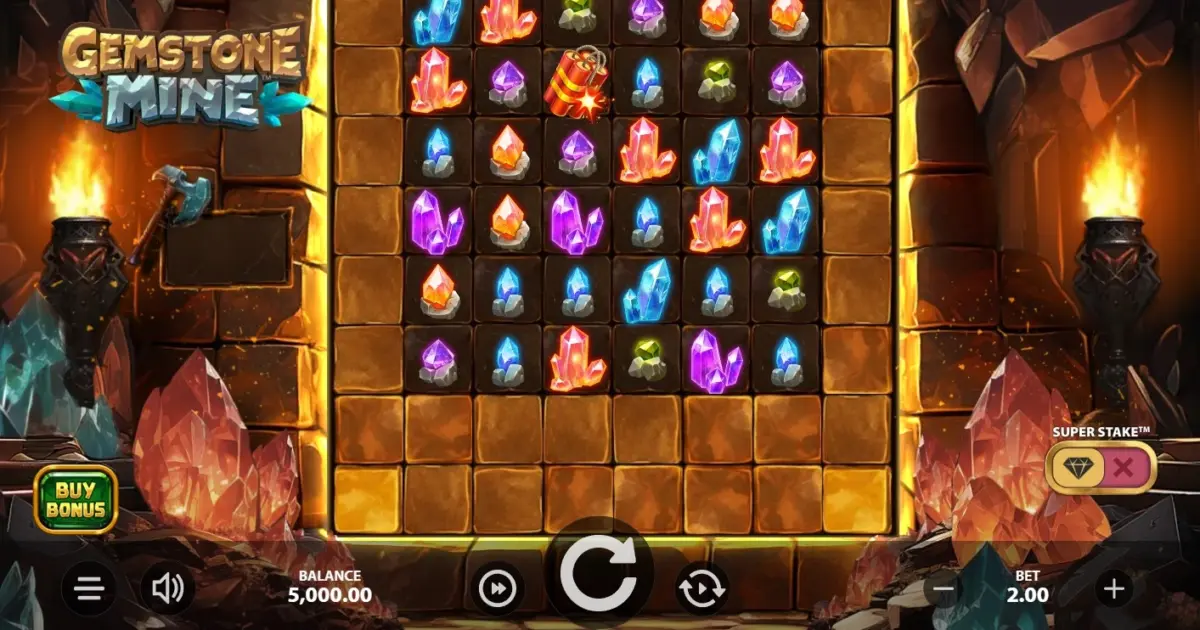
Gemstone Mine is a six-reel slot machine from Stakelogic, built on a mining theme. That is the full extent of what the provider has put on record about its structure, and it is worth being clear about that before you read any further.
Stakelogic has 182 titles in our database, with an average RTP of 95.56%. This one returns 95.98%, so it sits above the studio’s own typical figure rather than below it. Against the 95.71% average across every game we track, it is 0.27 percentage points ahead — a small edge, but an edge in the right direction.
On popularity, the game ranks 2,767th, placing it in the 86.1st percentile. That means it gets played more than roughly six in seven titles we list. Popularity tells you nothing about how a game treats your bankroll, but it does tell you the game has found an audience rather than sinking without trace.
| Detail | Figure |
|---|---|
| Provider | Stakelogic |
| RTP | 95.98% |
| Reels | 6 |
| Theme | Mining |
| Type | Slot machine |
| Popularity rank | 2,767 (86.1st percentile) |
| Provider average RTP | 95.56% |
| Database average RTP | 95.71% |
| Free demo | Available |
How a round plays out
Here is where honesty is more useful than word count. FACTS confirms six reels and nothing about paylines, ways, symbol behaviour or bonus rounds. So this review will not tell you how many free spins the game awards, what its multipliers reach, or whether there is a feature buy — because that information has not been published, and guessing it would be worse than leaving it blank.
What the reel count does tell you is scale. Six-reel layouts generally carry more symbol positions than the classic five-reel grid, and studios typically use that extra width in one of two ways: more fixed paylines, or a “ways” style system where matching symbols on adjacent reels pay regardless of position. Both approaches usually raise the raw number of possible outcomes per spin. That often produces more frequent small returns and a longer tail of larger ones, though the balance differs from game to game and cannot be assumed here.
The one mechanic that is certain applies to every slot ever built: the outcome of each round is generated independently. Nothing carries over from the last spin, and no sequence of results makes the next one more or less likely.
Reading the 95.98% return figure
RTP is a long-run average, not a session promise. At 95.98%, the theoretical return is £95.98 for every £100 staked — but that figure only emerges across a sample far larger than any individual player will ever produce. The house edge is 4.02%.
Put numbers on it. Stake £0.50 a spin for 500 spins and you have wagered £250; the theoretical return on that is about £239.95, an expected cost of roughly £10 for the session. Your actual result will land somewhere either side of that, potentially a long way either side, and the shorter the session the wider that spread becomes as a proportion of what you staked.
Compared with the wider market, 95.98% is slightly better than typical. Against the Stakelogic average of 95.56%, the difference over £1,000 wagered is about £4.20 in theoretical return. That is real, but it is small enough that RTP alone should not decide which game you open — the swing profile usually affects your session far more.
Why unpublished volatility changes your bankroll maths
Stakelogic has not published a volatility rating for this title, so treat any confident claim you see elsewhere about how swingy it is with suspicion. That absence is worth planning around rather than ignoring.
Volatility describes how returns are distributed over time, not how much comes back. A low-volatility game pays smaller amounts more often, so balances drift rather than lurch and a modest bankroll stretches across plenty of spins. A high-volatility game pays rarely and larger, which means long stretches of nothing punctuated by occasional bigger returns — and it requires a deeper bankroll to sit through those stretches without the session ending early. Two games can share an identical RTP and feel nothing alike.
With no figure to work from, the practical approach is to assume the higher-risk case and size accordingly, then use the demo to observe how the balance actually behaves across a few hundred spins. Bear in mind that demo results are their own small sample and predict nothing about a real-money session.
Bet sizing from an unpublished minimum upwards
No minimum or maximum stake is on record for Gemstone Mine, so the range will only show once the game loads in your chosen client. Most modern slots open somewhere around 0.10 to 0.20 per spin and run up to 100 or more, but that is an industry pattern, not a fact about this game.
The useful maths does not depend on knowing the range in advance. Decide your session budget first, then divide it by the number of spins you want the session to last. A £40 budget across 400 spins points to £0.10 a spin. Want the same money to cover 200 spins with more per-round action, and £0.20 is your number.
Two things to avoid: raising stakes to recover losses, and lowering them after a win in the belief that outcomes even out. Neither changes the 4.02% edge. Every spin is an independent event, so stake progression alters your variance and nothing else.
Where the gemstone mine slot sits among Mining slots
Mining is a well-populated category — 168 titles in our database carry the theme — so the comparison set is genuinely competitive. On return alone, this one lands mid-pack.
Fire in the Hole edges ahead at 96.06% and is the obvious first alternative if you want a fractionally better long-run figure from the same theme. Gold Collector: Diamond Edition goes further at 96.40%, which is 0.42 percentage points above Gemstone Mine — worth about £4.20 in theoretical return per £1,000 wagered. Going the other way, Magic Stones returns 95.08%, so if you have played that one and liked it, this title is a straight upgrade on the numbers.
Within Stakelogic’s own catalogue the picture is similar: several of their titles sit a little higher, so this is a solid rather than standout entry from the studio.
The honest verdict
Gemstone Mine earns a look for one clear reason and comes with one clear caveat. The reason is 95.98% RTP, above both the Stakelogic average of 95.56% and the 95.71% database average. The caveat is how little else has been published — no volatility band, no stake range, no max win, no feature detail. If you want a game you can fully research before you open it, this is not it.
What makes that workable is the Gemstone Mine free demo. Play the unpaid version for a few hundred spins and you can see the grid, the stake steps and the rhythm of returns for yourself, which is more reliable than anything a review can infer from a reel count. Just remember the demo is a small sample and cannot forecast real-money outcomes.
Slots are 18+ and priced entertainment, not a way to make money — the 4.02% house edge is the price of the session. Set a budget before you start, treat it as spent the moment you do, and stop when it is gone.
Frequently Asked Questions
Can you play Gemstone Mine for free?
A free demo of Gemstone Mine is available, so you can try the six-reel Stakelogic game without staking anything. The demo uses the same 95.98% RTP maths as the paid version, which makes it a sensible way to see the grid and stake steps before deciding whether the game suits you.
What is the RTP of Gemstone Mine?
Gemstone Mine returns 95.98%, meaning a theoretical £95.98 back per £100 staked across a very large sample, and a house edge of 4.02%. That is 0.27 percentage points above the 95.71% average across our database and above the 95.56% Stakelogic average. Short sessions will vary widely from that figure.
Is Gemstone Mine high or low volatility?
Stakelogic has not published a volatility rating for Gemstone Mine, so nobody can state it honestly. The safer approach is to plan your bankroll as though swings will be large, then watch how the balance moves across a few hundred demo spins. Remember demo behaviour is its own small sample, not a forecast.
Who makes Gemstone Mine?
Stakelogic developed Gemstone Mine. The studio has 182 titles in our database with an average RTP of 95.56%, so this game sits slightly above their own house figure. Other Stakelogic releases include Manimals at 96.01%, Mega Fortune Hold 'N' Win at 96.03% and Wild Buzz at 96.20%.
How does Gemstone Mine compare with Fire in the Hole?
Fire in the Hole returns 96.06% against 95.98% for Gemstone Mine, so it holds a 0.08 percentage point edge — roughly 80p in theoretical return per £1,000 wagered. Both carry the mining theme. Since neither volatility figure is published for Gemstone Mine, the playing experience may differ far more than the RTP gap suggests.